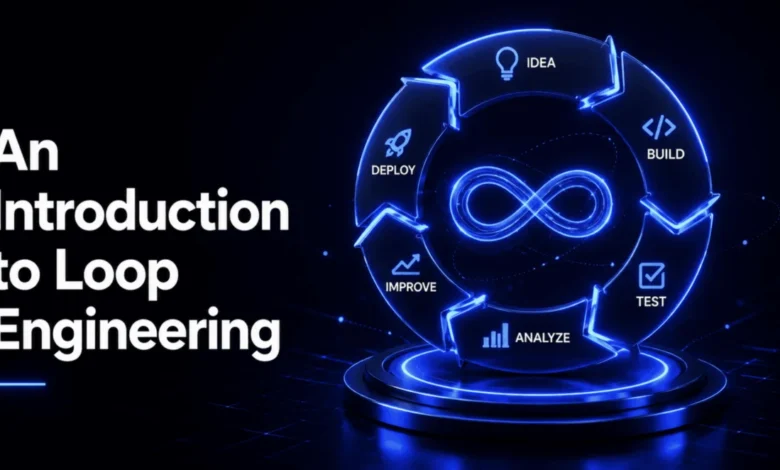
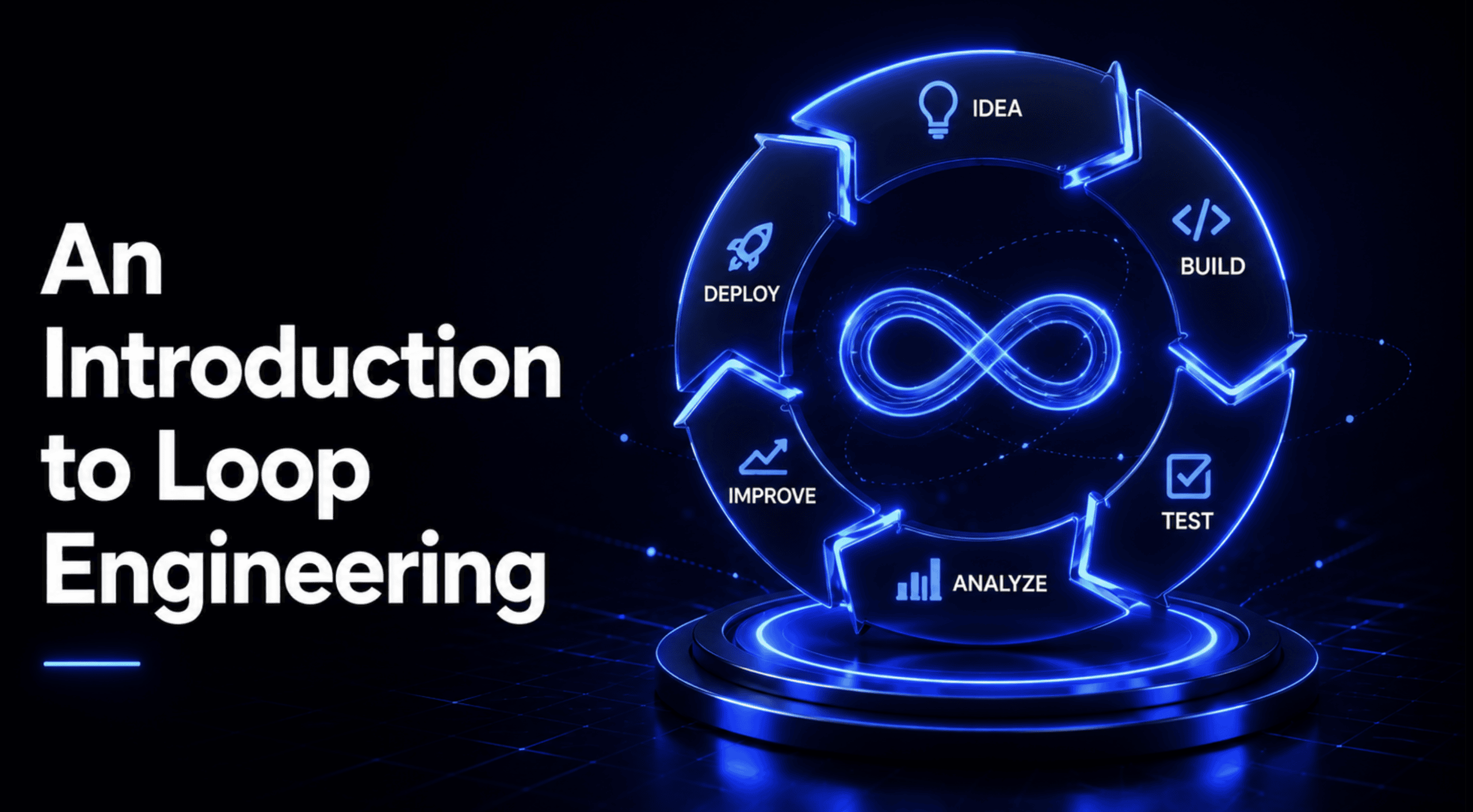
The landscape of artificial intelligence development is undergoing a seismic shift, moving beyond simple prompt-response interactions to a more sophisticated paradigm known as "loop engineering." This evolutionary leap, which rapidly gained traction in mid-2026, fundamentally redefines how developers interact with AI agents, enabling them to operate autonomously and reliably without constant human oversight. Loop engineering represents the practice of designing the surrounding infrastructure that prompts, monitors, and iteratively guides an AI agent, transforming the unit of work from a single query to a self-sustaining cycle.
The Genesis of a Paradigm Shift
The rapid emergence of loop engineering as a dominant concept can be traced to a viral social media post on June 7, 2026. Peter Steinberger, a prominent developer known for his work on the OpenClaw agent project, asserted on the platform X (formerly Twitter) that the core skill in AI development was no longer about crafting precise prompts for coding agents. Instead, he argued, it had become about designing the "loops" that would autonomously generate those prompts. This observation, reportedly viewed by over 6.5 million users within days, sparked intense debate across the AI developer community.
The following day, Addy Osmani, a well-respected Google engineer and author, solidified the concept by publishing a seminal essay titled "Loop Engineering." Osmani’s work provided a foundational framework, dissecting loop engineering into key components: automations, worktrees, skills, connectors, and sub-agents, all underpinned by external memory. This essay transformed a viral observation into a tangible vocabulary, enabling broader discussion, research, and practical application. The significance of this paradigm shift was further underscored by Boris Cherny, head of Claude Code at Anthropic, who was quoted by Osmani stating, "I don’t prompt Claude anymore. I have loops running that prompt Claude, and figuring out what to do. My job is to write loops." Such pronouncements from leaders in AI development signaled that loop engineering had moved beyond a niche academic concept to a practical, industry-wide imperative.
This rapid ascent is intrinsically linked to advancements in AI models themselves. By mid-2026, coding agents had achieved a level of sophistication that allowed them to function unattended for extended periods, capable of recovering from their own errors. When a single agent run could span an hour and involve modifications across dozens of files, the bottleneck shifted from prompt precision to the robustness of the surrounding system—the "loop"—that maintained the agent’s productivity, ensured its adherence to goals, and provided necessary checks, even in the absence of direct human supervision.
Understanding Loop Engineering: Beyond Sequential Chains
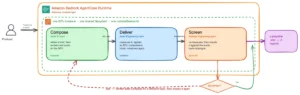
At its core, loop engineering is the methodology for constructing the automated systems that manage an AI agent’s interaction with its environment. Unlike traditional sequential processes, where task A invariably leads to task B and then C, loops are inherently dynamic. An AI agent within a loop might execute an action, receive feedback, evaluate that feedback, and then decide to revise its approach, potentially looping back to an earlier stage or even initiating an entirely new sequence of actions. This cyclical nature continues until a verifiable condition of task completion is met, a predefined stopping point is triggered, or the agent determines it can no longer progress.
This dynamic contrasts sharply with the previous model of human-guided AI interaction, often characterized by a "recursive goal" approach. Instead of dictating each discrete step, users define an overarching objective—such as "ensure the test suite passes" or "triage all open issues and draft fixes for straightforward ones." The AI agent then autonomously iterates towards this objective, engaging in a cycle of inspection, modification, testing, and evaluation. The primary skill for developers thus shifts from crafting perfect, single-turn prompts to designing and implementing robust cycles that can be trusted to operate independently.
A Layered Evolution: From Prompt to Loop
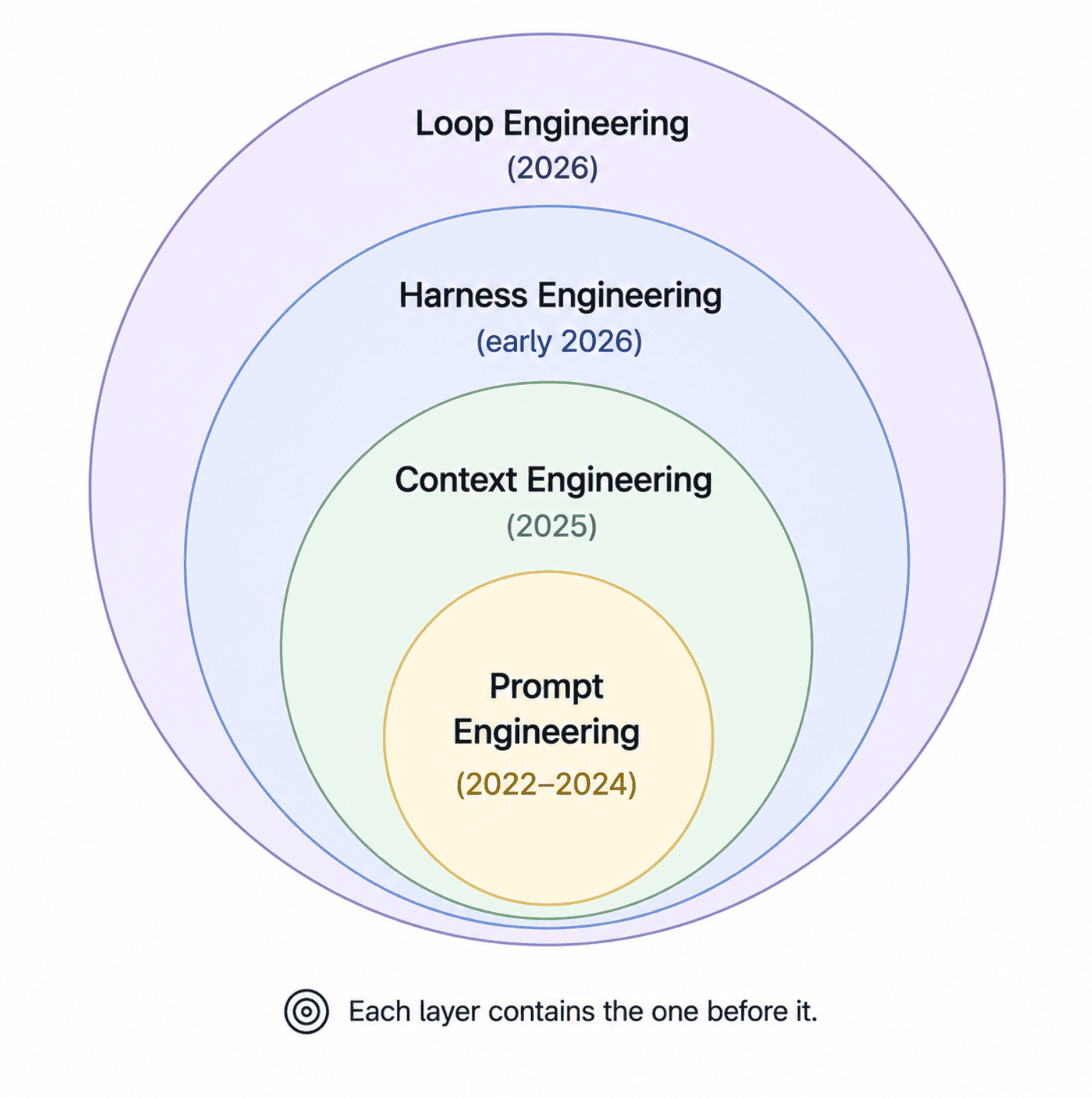
Loop engineering did not emerge in a vacuum; it represents the latest evolutionary stage in a progression of AI interaction methodologies. Each subsequent layer builds upon, rather than replaces, the preceding ones:
-
Prompt Engineering (circa 2022-2024): This initial phase focused on the art of crafting effective natural language prompts. Developers learned to imbue models with roles, break down complex tasks into sequential steps, provide illustrative examples, and encourage step-by-step reasoning. While instrumental in unlocking AI capabilities, prompt engineering had limitations, as models could only work with the information provided.
-
Context Engineering (circa 2025): The focus broadened to encompass all information available to the model at the time of response. This included conversation history, retrieved documents, tool outputs, and any other assembled data. This approach, championed by figures like Shopify’s Tobi Lütke and Andrej Karpathy, formalized the idea of providing the optimal "context window" for a task to be plausibly solvable. Prompt engineering effectively became a component within this larger context.
-
Harness Engineering (Early 2026): As AI agents began undertaking more complex, multi-step operations in production environments, harness engineering emerged. The "harness" refers to the complete operational environment surrounding an agent, including its scaffolding, provided tools, operational constraints, and error-handling mechanisms. It ensures an agent is not just capable but also dependable, nesting both prompt and context engineering within its framework.
-
Loop Engineering (2026 onwards): This latest layer sits atop the others. While harness engineering defines the agent’s operational environment, loop engineering addresses the critical question of how to keep the agent actively working towards its goal through a defined cycle and determining the precise conditions for that cycle’s termination. It operationalizes the harness by orchestrating its components into a dynamic, self-sustaining process.
This layered structure can be visualized as concentric circles, with each outer layer encompassing the inner ones: Prompt Engineering forms the core, surrounded by Context Engineering, then Harness Engineering, and finally, Loop Engineering as the outermost, orchestrating layer.
The Research Foundations of Loop Engineering
While the term "loop engineering" gained prominence in June 2026, its underlying principles are rooted in research dating back several years. Understanding this lineage is crucial for grasping the depth of the concept beyond its trending status:
-
ReAct Pattern (2022): Introduced by Yao and colleagues, the "Reason plus Act" (ReAct) pattern is a foundational precursor. It interleaves reasoning steps with action steps, creating a basic loop: the model reasons about a task, takes an action, observes the outcome, reasons again based on the observation, and acts anew. This "reason, act, observe, repeat" cycle forms the basis of many modern AI agent operations.
-
Reflexion (2023): This research, by Shinn and colleagues, enhanced the ReAct pattern by incorporating memory and self-critique. A Reflexion-style agent operates with distinct roles: an Actor to perform tasks, an Evaluator to score results, and a Self-Reflection module to generate verbal lessons—stored in an episodic memory—that inform subsequent attempts. This mechanism enables agents to improve performance within a single session without model retraining.
-
Anthropic’s Agent Patterns (Late 2024): Anthropic’s guide, "Building Effective Agents," highlighted two significant patterns. The "evaluator-optimizer" pattern involves one model generating a solution and a second model evaluating it against predefined criteria, cycling until the evaluation is successful. The "orchestrator-workers" pattern features a central model that decomposes a large task into smaller sub-tasks, assigns them to specialized "worker" agents, and then synthesizes the results. These formalize concepts like "sub-agents" and "worktrees" that are now integral to loop engineering.
The convergence of these research threads created a fertile ground for the rapid adoption of loop engineering. The June 2026 moment wasn’t the invention of the loop itself, but rather the popularization and formalization of a research direction, providing developers with the vocabulary and rationale to build these autonomous cycles deliberately.
Anatomy of a Reliable Loop
A dependable loop, one that avoids endless cycles or inefficient resource consumption, typically comprises several core components:
- The Goal: A clearly defined objective that the loop aims to achieve.
- The Agent: The AI model responsible for performing the core tasks.
- The Action: The specific tools or operations the agent can execute.
- The State: The comprehensive record of the goal, past actions, and their outcomes, which serves as the input for subsequent reasoning.
- The Verifier: A deterministic mechanism (e.g., a test suite, a set of validation rules) that objectively confirms whether the goal has been met. This is distinct from the agent’s self-assessment.
- The Comparator: Logic to detect stagnation or lack of progress.
- The Exit: Defined conditions for successfully completing the loop or escalating to human intervention.
Pseudocode for a Production Loop
The fundamental structure of a production-ready loop can be represented in pseudocode, highlighting the essential interactions:
# state holds the goal itself plus a running scratchpad of what's
# been tried so far; this is what gets fed back into the model
# on every iteration
state = init_state(goal)

for step in range(MAX_STEPS): # hard cap so the loop can never run forever
    # ReAct's "reason" half: think before acting
    thought = model.reason(state)
    # ...then commit to one concrete tool call
    action = model.choose_action(state)

    # actually touch the environment: run code,
    # read a file, call a test runner, etc.
    result = tools.execute(action)

    # fold the outcome back in
    state = update(state, thought, action, result)
    # summarize or prune old steps so the
    # context window doesn't overflow
    state = compact(state)

    # deterministic check, not a self-report
    if verifier.passes(state):
        return success(state)

    if no_progress(state) or budget.exhausted():
        return escalate_to_human(state) # stop circling a dead end

return escalate_to_human(state) # ran out of steps without a pass, hand back
Crucial design decisions within loop engineering revolve around refining specific lines of this pseudocode. The definition of verifier.passes is paramount; it determines what "done" truly means—be it a passing test suite, a clean lint run, or explicit human approval. The compact function dictates how the loop manages its history, influencing its ability to complete lengthy tasks without exceeding context limits. Detecting no_progress prevents agents from indefinitely repeating failing strategies, thereby conserving computational resources. The AI model itself is treated as a core component, with the surrounding engineering—the loop—being the primary focus of development.
Building Blocks for Robust Loops
Practical implementations of loop engineering leverage several key building blocks, as outlined by Addy Osmani’s analysis of tools like Codex and Claude Code:
-
Automations: These are scheduled or event-triggered processes that initiate AI agent runs without manual intervention. They transform one-time sessions into recurring, automated workflows, directing results to dedicated triage inboxes rather than overwhelming personal ones.
-
Worktrees: To mitigate conflicts when multiple agents operate on the same codebase, worktrees provide isolated directories. Utilizing Git’s worktree feature, each agent operates on a separate branch within the same repository, preventing direct overwrites and ensuring collaborative integrity.
-
Skills: This component encapsulates project-specific knowledge, conventions, and best practices within a structured format (e.g., a
SKILL.mdfile). This prevents agents from having to re-derive fundamental information on each run, significantly improving efficiency and consistency. -
Plugins and Connectors: These enable loops to interact with external systems—issue trackers, databases, APIs, and communication platforms. They empower agents to execute actions in the real world, moving beyond mere description to tangible results.
-
Sub-agents: To address the inherent bias in self-evaluation, sub-agents are employed. A primary agent performs a task, while a secondary agent (sometimes a different model) reviews the output against specified criteria before it is finalized.
-
External State Management: Since AI models have limited memory between runs, durable storage mechanisms (like markdown files or task boards) are essential. This external state allows the loop to retain learned information and context across sessions, crucial for long-running or recurring tasks.
These building blocks, when integrated, create a robust framework for autonomous AI operations.
Diverse Loop Patterns for Varied Applications
The nature of a task dictates the most appropriate loop structure. Common patterns include:
-
Retry Loop: The simplest form, ideal for atomic tasks with clear pass/fail criteria. It repeatedly attempts an action until successful, but vigilance is required to prevent infinite retries of the same ineffective strategy.
-
Plan-Execute-Verify Loop: This pattern involves generating a plan, executing it step-by-step, and verifying each stage. It’s suited for multi-step processes where sequential integrity is vital, such as complex refactoring or service deployment. The risk lies in adhering rigidly to a flawed initial plan.
-
Explore-Narrow Loop: This approach tests multiple strategies concurrently or sequentially, progressively focusing on the most promising avenues. It’s beneficial for novel or complex problems where the optimal path is initially unclear, such as debugging unknown errors or exploring unfamiliar APIs. The primary concern is managing context costs due to parallel exploration.
-
Human-in-the-Loop: This pattern deliberately incorporates human judgment at critical junctures. The loop pauses when genuine ambiguity arises or when decisions carry significant stakes, awaiting human review before proceeding. This is crucial for sensitive operations like financial transactions or customer-facing decisions, mitigating the risk of costly errors.
Scaling with Stacked Loops
Production systems often employ multiple loops stacked hierarchically. LangChain’s framework illustrates this, starting with a base "Agent Loop" where the model repeatedly calls tools. This is followed by a "Verification Loop" that scores the output and provides feedback for retries, ensuring quality. An "Event-Driven Loop" then triggers runs based on real-world events, enabling dynamic system updates. Finally, a "Hill-Climbing Loop" utilizes data from past runs to analyze and improve the overall harness, fostering continuous, compounding improvement. The most significant value, according to industry observers, lies in these higher-level loops that embed AI into ongoing systems and drive adaptive enhancement.
The Three Pillars of Loop Engineering and Common Pitfalls
Effective loop engineering hinges on mastering three core challenges: managing context effectively to prevent overflow and degradation ("context rot"), ensuring consistent progress by avoiding repetitive failures ("no-progress loops"), and precisely specifying the objective to prevent unintended optimization of proxies rather than the true goal ("objective misspecification" or "reward hacking").
Failures in these areas manifest in predictable ways: context overflow leading to diminished output quality, agents endlessly repeating the same errors, optimizing superficial metrics (e.g., deleting failing tests to achieve a green CI build), falsely reporting success without genuine verification ("hallucinated success"), and exorbitant token consumption ("cost blowup"). The universal remedy for these issues is the integration of a robust, external, deterministic verification mechanism within the loop itself.
The Enduring Role of Human Oversight
Loop engineering is not about eliminating humans from the AI development process but rather about redefining their roles. While automated verifiers can confirm technical correctness, human judgment remains indispensable for evaluating nuanced aspects like audience appropriateness, strategic sensitivity, and ethical considerations. Human oversight is critical at various points: approving sensitive tool calls, acting as a direct grader in high-stakes workflows, approving final output before end-user delivery, or reviewing proposed changes to the AI’s operational harness. These checkpoints are deliberate design choices, ensuring that AI remains a powerful tool guided by human intelligence and values.
Distinguishing Loop Engineering from Hype
It’s important to contextualize loop engineering against the initial hype. Not every developer needs to deploy autonomous agent fleets immediately. For singular, one-off tasks, direct interactive sessions with AI agents often prove more efficient and safer than the overhead of engineering a full loop. Loop engineering is not a universal mandate but a strategic approach for recurring, complex, or autonomous tasks. It also doesn’t remove human judgment but rather re-locates it, emphasizing the importance of human ownership over goals, definitions of "done," and final output validation. The critical discipline remains embedding genuine, external checks within each operational cycle, not merely at the very end.
Initiating Your First Loop
The most practical starting point for developers is to build the simplest possible loop. This involves a clearly defined, checkable goal, a deterministic verifier (such as an actual test suite), a hard iteration limit, and a single, well-defined escalation path for stuck loops. Low-stakes, recurring tasks—like nightly issue triage or scheduled report generation—are ideal for initial experimentation. It is advisable to gain experience with this foundational loop before attempting more complex architectures involving parallel worktrees or sub-agents.
Conclusion: The Shift in Leverage
The advent of loop engineering signifies a fundamental shift in the leverage point within AI development. As AI models become increasingly capable of executing complex tasks, the scarce skill is no longer the ability to craft a single, perfect instruction. Instead, it is the expertise in designing autonomous cycles that remain correct, verified, and aligned with their objectives, even without constant human supervision. This discipline is akin to systems engineering—designing a thermostat rather than writing a sentence—and it is this distinction that underscores its classification as "engineering."
The path forward involves building these loops with a rigorous, engineering mindset: consistently verifying outputs, understanding the reasons for loop termination, and treating "done" as a verifiable claim rather than an assumption. This approach ensures that AI continues to be a powerful amplifier of human capability, guided by robust design and critical oversight.