Rethinking Corporate Courage Why Bravery in Leadership is an Action Rather Than a Feeling

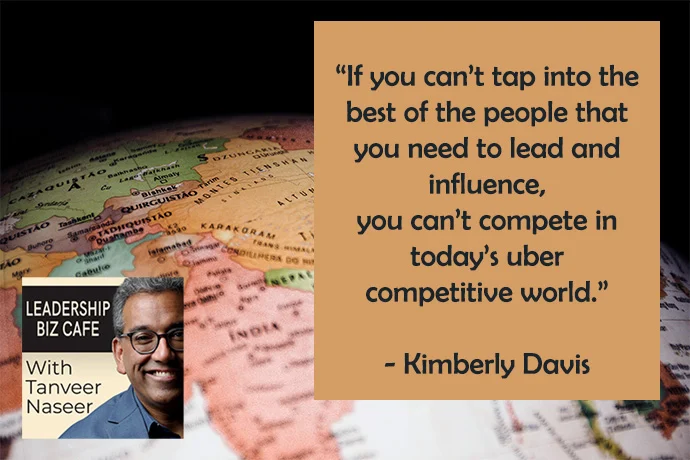
In a recent episode of the Leadership Biz Cafe podcast, host Tanveer Naseer and guest Kimberly Davis explored a fundamental shift in the conceptualization of leadership courage, arguing that bravery should be viewed as a deliberate set of actions rather than an internal emotional state. This perspective challenges the traditional "heroic" archetype of leadership, which often characterizes courage as a rare, innate trait or a sudden surge of adrenaline in times of crisis. Instead, Davis, a renowned educator and author, posits that bravery is a discipline that can be practiced and refined, particularly in an era defined by organizational volatility and shifting employee expectations.
The Shift from Internal Sentiment to External Action
The core of the discussion centered on the "reframe" of bravery. Traditionally, management theory has often conflated bravery with a lack of fear. However, Davis argues that waiting for the feeling of courage to arrive can lead to paralysis in the face of uncertainty. By defining bravery as the embodiment of what a leader does during moments of urgency, the focus shifts from psychological readiness to operational execution.
This behavioral approach suggests that leaders do not need to feel fearless to act bravely. Instead, bravery is manifested through the decision to prioritize organizational goals and employee well-being over personal comfort or the avoidance of risk. In the context of modern corporate environments, this often involves having difficult conversations, admitting ignorance, or making unpopular decisions that serve the long-term health of the institution.
Professional Trajectory and the Bush Institute’s WE Lead Program
Kimberly Davis brings a diverse background to this leadership philosophy. As an educator at Southern Methodist University’s Cox School of Business Executive Education, she has worked extensively with high-level executives to bridge the gap between technical competence and interpersonal effectiveness. Her theories on bravery are further informed by her four-year tenure with the George W. Bush Institute’s WE Lead program.
The WE Lead program is specifically designed to empower female leaders across the Middle East and North Africa (MENA) region. Working in these high-stakes, culturally complex environments provided Davis with a unique vantage point on the universal applications of brave leadership. In these contexts, bravery often meant navigating rigid social structures and advocating for institutional change in the face of significant systemic opposition. The success of these leaders was not predicated on an absence of fear, but on their ability to act decisively despite it. This experience served as a catalyst for the revised and updated edition of her award-winning book, Brave Leadership: Unleash Your Most Confident, Powerful, and Authentic Self to Get the Results You Need.
The "Super-Objective" and Employee Centricity
A significant portion of Davis’s framework involves the concept of the "super-objective"—a term borrowed from acting theory but applied to the boardroom. In this context, a leader’s super-objective is the overarching purpose that guides their actions and helps them transcend their personal anxieties. When a leader is focused on a goal larger than themselves, such as the growth of their team or the fulfillment of a mission, the "feeling" of fear becomes secondary to the "action" of leadership.
Davis emphasizes that a critical component of this action is understanding what matters most to employees. In the current labor market, where traditional hierarchies are being replaced by more collaborative models, the power dynamic has shifted. Leaders can no longer rely on the "obligation" of their subordinates to ensure productivity. Instead, they must cultivate an environment where employees "choose" to follow. This requires a brave level of transparency and a commitment to understanding the individual motivations of the workforce.
Supporting Data: The Trust and Engagement Gap
The necessity for a new model of brave leadership is supported by recent global workforce data. According to the 2023 Edelman Trust Barometer, there is a growing expectation for CEOs to be the "face of change," with 62% of respondents stating that they expect CEOs to take a public stand on social issues, even when those issues are controversial. This expectation places leaders in a position where "brave action" is no longer optional but a requirement for maintaining institutional credibility.
Furthermore, Gallup’s "State of the Global Workplace: 2023 Report" highlights that employee disengagement remains a significant hurdle, costing the global economy an estimated $8.8 trillion in lost productivity. The report indicates that "quiet quitting" and low engagement are often symptoms of a lack of trust in leadership. Davis’s assertion that leaders must understand what matters to their employees aligns with data suggesting that workers who feel their supervisors care about them as people are significantly more likely to be engaged and productive.
Chronology of the Brave Leadership Framework
The evolution of the "Brave Leadership" concept can be traced through several key developmental phases:
- Initial Research and Publication (2017-2018): Davis released the first edition of Brave Leadership, establishing the foundational idea that authenticity is the key to effective management.
- Global Application (2019-2022): Through her work with the Bush Institute and SMU, Davis tested these theories in diverse environments, ranging from Fortune 500 boardrooms to emerging markets in the MENA region.
- The Post-Pandemic Pivot (2022-2023): The global pandemic served as a stress test for leadership bravery. The sudden shift to remote work and the heightening of social tensions required a more nuanced approach to "brave action," leading to the revision of her book.
- Current Integration: The latest iteration of the framework, as discussed on the Leadership Biz Cafe, emphasizes the "super-objective" and the shift from "obligatory followership" to "voluntary followership."
Official Responses and Expert Analysis
Leadership consultants and organizational psychologists have largely echoed the sentiments shared by Davis and Naseer. Industry analysts suggest that the "command and control" style of leadership is increasingly ineffective in a knowledge-based economy.
"The modern leader’s primary challenge is no longer just the management of tasks, but the management of meaning," says one independent organizational consultant. "Kimberly Davis’s focus on bravery as an action rather than a feeling provides a practical roadmap for leaders who are struggling to maintain authority in a decentralized world. By focusing on what they do—such as listening, being vulnerable, and acting with integrity—they build a culture of psychological safety."
This concept of psychological safety, popularized by Harvard Business School professor Amy Edmondson, is a direct byproduct of brave leadership. When leaders act bravely by admitting their own mistakes, they create a "safe" space for employees to do the same, which fosters innovation and reduces the likelihood of catastrophic organizational failures.
Broader Impact and Implications for the Future
The implications of redefining bravery are far-reaching. As organizations continue to navigate an era of "permacrisis"—characterized by continuous geopolitical, economic, and environmental disruptions—the ability to act bravely will become a primary competitive advantage.
For the individual leader, this reframe removes the burden of having to feel "ready" or "confident" before taking action. It allows for a more iterative, learning-focused approach to management. For the organization, it promotes a culture of resilience. If bravery is an action that can be taught, then courage can be institutionalized.
As Davis noted in her conversation with Naseer, the goal is not to eliminate uncertainty but to perform effectively within it. By focusing on the "super-objective" and the needs of the people they lead, executives can move past the paralysis of fear and into the realm of impactful action. This shift from "feeling" to "doing" represents a significant evolution in leadership theory, one that prioritizes the human element of business in an increasingly automated and volatile world.
In conclusion, the updated framework for brave leadership provides a necessary toolset for the modern executive. It moves the conversation away from the abstract qualities of "great men" and "great women" and toward a practical, repeatable set of behaviors that anyone in a position of authority can adopt. As the corporate landscape continues to change, the definition of a "brave leader" will likely continue to evolve, moving further away from the hero on a pedestal and closer to the facilitator who acts with purpose and empathy.