Are You Simplifying The Right Things? A Leadership Framework for Cutting Through Complexity

The modern corporate landscape is currently grappling with a profound paradox: as global markets become increasingly volatile and operational environments more convoluted, organizational leaders are frequently retreating into a defensive posture characterized by a frantic pursuit of "efficiency." This phenomenon, observed by executive leadership experts and educators, suggests that the drive for control in an uncertain world often results in the implementation of superficial fixes that exacerbate rather than alleviate organizational friction. Leadership specialist Tanveer Naseer has recently highlighted this trend, noting that the impulse to "do something" to regain a sense of mastery often leads to the adoption of complex systems disguised as streamlined solutions.
This tension between the need for operational clarity and the psychological drive for control forms the basis of a new pedagogical approach being introduced to executive education. By shifting the focus from mere efficiency to a sequenced framework of simplification, organizations are finding they can bridge the gap between high-level strategic objectives and the daily motivations of their workforce. This report examines the structural shifts in leadership theory, the data supporting the need for simplification, and the strategic implications of failing to align organizational goals with human-centric operational models.
The Evolution of Complexity: A Historical Context
The current crisis of complexity did not emerge in a vacuum. To understand why modern leaders are struggling with simplification, it is necessary to trace the chronology of management styles over the past century. During the early 20th century, the era of Scientific Management (Taylorism) prioritized the deconstruction of tasks into their simplest components to maximize manual output. This was the first major era of "simplification," but it was rigid and mechanical.
By the late 20th century, the rise of Lean Manufacturing and Six Sigma in the 1980s and 1990s introduced a more sophisticated version of efficiency, focusing on waste reduction and process optimization. However, as the global economy shifted from industrial manufacturing to a knowledge-based digital economy, these linear models began to falter. The introduction of the "VUCA" (Volatile, Uncertain, Complex, and Ambiguous) framework by the U.S. Army War College in the late 1980s accurately predicted the environment leaders face today.
In the last decade, the rapid acceleration of digital transformation and the shift toward remote or hybrid work models have added layers of digital and social complexity. According to recent industry reports, the average enterprise now uses over 1,000 different cloud-based applications, creating a "fragmentation of focus" that previous generations of leaders never encountered. This historical progression shows that while tools have become more advanced, the cognitive load on leaders and employees has reached a critical tipping point.
Data-Driven Insights: The Cost of Corporate Complexity
The financial and psychological costs of complexity are significant. Research from the Boston Consulting Group (BCG) indicates that over the last 55 years, organizational complexity has increased by 6.7% annually. This "complicatedness"—the proliferation of structures, processes, and systems—creates a drag on productivity that is often invisible to senior management.
Supporting data from the 2023 Global Leadership Forecast reveals that only 12% of organizations feel they have a "strong" leadership bench capable of navigating current global uncertainties. Furthermore, a study by Deloitte found that nearly 70% of executives believe their organizational complexity is a significant barrier to business growth.
The human cost is equally measurable. In a survey of 5,000 global employees, approximately 64% reported that they are frequently distracted by "low-value" tasks, such as excessive meetings and redundant reporting, which prevent them from engaging in the "deep work" required for innovation. This data suggests that the "efficiency drive" mentioned by Naseer is often misdirected; leaders are optimizing the wrong variables, focusing on activity metrics rather than impact.
The Three-Step Framework for Strategic Simplification
To address these systemic issues, a new three-step framework is being disseminated through executive education channels. This framework is designed to be executed in a specific sequence to ensure that simplification does not result in the loss of essential institutional knowledge or operational integrity.
1. Identifying the "Signal" Amidst the "Noise"
The first stage involves a rigorous audit of organizational priorities. Leaders are encouraged to distinguish between "complicatedness" (unnecessary hurdles) and "complexity" (inherent challenges of the market). By identifying the core objectives that truly drive value, organizations can begin to prune the secondary and tertiary goals that dilute employee focus. This stage requires what psychologists call "cognitive offloading"—the removal of non-essential decision-making processes to free up mental energy for high-stakes strategy.
2. Process De-cluttering and Sequence Optimization
Once priorities are clarified, the framework moves to the structural level. This involves re-evaluating how work flows through the organization. Rather than adding new software or layers of management to "manage" a problem, the goal is to remove steps. Industry experts suggest that for every new process an organization introduces, it should strive to eliminate two existing ones. This creates a "net-zero" growth in complexity.
3. Human-Centric Alignment
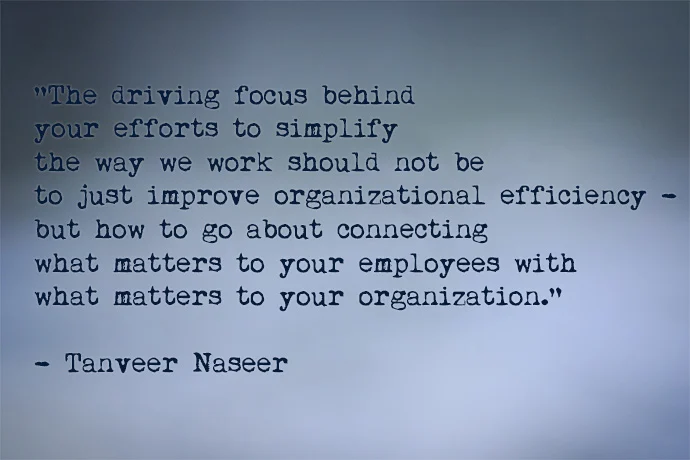
The final and most critical step is closing the gap between organizational mandates and employee motivation. This involves translating high-level goals into meaningful, actionable tasks that resonate with the workforce. When employees understand the "why" behind a simplified process, they are more likely to bring their "best efforts" to work, as the framework suggests. This alignment is what transforms a company from an efficient machine into an effective, purpose-driven community.
Professional Reactions and Industry Analysis
The shift toward simplification has garnered significant attention from organizational psychologists and HR directors. Dr. Aris Thorne, a consultant specializing in workplace dynamics, notes that "the impulse to control through more data and more oversight is a natural human reaction to fear. However, in a corporate setting, this ‘control’ is often an illusion that creates a bottleneck at the middle-management level."
Industry analysts point out that the most successful companies in the current era—often referred to as "exponential organizations"—are those that have successfully implemented radical simplification. Companies like Netflix and Shopify have famously utilized "culture decks" and "internal simplification mandates" to ensure that as they scale, they do not become bogged down by the bureaucracy that typically plagues large enterprises.
However, some critics warn that simplification should not be confused with "simplism." There is a danger that in the pursuit of cutting through complexity, leaders might overlook the nuanced requirements of regulatory compliance or diverse market needs. The consensus among experts is that the framework must be applied with surgical precision, ensuring that the "right things" are being simplified.
Broader Impact and Future Implications
The long-term implications of adopting a simplification framework extend beyond immediate productivity gains. As the global workforce continues to prioritize mental well-being and purpose-driven employment, organizations that fail to simplify their internal environment will likely face a "talent drain."
Furthermore, the integration of Artificial Intelligence (AI) into the workplace presents a dual-edged sword for complexity. While AI has the potential to automate mundane tasks and simplify data analysis, it also introduces new layers of technical and ethical complexity. Leaders who have mastered the art of simplification will be better positioned to integrate AI as a tool for clarity rather than another source of organizational noise.
In conclusion, the movement toward simplifying the way we work is a necessary response to an era of unprecedented data saturation and global instability. By moving away from the paradox of "doing more to feel in control" and toward a structured framework of alignment and clarity, leaders can unlock the latent potential of their teams. The transition from efficiency-focused management to effectiveness-driven leadership represents the next frontier in organizational excellence. As businesses navigate the remainder of the decade, the ability to cut through complexity will likely be the primary differentiator between organizations that merely survive and those that define the future of their industries.