The Global Marketing Automation Landscape: 2024 Market Growth Adoption Trends and Strategic Impact

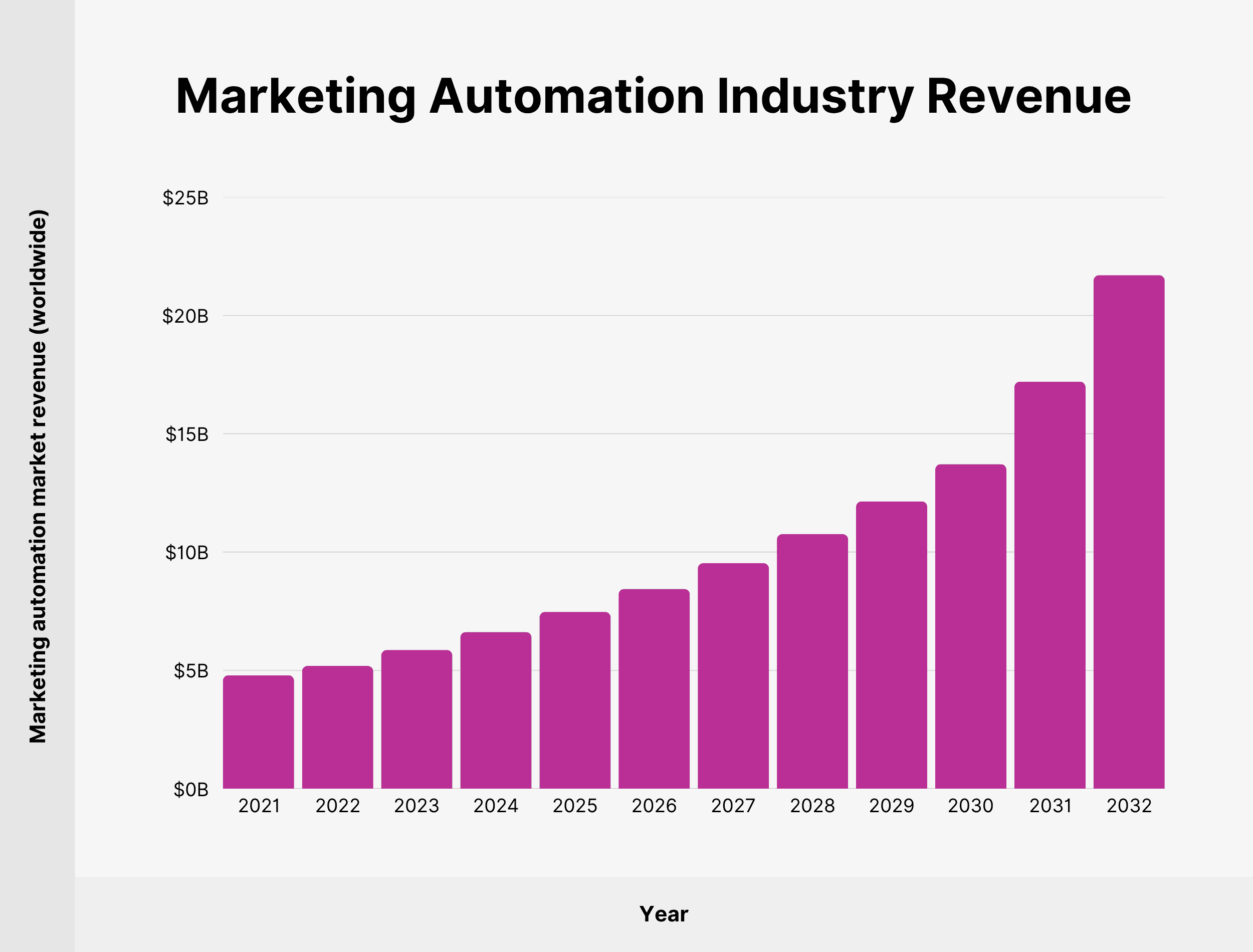
The global marketing automation industry is currently undergoing a period of unprecedented expansion, driven by the dual pressures of digital transformation and the increasing necessity for data-driven customer engagement. As businesses transition from manual outreach to sophisticated, multi-channel orchestration, the demand for integrated technology stacks has reached a critical mass. Recent industry data reveals that the marketing automation market, valued at approximately $4.79 billion in 2021, is on a trajectory to reach an estimated $21.7 billion by 2032. This represents a compound annual growth rate that underscores the technology’s transition from a competitive advantage to a foundational requirement for modern enterprise operations.
The Economic Trajectory of Marketing Automation
The financial commitment to marketing automation software reflects a broader shift in corporate spending toward "MarTech" (marketing technology). Analysis of market revenue suggests a steady climb in the early 2020s, with 2023 seeing revenues of $5.86 billion and 2024 projected to hit $6.62 billion. However, the most significant acceleration is expected toward the end of the decade. By 2029, the market is anticipated to surpass $12 billion, nearly doubling again in the following three years as artificial intelligence (AI) and machine learning (ML) become standard features within these platforms.

Budgetary allocations among marketing professionals further validate this growth. According to current surveys, 68% of marketers report that their budgets for automation are increasing, with 14% characterizing that increase as "significant." Conversely, only 11% of organizations are planning to decrease their spending, often citing internal restructuring or the consolidation of existing tools rather than a rejection of automation itself. This widespread financial commitment indicates that the "efficiency gap"—the difference between manual output and automated scale—has become a primary concern for Chief Marketing Officers (CMOs) globally.
A Chronology of MarTech Evolution
To understand the current surge in adoption, it is necessary to examine the historical context of marketing automation. The industry has evolved through four distinct eras:
- The CRM Foundation (Late 1990s – Early 2000s): The initial phase focused on Customer Relationship Management (CRM) systems. These were primarily digital Rolodexes designed for sales teams to track contacts and deal stages.
- The Email Automation Era (2005 – 2012): This period saw the rise of platforms like Eloqua, Marketo, and Pardot. The focus was largely on "drip campaigns"—sequential emails triggered by specific user actions.
- The Multi-Channel Integration Era (2013 – 2020): Automation expanded beyond email to include social media management, landing page builders, and basic lead scoring. During this time, the "platform" concept emerged, where a single suite attempted to manage the entire marketing funnel.
- The AI and Hyper-Personalization Era (2021 – Present): Current systems are defined by their ability to process massive datasets in real-time. Automation is no longer just about scheduling; it is about predictive analytics, identifying the "next best action" for a customer before they even express a need.
Current Adoption Patterns and Performance Metrics
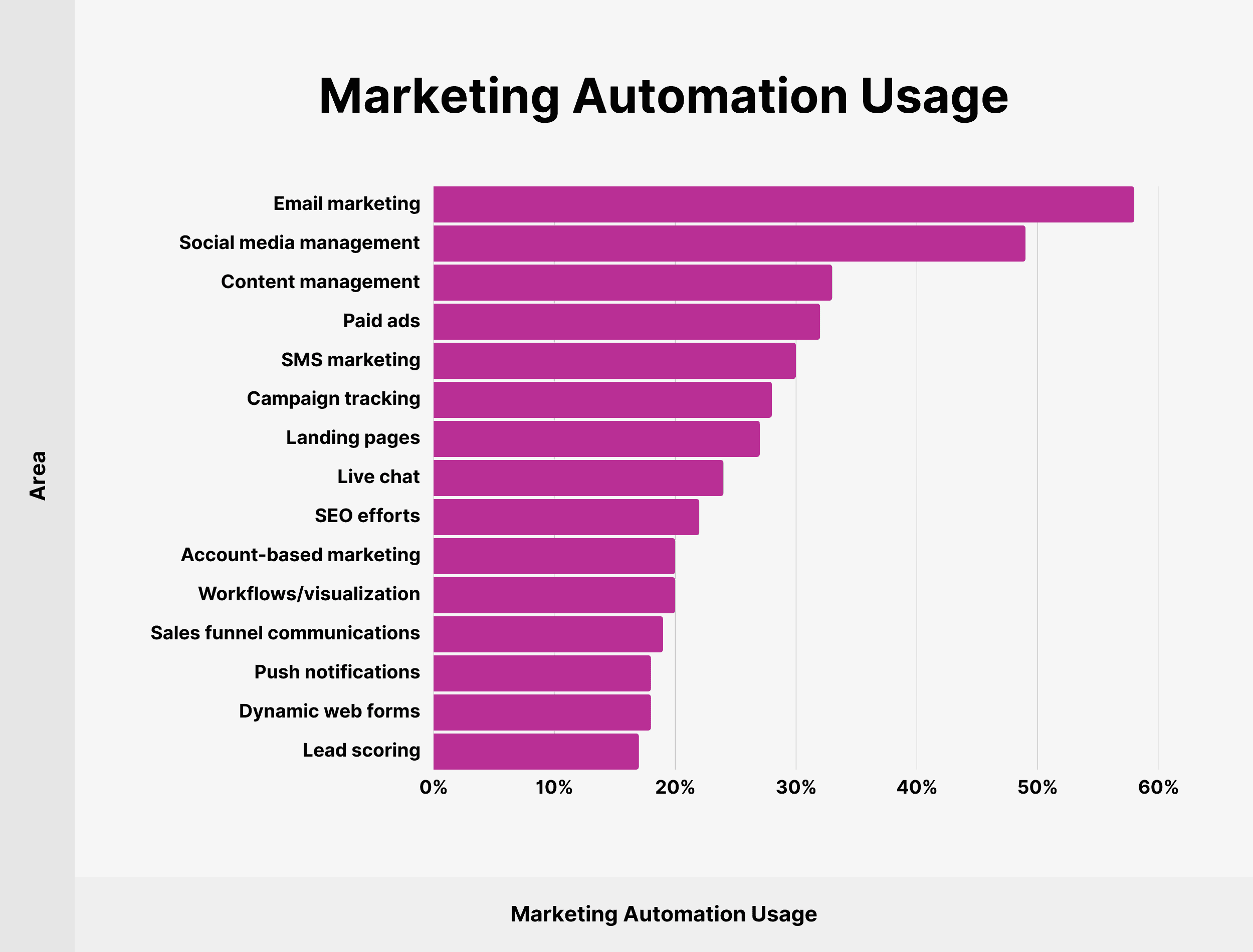
The application of automation is not uniform across all marketing disciplines. Email marketing remains the most mature sector, with 58% of marketers currently utilizing automation for their email efforts. This is followed by social media management at 49% and content management at 33%.
Interestingly, the areas where marketers plan to implement automation in the near future suggest a shift toward top-of-funnel activities. Social media management and paid advertising are tied for the highest "planned usage" at 29% each. This suggests that while email is the "bread and butter" of current automation, the next frontier is the automation of creative distribution and programmatic ad buying.
Despite the high adoption rates in specific silos, the concept of a "fully automated" customer journey remains elusive for most. Only 9% of marketers claim their customer journey is fully automated, while the vast majority (59%) report that their processes are only "partially automated." This gap highlights the technical complexity of connecting disparate data sources across the entire lifecycle, from initial brand awareness to post-purchase loyalty.
Strategic Objectives Driving Implementation
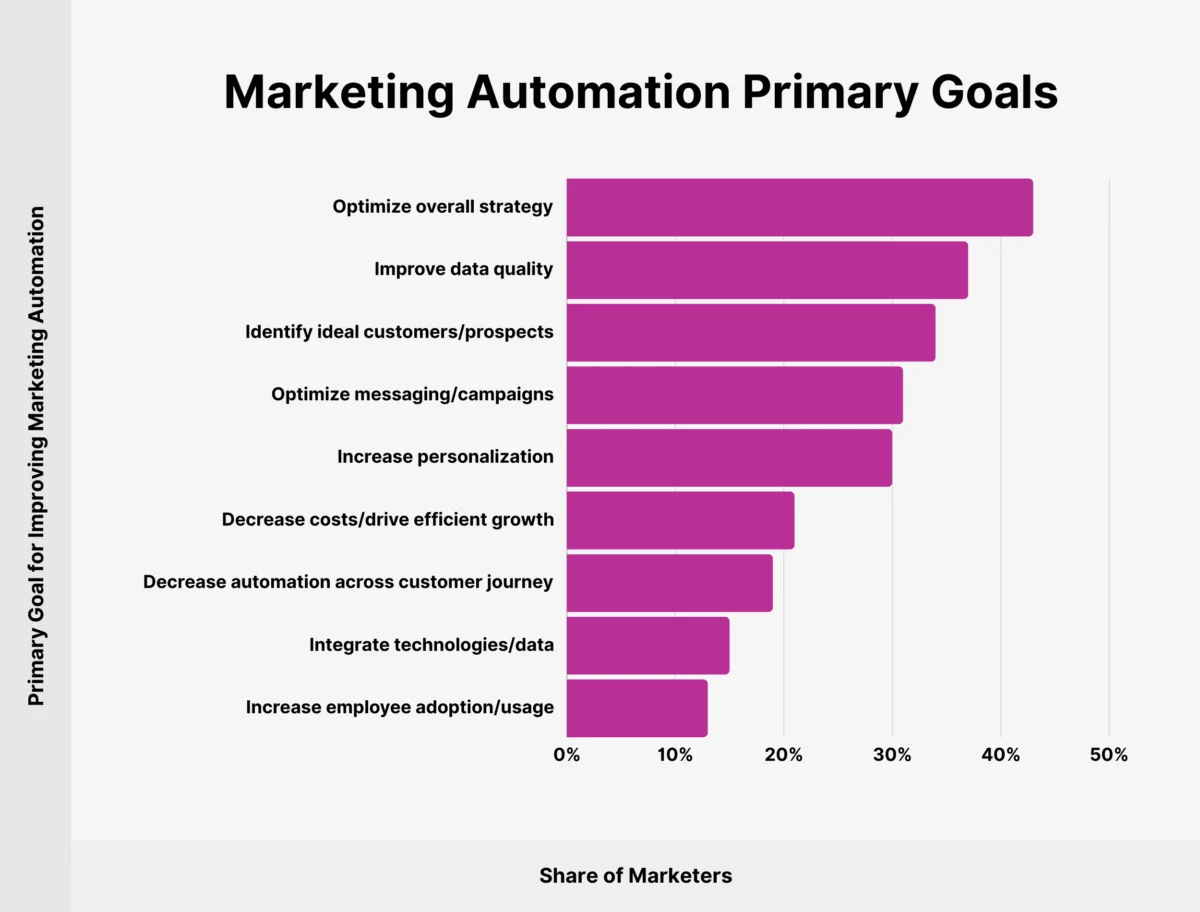
The primary motivation for adopting marketing automation has shifted from simple time-saving to high-level strategic optimization. When asked about their primary goals for improving automation, 43% of marketers cited "optimizing overall strategy." This is a significant departure from the historical focus on "reducing workload."
Other key drivers include:
- Improving Data Quality (37%): As privacy regulations like GDPR and CCPA limit third-party data, companies are using automation to better manage and clean their first-party data.
- Identifying Ideal Customers (34%): Lead scoring and behavioral tracking allow teams to focus their resources on high-value prospects.
- Increasing Personalization (30%): Consumers increasingly expect tailored experiences. Automation is the only way to deliver personalized messaging at scale.
Barriers to Entry and Purchase Factors
Despite the clear benefits, the path to implementation is often hindered by financial and technical hurdles. When selecting a marketing automation solution, price remains the most influential factor for 58% of decision-makers. This is closely followed by "ease of use" at 54%.
The emphasis on ease of use points to a growing "skills gap" in the industry. Many marketing departments lack the technical expertise to manage complex, code-heavy platforms, leading to a preference for "no-code" or "low-code" solutions. Customer service (27%) and customization options (24%) also rank highly, suggesting that while marketers want a simple interface, they also require significant backend support to tailor the software to their specific business models.
The Tangible Benefits: Efficiency and Customer Experience
The ROI of marketing automation is increasingly measured through the lens of customer experience (CX). Approximately 43% of marketers agree that the single greatest advantage of automation is the improvement of the customer experience. By ensuring that communications are timely, relevant, and consistent, brands can reduce "friction" in the buying process.
Internal efficiency gains are equally notable. Thirty-eight percent of marketers report that automation enables better use of staff time, allowing creative teams to move away from repetitive tasks like data entry and manual scheduling. This shift is expected to lead to higher job satisfaction and lower turnover rates within marketing departments, as employees focus on high-value strategic and creative work.
Analysis of Broader Implications and Future Trends
The projected growth to a $21.7 billion market by 2032 carries several significant implications for the global business landscape.

First, the "Partial Automation" hurdle suggests that the next decade will be defined by the "Integration War." Companies that can successfully bridge the gap between their marketing, sales, and customer service data will outperform those operating in silos. The rise of Customer Data Platforms (CDPs) as a layer within the automation stack will likely be the solution to the 59% of firms currently stuck in partial automation.
Second, the role of the marketer is fundamentally changing. The data indicates a move toward "Marketing Technologists"—individuals who understand both the psychology of the consumer and the logic of the algorithm. Educational institutions and corporate training programs will need to pivot to address this hybrid requirement.
Finally, the move toward 2032 will likely see a "democratization" of these tools. As price remains a top purchase factor, SaaS providers are increasingly offering tiered pricing models that allow small and medium-sized enterprises (SMEs) to access the same sophisticated tools previously reserved for Fortune 500 companies. This leveling of the playing field means that competition will no longer be decided by who has the biggest budget, but by who uses their data most effectively.

In conclusion, the marketing automation industry is no longer a niche segment of the software market. It has become the central nervous system of the modern enterprise. As the market nears the $20 billion mark over the next decade, the focus will shift from "whether" to automate to "how" to do so in a way that remains human-centric, ethically sound, and strategically aligned with the ever-evolving expectations of the global consumer.
Related posts: