The rapid proliferation of AI-powered tools and platforms has democratized the creation of "skills" – specialized AI functionalities designed to perform specific tasks. However, a critical misunderstanding persists among many users: the distinction between a nascent, untrained AI capability and a truly production-ready, expertly honed skill. This widespread misconception, fueled by the ease with which basic AI functionalities can be generated or acquired, is leading to disillusionment and a failure to unlock the full potential of artificial intelligence in professional contexts. The current landscape often equates the act of "building a skill" with a mere initial generation or installation, overlooking the extensive refinement process necessary for these AI tools to deliver consistent, reliable, and contextually appropriate results.
The core issue lies in a fundamental misapplication of traditional software development paradigms to the nascent field of generative AI. Historically, software products, such as WordPress plugins or mobile applications, underwent rigorous testing and iteration, involving thousands of edge case scenarios and quality assurance checks before reaching version 1.0. This established mental model, where a product is expected to function flawlessly upon installation, does not translate directly to AI skills. Unlike pre-compiled software, AI skills, upon their initial creation or download from a marketplace, are essentially blank slates. They lack the embedded institutional knowledge, specific business context, nuanced preferences, and precise definitions of "good" that are vital for effective performance within a particular organizational environment. This absence of tailored understanding renders them, at best, novice-level tools, incapable of handling the complexities and unique demands of a given operation.
A significant bifurcation exists within the realm of AI skills, a distinction that has profound implications for their practical utility and the expectations users should hold. This division can be broadly categorized into "generic skills" and "context-dependent skills."
Generic Skills: The Out-of-the-Box Utility
Generic AI skills are designed to perform tasks with broadly standardized outcomes and minimal reliance on bespoke user or business information. Examples include prompts like "Run an SEO audit on this website," "Summarize this article," or "Generate a compliance checklist." These tasks have established methodologies and universally understood benchmarks for success. Consequently, a generic skill can often provide an adequate, if not always optimal, output without requiring deep prior knowledge of the user’s specific business or operational nuances. The inherent structure of these tasks allows for a reasonable degree of out-of-the-box functionality.
Context-Dependent Skills: The Demand for Deep Understanding
In stark contrast, context-dependent skills are those that necessitate a profound understanding of individual or organizational specificities. These include tasks such as "Write a social media update in my voice," "Prepare my weekly board report," or "Draft a customer email that sounds like me." The effectiveness of these skills hinges on their ability to accurately replicate a unique tone, understand a specific audience, adhere to established brand standards, and reflect intimate knowledge of a company’s products or services.

For sectors with high stakes, such as compliance, the implications of an untrained context-dependent skill are particularly severe. An AI skill tasked with generating audit reports, for instance, if left untrained in the specific regulatory framework, internal policies, and reporting standards of an organization, could produce inconsistent or factually incorrect outputs. This scenario is not merely unhelpful; it can be detrimental, potentially leading to regulatory non-compliance or internal missteps. The initial output from such a skill will, by definition, sound like a generalized AI generation because it lacks the hundreds of micro-adjustments and refinements that imbue an output with a personalized, human-like quality, reflecting the distinct communication style of the user or organization.
The concept of "vibe coding," coined by Andrej Karpathy in early 2025, described a phase of AI development characterized by an almost intuitive approach, where developers "fully give in to the vibes, embrace exponentials, and forget that the code even exists." This philosophy emphasized rapid iteration and a less structured approach to AI development. However, within a year, Karpathy himself acknowledged the limitations of this approach when applied to production environments. He noted that "the vibes weren’t enough. Production requires structure." This observation directly mirrors the challenges faced in developing effective AI skills. The initial creation of a skill, akin to "vibe coding," represents the exploratory phase. The subsequent, rigorous training process is the essential "structure" that transforms a nascent capability into a reliable tool.
The Unseen Investment: What True AI Skill Training Entails
The chasm between a novice AI skill and a hardened, production-ready skill is analogous to the journey of a new employee from their first day on the job to a year of dedicated experience and mentorship. During this period, the new hire learns the intricacies of the company culture, internal jargon, specific client needs, and the nuanced definition of "success" within their role. Similarly, an AI skill must undergo a continuous learning process to grasp what constitutes "too formal" for a particular brand, "too long" for a target audience, which specific edge cases require dedicated handling, and what the precise criteria for task completion entail.
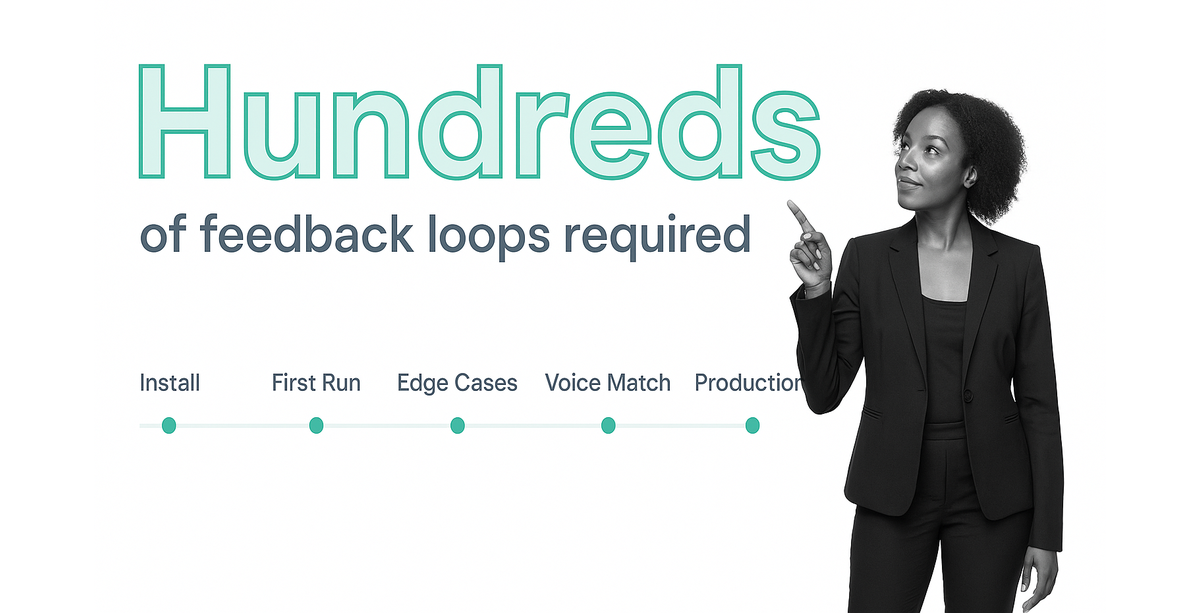
Production-ready AI skills are capable of managing branching paths and conditional logic with the same precision as sophisticated workflow automation systems. For instance, a well-trained skill can dynamically route tasks or adjust its output based on real-time inputs, much like conditional logic in a business process management (BPM) system routes tasks based on dynamic data rather than static assumptions. This level of adaptability and accuracy is not achieved through a single prompt or a quick download. It requires what can be accurately described as hundreds of feedback loops. These are not mere dozens; the iterative refinement process is extensive and demanding.
The Four Stages of Skill Maturity
The evolution of an AI skill can be visualized through a four-stage maturity journey:
- Untrained: This is the initial state of a newly generated or downloaded skill. It possesses basic functionality but lacks specific context and refinement.
- First Feedback: After the initial generation, the first few instances of feedback are applied. This stage marks the beginning of the learning process, but the skill’s output remains rudimentary.
- Hundreds of Loops: This is the critical phase where consistent and extensive feedback is provided over numerous iterations. The AI skill begins to internalize nuances, adapt to specific requirements, and significantly improve its performance.
- Production Ready: At this stage, the AI skill consistently delivers accurate, contextually relevant, and high-quality output, meeting the stringent demands of a professional environment.
This iterative development process is not unique to AI skills. Consider the analogy of a continuous compliance monitoring workflow. A pre-built template provides a starting point, but its true value is realized through continuous adaptation and refinement over dozens, if not hundreds, of operational cycles. Many users, however, abandon the process after only a few iterations, mistakenly concluding that "AI skills don’t work" when, in reality, they have not invested the necessary time and effort into the crucial training phase.
The Exploding Ecosystem and the Growing Divide
The current AI landscape is experiencing an unprecedented surge in the availability of AI skills. Marketplaces, skill libraries, prompt templates, and sophisticated agent frameworks are emerging at an exponential rate. The barrier to entry for creating a basic AI skill has effectively evaporated, allowing for the generation of functional capabilities within minutes. Major workflow automation platforms are integrating various forms of skills, agents, and prompt templates, further democratizing access.
However, this accessibility creates a dangerous illusion. The term "working" is often conflated with "production-ready." The significant gap between these two states is a canyon that many users are failing to recognize. The true competitive advantage in the current technological era, particularly as we move further into 2026, lies not solely in the inherent intelligence of AI models, but in the robustness of the infrastructure built around them. This infrastructure is the training loop – the systematic process of refinement. The intelligence, in turn, is the superior output that emerges from this intensive, iterative development.
Organizations that grasp this fundamental principle will be positioned to build AI skills that deliver compounding returns. These skills will evolve and improve with each cycle, much like a digital compliance officer who systematically enhances their understanding and application of policy knowledge with every compliance review. Conversely, organizations that continue to treat AI skills as plug-and-play solutions, installing novices and expecting immediate, sophisticated results, will inevitably find AI to be underwhelming and fail to achieve the transformative potential it offers.
In essence, an AI tool that has not undergone rigorous, context-specific training is not a skill. It remains, at best, a first draft – a promising but unpolished potential waiting for the structured investment required to become a truly valuable asset. The future of AI integration in business hinges on this critical understanding and the commitment to the iterative refinement process that transforms raw potential into reliable, high-performing capabilities.