Beyond the Boardroom Burnout: Why Traditional Self-Care Fails Leaders and How Proactive Well-Being Drives Organizational Success

In the modern corporate landscape, navigating perpetual economic uncertainty, rapid technological integration, and shifting workforce expectations has placed an unprecedented strain on organizational hierarchies. While employee mental health has rightfully claimed a central focus in contemporary human resources strategies, a critical blind spot persists at the apex of corporate leadership. The psychological well-being of executives, directors, and managers is frequently overlooked, ignored, or treated as an administrative afterthought. When leadership mental health is finally addressed, the conversation almost universally defaults to the concept of self-care. However, a growing consensus among leading psychologists, neuroscientists, and organizational behaviorists suggests that traditional definitions of self-care are not only widely misunderstood but may actually exacerbate workplace stress and diminish institutional resilience.
The Illusion of Modern Self-Care: A Misguided Paradigm
For decades, the dominant cultural narrative surrounding personal well-being has been consumer-driven and hyper-individualistic. Executives are routinely advised to disconnect through luxury vacations, retail therapy, binge-watching television series, or carving out solitary leisure time. Yet, empirical research in social neuroscience indicates that these isolated interventions fail to address the systemic drivers of professional burnout.
Addressing this phenomenon, Jamil Zaki, director of Stanford University’s Social Neuroscience Laboratory, has published extensive findings challenging the efficacy of insular self-care models. Zaki notes that individuals systematically miscalculate what brings genuine psychological restoration, incorrectly predicting that spending time, money, and energy exclusively on themselves will yield higher levels of fulfillment than allocating those same resources toward the support of others.
In a corporate context, while a weekend getaway or a momentary distraction may offer temporary relief from the cognitive load of executive decision-making, it does nothing to resolve the systemic friction within the enterprise. Burnout at the leadership level is rarely a product of insufficient downtime alone; rather, it stems from a profound disconnection from organizational purpose, the weight of constant crisis management, and the emotional contagion of an overstressed workforce.
Redefining the Oxygen Mask Analogy: The Science of Proactive Well-Being
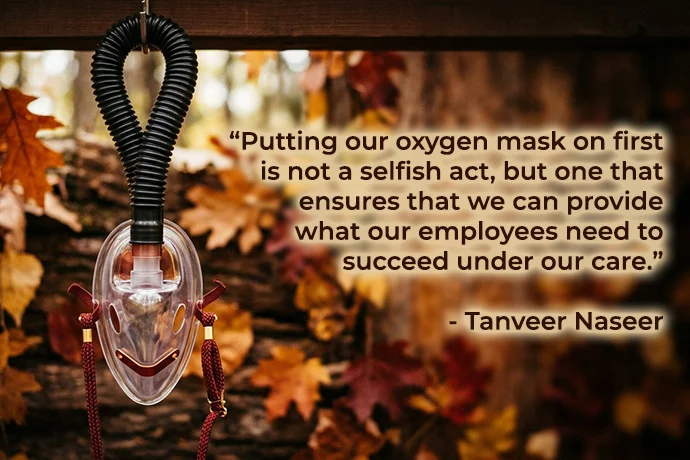
The aviation safety directive to secure one’s own oxygen mask before assisting others is frequently cited in leadership training. Historically, this metaphor has been misinterpreted as a validation of self-centered preservation—an implication that leaders must isolate their own needs from the operational demands of their teams.
Modern behavioral science reframes this dynamic entirely. Zaki’s research demonstrates that human beings are psychologically intertwined at a neurological level. When individuals engage in prosocial behavior—helping, mentoring, and genuinely supporting others—the human brain activates reward pathways associated with purpose and belonging. Consequently, extending kindness and operational support to employees is not merely an altruistic gesture directed outward; it is a restorative act that directly enhances the psychological well-being of the leader.
Putting on the organizational oxygen mask first is therefore not an act of selfishness. Instead, it is an intentional strategy to ensure that leaders possess the emotional regulation, cognitive bandwidth, and relational stability required to guide their teams through high-pressure environments. When leaders neglect their internal state, the deficit inevitably trickles down, poisoning the organizational culture and impairing collective productivity.
Three Practical Frameworks for Executive Mental Health Preservation
To move beyond superficial wellness initiatives, leadership experts and occupational health specialists advocate for actionable, systemic changes in how executives approach their daily routines and organizational responsibilities. Drawing from insights shared across organizational psychology platforms and leadership forums, three primary strategies emerge for safeguarding executive mental health without resorting to counterproductive isolation.
- Leveraging Influence Through Authentic Role Modeling
The most powerful determinant of organizational culture is executive behavior, not corporate policy pronouncements. For generations, corporate culture has covertly—and often overtly—rewarded extreme endurance paradigms, popularized by high-profile figures boasting about surviving on minimal sleep or maintaining 80-hour workweeks.
Modern occupational medicine directly contradicts these assertions. Dr. Richard Safeer, Chief Medical Director of Employee Health and Well-Being, emphasizes that sustainable leadership requires treating well-being as a biological necessity rather than a negotiable luxury. Elite athletes across competitive sports do not achieve peak performance by ignoring rest; rather, physiological recovery is treated as an indispensable component of the training regimen. Executives must similarly recognize that cognitive endurance relies on deliberate periods of mental recovery. By visibly prioritizing boundaries, adequate rest, and work-life integration, leaders validate those same behaviors for their subordinates, effectively dismantling the toxic normalization of overwork.
- Monitoring Emotional States and Non-Verbal Cues
Executive well-being encompasses far more than physical health; it requires rigorous emotional self-awareness. Leaders must actively monitor their internal emotional climate, recognizing physiological indicators of stress, such as muscle tension, irritability, or cognitive fatigue.
The implications of unmanaged emotional states extend far beyond personal discomfort. Neuroscience research confirms that emotional states are contagious within professional environments. Leaders operating under high strain often labor under the illusion that they are successfully projecting a calm, composed exterior. However, advanced behavioral studies show that employees acutely pick up on subtle non-verbal cues—micro-expressions, vocal tone, shifts in body language, and response latency. These non-verbal signals heavily influence how employees interpret strategic directives and organizational changes. If a leader is internally fractured or overwhelmed, their team absorbs that tension, resulting in heightened anxiety across the department. Developing emotional self-awareness through reflective practices is therefore a critical operational requirement, not merely a personal development exercise.
- Removing Systematic Barriers Rather Than Adding Well-Being Band-Aids
Perhaps the most overlooked dimension of executive and employee burnout is the accumulation of operational friction. Organizations frequently attempt to resolve workplace stress by introducing supplemental wellness programs, meditation apps, or resilience seminars, while simultaneously failing to address the structural inefficiencies that generated the stress in the first place.
A stark illustration of this disconnect is found in recent technological adoption trends. A widely cited study by the MIT Media Lab revealed that an alarming 95 percent of enterprise artificial intelligence adoption efforts fail to meet their intended objectives. While considerable corporate analysis has focused on technical limitations, algorithms, and capital allocation, mainstream discussions have largely ignored the profound human cost borne by the workforce. Employees are repeatedly forced to alter established workflows to integrate complex, unproven technologies, only to experience implementation failure and be ordered to revert to legacy systems—all while remaining beholden to aggressive annual performance targets.
Leaders inevitably absorb the psychological toll of these systemic failures, which erode institutional trust in their strategic decision-making capabilities. To protect both personal mental health and organizational stability, leaders must adopt a subtraction mindset. Rather than layering new initiatives onto an already overburdened workforce, executives should proactively audit internal processes. By engaging directly with employees to identify redundant technologies, bureaucratic bottlenecks, and counterproductive workflows, leaders can remove friction. This collaborative inquiry not only relieves operational pressure on the team but also restores a shared sense of accomplishment and agency for both executives and staff by the end of the fiscal year.
Systemic Implications for the Modern Enterprise
The paradigm shift regarding leadership mental health carries profound macroeconomic and institutional implications. As global markets remain volatile, organizations can no longer afford the human and financial costs of executive burnout, which frequently manifests as poor strategic foresight, elevated employee turnover, and cultural degradation.
When corporations transition from superficial self-care slogans to structural, relationally grounded well-being practices, the benefits compound across the enterprise. Leaders who view their psychological health as a collective asset rather than a private burden are better equipped to foster psychological safety, drive sustainable innovation, and retain top-tier talent.
Ultimately, taking care of oneself as a leader is the foundational prerequisite for taking care of an organization. By rejecting isolationist self-care myths, modeling authentic recovery, maintaining rigorous emotional self-awareness, and systematically removing operational barriers, modern executives can cultivate resilient cultures capable of weathering any economic or technological storm.