The 2026 edition of the annual "Best and Worst States for Business" survey, conducted by Chief Executive magazine, highlights a period of both remarkable stability at the summit of American economic competitiveness and significant volatility among middle-tier states. Based on the comprehensive feedback of more than 650 CEOs, presidents, and business owners representing every state in the Union, the 2026 rankings underscore a growing consensus among corporate leaders: the long-term success of a state is no longer determined solely by tax incentives, but by a rigorous adherence to economic "fundamentals" including talent availability, infrastructure reliability, and regulatory predictability.
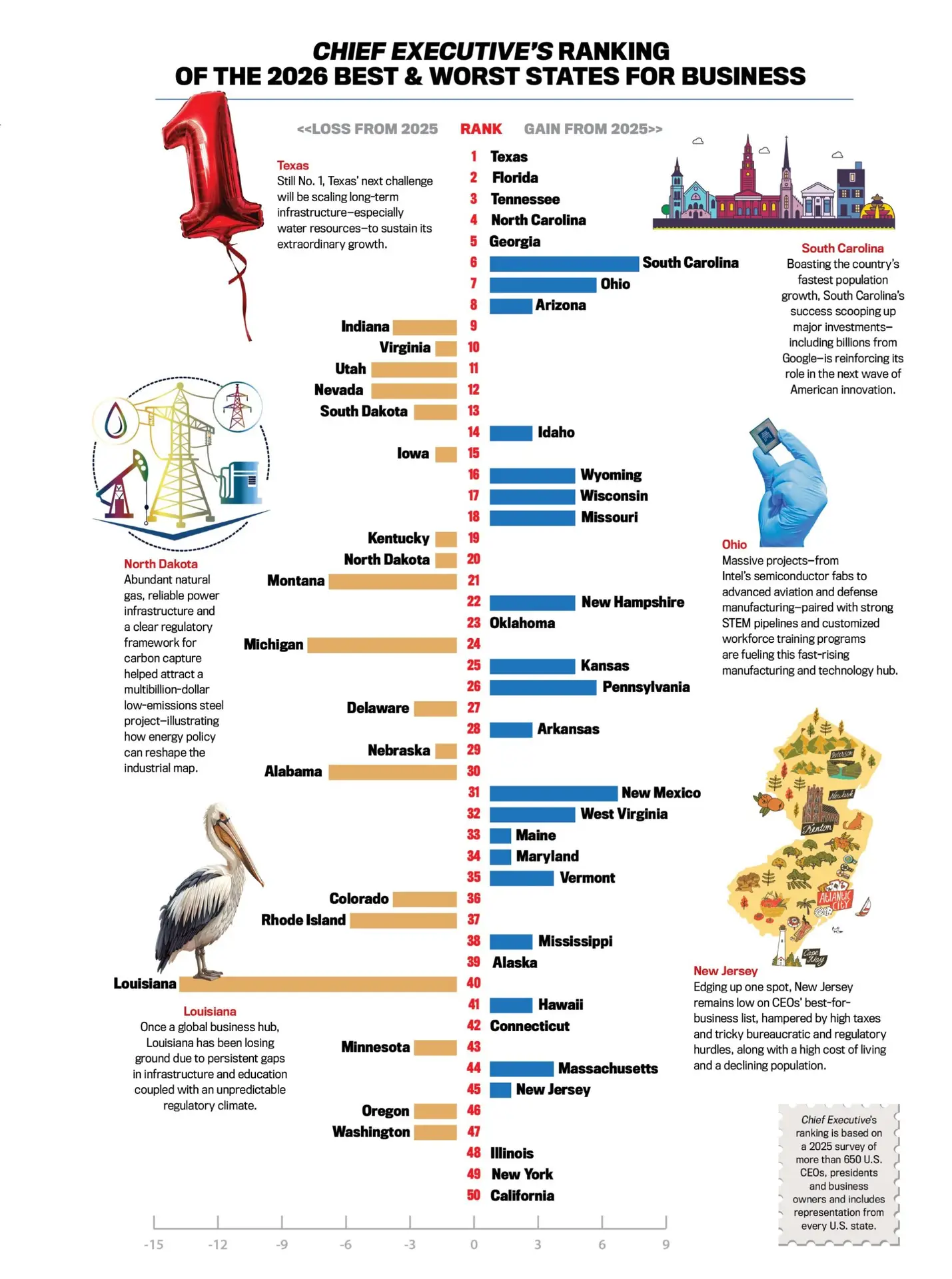
Texas has secured the No. 1 position for yet another year, maintaining a decades-long streak as the premier destination for American enterprise. Florida continues to hold the No. 2 spot, followed by Tennessee, North Carolina, and Georgia, completing a top five dominated entirely by the Sun Belt and the Southeast. However, the 2026 data suggests that the gap between these perennial leaders and the rest of the country is being challenged by states that have successfully modernized their industrial policies.
The Foundations of Growth: Talent, Infrastructure, and Regulatory Climate
The 2026 survey results emphasize that the most successful states are those focusing on "Google-style fundamentals." This term, popularized by site selection experts, refers to an environment where the government prioritizes the long-term health of the business ecosystem over short-term political wins. According to Larry Gigerich, executive managing director of Ginovus and a leading expert in corporate site selection, the states that focus on talent, infrastructure, and a stable tax and regulatory climate are the ones that will continue to thrive in an increasingly mobile global economy.
The survey methodology remains consistent, asking executive respondents to rank states based on their personal experiences and perceptions of doing business there. This perception is a critical leading indicator of future investment. When a CEO perceives a state as "business-friendly," it often translates into new corporate headquarters, manufacturing facilities, and regional hubs. Conversely, a poor ranking can signal a coming drought in capital expenditure for that region.
Significant Risers: South Carolina and Ohio Lead the Charge
One of the most notable stories of the 2026 report is the ascent of South Carolina. The state jumped seven spots to reach No. 6, its highest ranking in recent years. This rise is attributed to the state’s aggressive pursuit of advanced manufacturing and its investment in logistical infrastructure, including its port systems and interstate connectivity. CEOs cited South Carolina’s proactive approach to workforce development as a primary driver for their positive outlook.
Ohio also demonstrated significant momentum, climbing five places to reach No. 7. This makes Ohio the highest-ranked state in the Midwest, a region that has historically struggled to compete with the rapid growth of the South. Ohio’s success is being viewed as a blueprint for the "Rust Belt" transition. The state has combined targeted marketing and storytelling—highlighting its "Silicon Heartland" initiatives—with a sustained focus on upskilling its existing workforce. By pivoting toward technology and semiconductor manufacturing, Ohio has successfully rebranded itself as a forward-looking hub for innovation.
The Middle-Pack Movement: Structural Momentum vs. Statistical Noise
While the top ten often capture the most headlines, the 2026 survey reveals meaningful shifts in the middle of the rankings. Wyoming, Wisconsin, and Missouri each climbed four spots this year. Of these, Wisconsin’s move is particularly noteworthy; it follows a nine-place jump in the previous year. Analysts suggest that Wisconsin’s upward trajectory is becoming "structural" rather than "statistical noise," indicating that the state’s long-term policy shifts are finally being recognized by the executive community.
Pennsylvania also showed signs of life, rising five places to No. 26. This move suggests that CEO perceptions can be moved when a state demonstrates consistency. Pennsylvania has focused on "doing the basics well," particularly in streamlining permitting processes and maintaining infrastructure. As one CEO respondent noted, "Consistency is often more valuable than a one-time tax credit. We need to know that the rules won’t change every four years."
Energy and Grid Reliability: Arizona’s Strategic Rebound
Arizona, which had slipped in the 2025 rankings due to concerns over infrastructure strain, rebounded two spots to No. 8 in 2026. The state’s recovery is a direct result of aggressive action by regulators and utility providers to address the energy demands of a rapidly growing population and a burgeoning tech sector.
Facing potential grid instability, Arizona approved nearly 5,000 megawatts of new power generation and storage. The state also launched multibillion-dollar expansion plans for its water and power infrastructure. This proactive response reassured CEOs that the state could handle the "growth surge" that has accompanied its rise as a secondary tech hub to California. In a world where data centers and high-tech manufacturing require massive, uninterrupted power supplies, Arizona’s focus on energy security has become a competitive advantage.
The Decliners: Vulnerabilities in the Modern Economy
Not all states fared well in the 2026 assessment. Louisiana suffered the most significant decline of any state, dropping 13 places to No. 40. This precipitous fall is attributed to persistent gaps in the state’s educational outcomes and crumbling infrastructure, paired with what many CEOs described as an "unpredictable" regulatory environment. For Louisiana, the 2026 results serve as a warning that natural resources and geographic advantages are no longer enough to offset systemic internal weaknesses.
Michigan also saw a decline, slipping seven spots to No. 24. However, market analysts view this less as a permanent failure and more as a "transition period." Michigan is currently attempting to diversify its economy beyond its traditional automotive base, moving into life sciences and green energy technology. While this transition has caused some temporary friction in CEO perceptions, the state’s long-term viability will depend on how effectively it can integrate its manufacturing heritage with 21st-century technological demands.
Other notable decliners include Washington, which slid four spots to No. 47, and Colorado, which also fell four spots to No. 36. In both cases, high costs of living and increasing regulatory burdens were cited by executives as primary deterrents to future expansion.
The Perpetual Bottom Tier: California, New York, and Illinois
The bottom of the rankings remained largely unchanged, with the trio of Illinois (No. 48), New York (No. 49), and California (No. 50) occupying the "cellar" for another consecutive year. Despite being home to some of the world’s largest corporations and most innovative ecosystems, these states continue to be viewed unfavorably by the broader CEO community.
The primary grievances cited by respondents include:
- High Taxation: Excessive corporate and personal income tax rates that drive talent and capital to other states.
- Bureaucratic Friction: Onerous permitting processes and a complex regulatory landscape that increases the cost of doing business.
- Cost of Living: High housing costs that make it difficult for companies to recruit and retain mid-level management and skilled labor.
New Jersey managed to edge up one spot to No. 45, but it remains deep in the bottom tier. The state continues to struggle with a declining population and high property taxes, factors that outweigh its strategic location between New York City and Philadelphia.
Quiet Success: The Cumulative Result of Incremental Improvements
The 2026 survey also highlights states that have made "quiet" progress. New Hampshire climbed four spots to No. 22, Kansas rose three to No. 25, and Arkansas gained four to reach No. 28. These states have avoided headline-grabbing "mega-deals" in favor of making themselves incrementally easier to do business with year after year.
By focusing on reducing the "friction" of business—such as simplifying tax filings, modernizing local zoning laws, and fostering better communication between the governor’s office and the private sector—these states are positioning themselves as attractive alternatives for companies looking to escape the high costs of the coasts.
Analysis of Implications: A New Era of Site Selection
The 2026 Chief Executive survey reflects a broader shift in the American economic landscape. For decades, the primary driver of site selection was labor cost and tax incentives. In the 2026 environment, however, "certainty" has become the new currency.
The rise of artificial intelligence and advanced manufacturing has made the availability of specialized talent more critical than ever. States like Ohio and South Carolina are winning because they have treated workforce development as a core infrastructure project, similar to building roads or bridges. Furthermore, the 2026 results indicate that CEOs are increasingly wary of political volatility. States that offer a stable, predictable regulatory environment—regardless of which party is in power—are seeing the greatest gains in their rankings.
As the United States continues to navigate a post-inflationary economy characterized by labor shortages and energy transitions, the "Best and Worst States for Business" survey serves as a vital roadmap. It demonstrates that while the Sun Belt remains the dominant force in American business, the door is open for any state that is willing to focus on the fundamentals and listen to the needs of the people who run the nation’s enterprises. The 2026 rankings are not just a scorecard; they are a reflection of the evolving priorities of the American corporate world.