The Galaxy Starshine 7 is the latest addition to Geely’s "Galaxy" sub-brand, a series launched in early 2023 to bridge the gap between mainstream economy cars and the ultra-luxury offerings of the group’s other subsidiaries. While the Galaxy line was initially expected to focus on high-end plug-in hybrids and pure electrics, the Starshine 7’s pricing strategy indicates that Geely is now aggressively targeting the budget-conscious consumer without sacrificing the "premium" identity the brand has cultivated.
A Design Language That Defies the Budget Label
Traditionally, the automotive industry has adhered to a strict hierarchy where lower price points are synonymous with utilitarian styling, visible cost-cutting, and a lack of aesthetic cohesion. The Galaxy Starshine 7 deliberately subverts these expectations. Measuring 4,930mm in length with a substantial 2,915mm wheelbase, the sedan occupies a footprint comparable to executive luxury vehicles such as the BMW 5 Series or the Mercedes-Benz E-Class.
The exterior design is characterized by a sleek fastback silhouette, a profile usually reserved for high-performance grand tourers or luxury EVs like the Porsche Taycan. The front fascia features a clean, "closed-off" nose typical of modern electric vehicles, but it is elevated by intricate, sharp light signatures that utilize advanced LED technology. Flush-mounted door handles, which improve both aerodynamics and visual flow, are standard features—a detail often omitted in Western vehicles at this price range to save on manufacturing costs.

The Starshine 7 also incorporates a full-width rear lighting element and a large panoramic glass roof, further blurring the lines between a budget commuter and a luxury sedan. These design choices are not merely cosmetic; they reflect Geely’s ability to leverage its global design centers, including those in Gothenburg and Coventry, to apply high-level aesthetic principles to its domestic Chinese products.
Interior Sophistication and Technological Integration
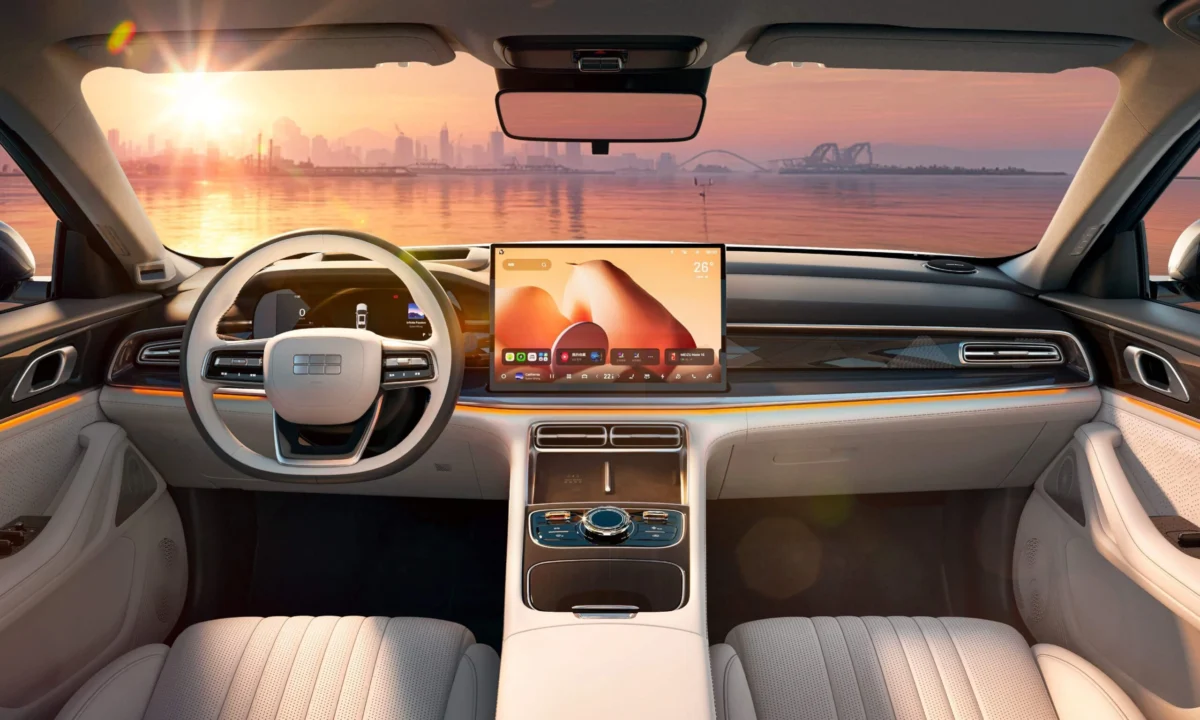
The interior of the Galaxy Starshine 7 is perhaps where the "premium" claim is most evident. Official promotional materials and early show models reveal a cabin dominated by a 15.4-inch floating central touchscreen display. This screen serves as the hub for the vehicle’s infotainment system, which is expected to run on Geely’s proprietary software architecture, likely integrated with Flyme Auto—a system developed in collaboration with the smartphone manufacturer Meizu, which Geely acquired in 2022.
The cabin materials depart from the hard plastics typically found in entry-level sedans. Instead, the Starshine 7 utilizes layered materials, including wood-like trims and soft-touch surfaces, arranged in a "lounge-like" color palette. This design philosophy aims to create a calming, high-end atmosphere rather than a purely functional one. The inclusion of a minimalist dashboard and a digital instrument cluster further reinforces the car’s futuristic appeal.
Performance Specifications and Battery Architecture
Despite its aggressive pricing, the Galaxy Starshine 7 does not compromise significantly on performance. Geely is offering the vehicle in two primary configurations to cater to different consumer needs:

- Rear-Wheel Drive (RWD) Variant: This entry-level model is equipped with a 190kW (approximately 255 horsepower) electric motor. For a vehicle at this price point, 255 horsepower is a significant figure, often exceeding the output of base-level internal combustion engine (ICE) competitors.
- All-Wheel Drive (AWD) Variant: The high-performance version adds a 150kW motor to the front axle, resulting in a combined system output of 340kW (approximately 455 horsepower). This setup allows the Starshine 7 to accelerate from 0 to 100 km/h (0 to 62 mph) in just 5.4 seconds, placing it firmly in the territory of sports sedans.
Battery options include a 58.4kWh pack and a larger 73.6kWh pack. Under the China Light-Duty Vehicle Test Cycle (CLTC), these batteries provide a maximum range of up to 610 kilometers (approximately 379 miles). While CLTC figures are generally more optimistic than the EPA ratings used in the United States or the WLTP standards used in Europe, a range exceeding 600km remains impressive for a vehicle priced under $17,000.
The Strategic Context: Geely’s Galaxy and the Chinese Price War
The launch of the Starshine 7 comes at a time of unprecedented competition within the Chinese domestic market. China is currently embroiled in a fierce "price war" led by industry giants like BYD and Tesla China. This environment has forced manufacturers to pack more value into their vehicles while simultaneously driving prices down to maintain market share.
Geely’s Galaxy sub-brand is central to the company’s "Smart Geely 2025" strategy, which aims to sell 3.65 million vehicles annually by 2025. By offering a car that looks and feels like a $40,000 vehicle for less than half that price, Geely is positioning itself to capture the massive middle-class demographic in China that is currently transitioning from gasoline to electric power.
This strategy stands in stark contrast to other Chinese tech entrants. For example, Xiaomi CEO Lei Jun recently stated that his company would not produce an EV priced below 100,000 yuan ($13,800), citing the difficulty of maintaining high-level intelligent features and software quality at such low margins. Geely, however, is able to achieve these price points through immense economies of scale. As the owner of Volvo, Polestar, Zeekr, and Lynk & Co, Geely shares platforms, battery procurement contracts, and R&D costs across millions of units globally.

Global Implications and the "Value Gap"
The existence of the Galaxy Starshine 7 poses a significant challenge to Western automakers. In the United States and Europe, the average price of a new electric vehicle remains well above $40,000. While companies like Ford and General Motors have expressed a desire to produce affordable EVs, they have struggled to match the cost structures of Chinese manufacturers who benefit from a fully integrated battery supply chain and lower labor costs.
The "value gap" is becoming increasingly apparent to global consumers. While the Starshine 7 is currently limited to the Chinese market, its specifications and aesthetics serve as a benchmark for what is industrially possible. For Western buyers, the car represents a "forbidden fruit"—an aspirational product that remains out of reach due to geopolitical tensions and trade barriers.
Currently, the United States has imposed a 100% tariff on Chinese-made electric vehicles, effectively barring cars like the Starshine 7 from entering the American market. The European Union has also introduced provisional countervailing duties on Chinese EVs, citing concerns over state subsidies. These measures are designed to protect domestic industries, but they also prevent the entry of low-cost, high-quality competition that could accelerate the transition to green energy.
Analysis of Market Impact
If Geely were to export the Galaxy Starshine 7 to international markets, even with modest price increases to account for shipping and compliance, it would likely dominate the entry-level segment. In markets like Southeast Asia, Latin America, and the Middle East, where trade barriers against Chinese goods are lower, Geely is already seeing rapid growth.

The Starshine 7 follows the recent announcement of the Geely Boyue EREV SUV, an extended-range electric vehicle priced near $15,000. Together, these models signal Geely’s intent to own the "affordable premium" space. The implication for the broader industry is clear: the era of the "cheap-looking" budget car is coming to an end. As manufacturing processes become more refined and digital technologies become cheaper to integrate, consumers will increasingly demand that even their entry-level vehicles offer a sense of luxury and technological sophistication.
Future Outlook
As of now, Geely has not announced plans for a North American or European launch of the Galaxy Starshine 7. The company is currently focused on fulfilling domestic demand and expanding its footprint in markets where the Geely brand is already established. However, the technology and design language debuted in the Starshine 7 will almost certainly trickle up to Volvo and Polestar products, which are sold globally.
The Galaxy Starshine 7 is more than just a new car model; it is a statement of intent from the Chinese automotive industry. It proves that the "premium" experience is no longer the exclusive domain of high-priced luxury brands. By combining the manufacturing prowess of a global giant with the aggressive pricing required by the Chinese market, Geely has created a vehicle that challenges the very definition of a "budget" car. For the rest of the world, the Starshine 7 serves as a window into a future where electric mobility is not just sustainable and affordable, but also undeniably stylish.