Inkitt Automates Low-Risk Software Development with Innovative One-Shot Pull Request Creator

The modern software engineering landscape is defined by an unceasing quest for developer velocity, balanced delicately against the imperative of system stability and security. As artificial intelligence models transition from passive code-completion assistants to autonomous agents capable of modifying codebases, engineering organizations face a complex operational challenge: how to safely harness automation without introducing catastrophic regressions or security vulnerabilities. Addressing this exact dilemma, publishing and technology platform Inkitt has developed and deployed an advanced, event-driven automated system known as the one-shot pull request (PR) creator. This infrastructure automates the end-to-end lifecycle of minor, low-risk software modifications—progressing seamlessly from initial task intake to the generation of a polished draft pull request prepared rigorously for human testing and peer review.
Unveiled through technical documentation published via Inkitt Tech, the system operates on isolated remote infrastructure, effectively eliminating the cumbersome requirement for individual software developers to locally configure, monitor, and supervise disparate coding agents. According to architectural disclosures, this innovative workflow has already achieved production maturity, successfully shipping code updates on a daily basis. Led by Agi Letkiewicz Tanner, Lead Engineer at Inkitt, the engineering team set out to construct an orchestration paradigm that diverges significantly from traditional, rigid deployment pipelines. Rather than relying on linear scripts or sequential execution models, Inkitt’s system utilizes an event-driven orchestrator designed specifically to coordinate short-lived, ephemeral agent containers.
Architectural Anatomy: Orchestration and State Management
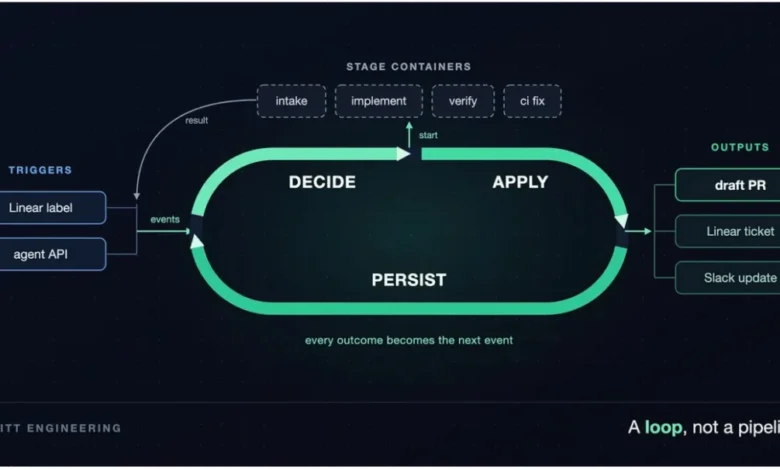
At the heart of Inkitt’s one-shot PR creator lies a sophisticated state machine architecture. As described by Tanner, the orchestrator functions as an event-driven coordinator governing short-lived agent containers. The comprehensive software development lifecycle managed by this system is segmented into distinct, modular stages: specification generation, code implementation, automated verification, continuous integration (CI) failure repair, and merge conflict resolution. To ensure high reliability and fault tolerance, the orchestrator meticulously persists the state of every execution run within a dedicated database. This persistent design paradigm grants the system the vital capability to pause, fail, or resume execution directly from its previously recorded state, safeguarding against data loss and interrupted workflows.
A foundational principle of the orchestrator’s software design is the strict separation of decision-making logic from side effects. The core transition function evaluates the current run state alongside any incoming events to compute the exact next action. Crucially, this evaluation mechanism operates purely in-memory, without directly accessing databases, external networks, or large language models. Security and credential management are handled with equivalent rigor. The central orchestrator retains exclusive possession of credentials required for interacting with external platforms, whereas the ephemeral agent containers are provisioned solely with short-lived repository tokens and scoped model credentials. Under no circumstances do these agent containers possess direct access to Slack, Linear administrative credentials, broader cloud identities, or arbitrary external network connections. Furthermore, an independent security validation check programmatically inspects the actual Git diff prior to submission, guaranteeing that generated code modifications never inadvertently touch restricted file paths or sensitive application directories.
Guardrails, Scope Limitations, and Operational Boundaries
While the generative capabilities of modern large language models are vast, unchecked autonomy within a production codebase presents unacceptable organizational risks. To mitigate these inherent dangers, Inkitt has deliberately engineered strict operational boundaries and guardrails into the one-shot PR creator. The automated workflow is programmed to categorically reject any task classification involving high-risk modifications. Specifically, the system refuses to process tasks involving database migrations, alterations to core database schemas or shared system contracts, CI pipeline and container build configuration adjustments, authentication modules, payment processing logic, or the addition and updating of third-party software packages and dependencies.
Compounding these structural restrictions, error recovery and iterative repair mechanisms are bounded by strict numerical thresholds to prevent infinite execution loops or runaway compute costs. Verification routines, CI failure repairs, and merge conflict resolution steps are each strictly capped at a maximum of two automated attempts. In the event of duplicate webhook deliveries—a common occurrence in distributed event-driven systems—the orchestrator implements advanced deduplication logic coupled with conditional database writes. This design successfully adheres to the engineering principle of idempotent operations, ensuring that workflows executing retries or processing repeated events remain entirely predictable and state-safe. Regarding synchronization with external CI services, rather than treating every individual job event as the definitive completion of the entire pipeline, the orchestrator actively queries GitHub to ascertain whether all relevant background jobs have definitively concluded.
Reflecting on the complex realities of implementing agentic automation, Lead Engineer Agi Letkiewicz Tanner remarked that managing the model itself was the straightforward aspect of the project, noting that the true engineering hurdles lay in mastering idempotency, distributed locking, strict retry budgets, and granular permission boundaries.
Industry Context and Comparative Analysis
Inkitt’s deployment joins a rapidly evolving ecosystem of autonomous and semi-autonomous software engineering agents designed to alleviate developer toil. Across the technology sector, major platforms and open-source projects are exploring diverse methodologies for integrating artificial intelligence into the software delivery lifecycle. For instance, GitHub Copilot’s cloud agent enforces strict permission boundaries and mandates mandatory human review phases prior to code merging, sharing structural similarities with Inkitt’s human-in-the-loop philosophy. Similarly, open-source initiatives like SWE-agent focus heavily on resolving complex repository-level issues through specialized, model-driven interfaces capable of browsing, editing, and executing code within sandboxed environments.
However, where many existing solutions prioritize conversational interfaces or broad, open-ended problem-solving capabilities, Inkitt’s architecture distinguishes itself through an uncompromising emphasis on persistent workflow states, tightly bounded retry budgets, and centralized, hierarchical control over external system actions. This philosophy addresses a critical gap in enterprise software engineering: the need for reliable, deterministic automation of mundane, repetitive, and low-risk coding tasks without sacrificing organizational governance.
Human-in-the-Loop Governance and Future Implications
Despite the high degree of automation achieved by Inkitt’s system, human oversight remains an indispensable and non-negotiable component of the software development lifecycle. The one-shot PR creator is intentionally restricted in its ultimate authority; it generates draft pull requests, but it cannot bypass repository branch protection rules, nor can it merge its own modifications into production branches. Once the system successfully guides a set of changes through automated verification and ensures that CI pipelines pass, it dispatches a notification to the requesting developer, confirming that the code has safely reached a staging environment. From that juncture, a human engineer must manually mark the pull request as ready for formal review, manage peer reviewer assignments, and grant final approval. For larger, more complex software tasks that exceed the deterministic boundaries of the one-shot system, Inkitt maintains alternative local workflows that ensure deep, continuous human involvement throughout the engineering process.
The successful implementation of Inkitt’s one-shot PR creator signals a broader, accelerating trend within the software industry toward micro-automation and bounded agentic workflows. By offloading routine, low-risk engineering tasks—such as minor boilerplate generation, small bug fixes, and documentation updates—to secure, event-driven agent containers, organizations can reclaim significant engineering hours. This shift allows human developers to redirect their cognitive focus toward complex architectural design, strategic feature development, and deep exploratory testing. As organizations continue to refine governance frameworks, permission models, and state-management protocols, systems like Inkitt’s provide a pragmatic blueprint for safely scaling artificial intelligence integration within enterprise software engineering environments.