Midterm Elections Provide a Tactical Reprieve for CEOs Amidst Lingering Economic Uncertainty

The landscape for American business leadership shifted in early November 2026 as the conclusion of the midterm elections provided a surprising, albeit modest, buoyancy to the Chief Executive Confidence Index. Despite a broader trend of economic malaise that pushed confidence to a 14-month low, the polling data suggests that corporate leaders are finding a silver lining in the finality of the election results. While the overall economic outlook remains cautious, the transition from political speculation to legislative reality is being welcomed by the C-suite as a necessary catalyst for renewed operational focus.
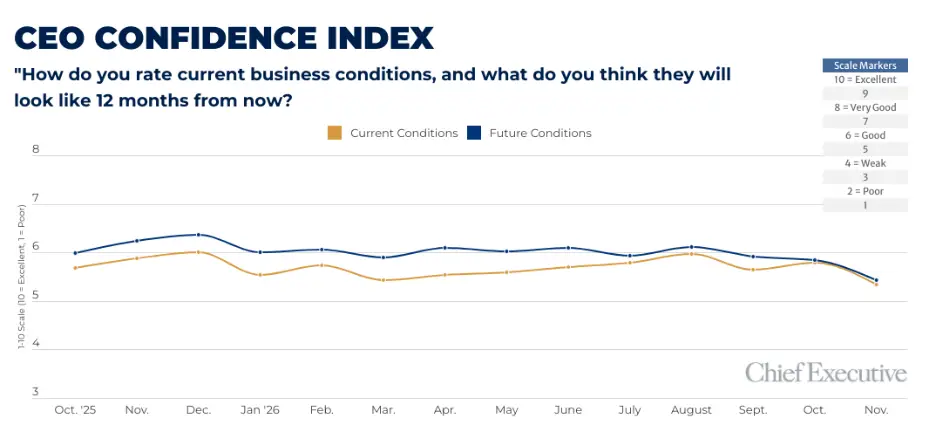
The survey, conducted between November 3 and November 5, 2026, and involving 435 U.S. chief executives, offers a granular look at how political stability—or the lack thereof—impacts capital allocation and long-term planning. The headline figures indicate a significant cooling in sentiment: current business conditions were rated at 5.3 out of 10, an 8 percent decline from October, while the 12-month forecast fell 7 percent to 5.4. However, a deep dive into the timing of these responses reveals a distinct "election effect."
The Chronology of Confidence
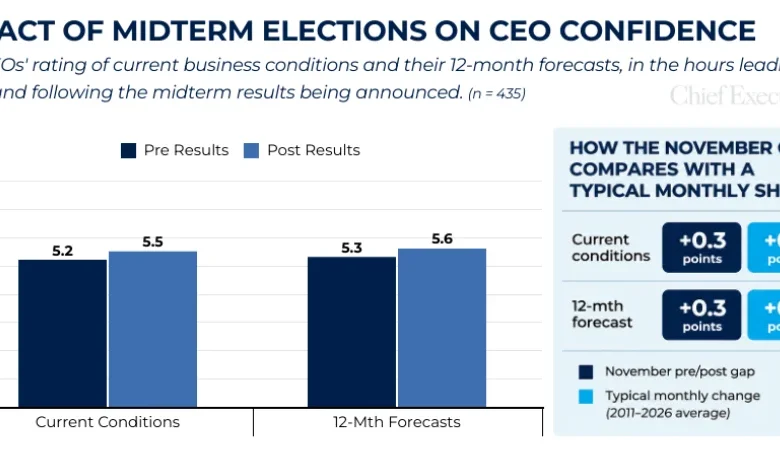
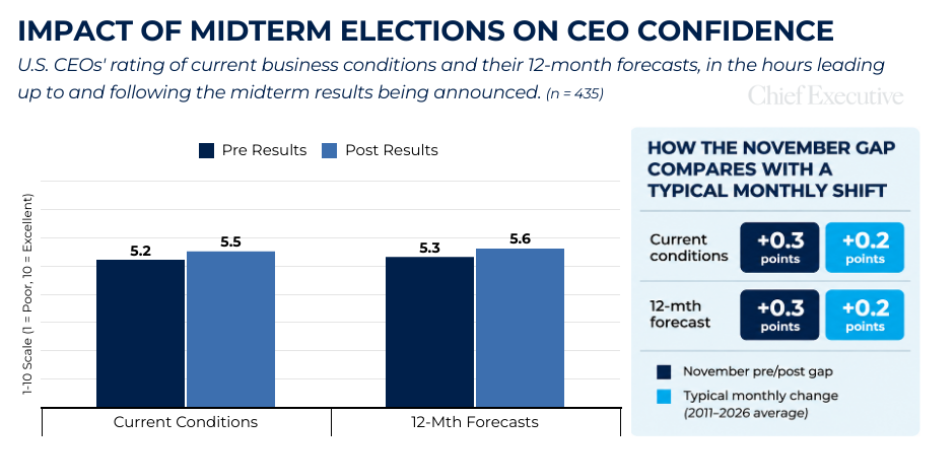
The methodology of the survey allows for a rare "before-and-after" analysis of sentiment. CEOs who submitted their responses prior to the initial wave of election results on the evening of November 3 provided a baseline assessment of 5.2 for current conditions and 5.3 for the year ahead. Following the emergence of the election results, those metrics rose to 5.5 and 5.6, respectively.
In a sector where monthly fluctuations of two-tenths of a point are considered standard, a three-tenths-of-a-point shift within a 48-hour window is statistically significant. This movement does not necessarily signal a sudden surge in optimism regarding the economy at large; rather, it indicates a profound relief that the period of electoral paralysis has concluded. For many, the value lies in predictability. As one respondent from a family-owned manufacturing firm noted, "The midterm election is over and the balance of power is in place. At least we know what we should probably do."
Historical Context and Economic Headwinds
To understand the significance of the current 5.3 index reading, one must look back to September 2025. During that period, the Index bottomed out at 5.1, driven by a volatile mix of tariff-related anxieties, erratic government regulatory shifts, and fears of a stalling economic recovery. Throughout 2026, the corporate sector had hoped for a return to growth, with many forecasting an index score of 6.2 by the fourth quarter. The reality, at 5.3, represents a 15 percent gap between executive expectation and realized performance.
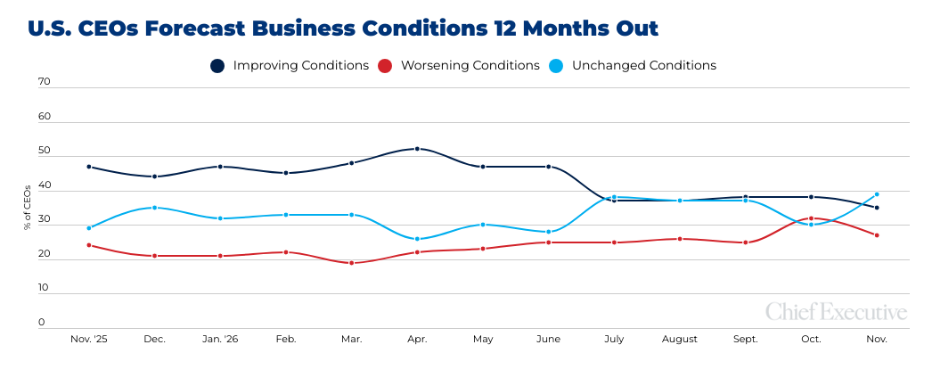
The current atmosphere is characterized by a "wait-and-see" approach. The proportion of CEOs who expect business conditions to remain stagnant over the next year has climbed to 39 percent, up from 30 percent in October. This reflects a broader trend of risk mitigation, where capital is being preserved rather than deployed in the face of persistent inflationary pressures and geopolitical instability.
The Duality of Political Impact
The post-election response was not universally positive, highlighting a deep polarization within the business community. While many CEOs viewed the shift in Congress as a pathway to "functional" government, a segment of the respondents expressed concern that the new political alignment would result in deeper legislative gridlock.
Roughly 30 percent of those who responded after the election results were announced expressed a pessimistic outlook, a higher percentage than the 25 percent recorded among those who responded earlier. This suggests that for a significant minority of the business community, the election did not solve the fundamental problem of polarization; it merely shifted the battlefield. One executive, anticipating further deterioration, noted that "election results create uncertainty and gridlock," suggesting that the division between the executive and legislative branches may continue to impede progress on critical issues such as tax reform, energy policy, and infrastructure spending.
Growth Forecasts Amidst Cost Pressures
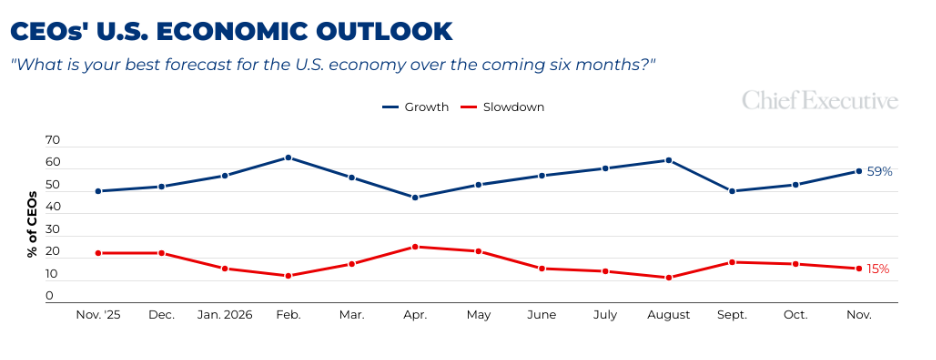
Despite the pessimistic reading of general business conditions, the internal forecasts for individual companies remain remarkably resilient. The disconnect between "the economy" and "my company" is a recurring theme in corporate sentiment. Six out of 10 CEOs now anticipate U.S. economic growth over the next six months, an improvement from the 53 percent reported in October.
This confidence in individual performance is backed by tangible planning. As corporations look toward 2027, the focus shifts to internal efficiency and market expansion:
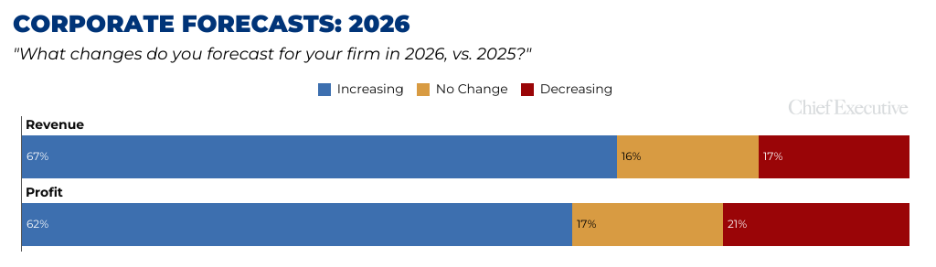
- Revenue Expectations: Roughly 80 percent of CEOs project revenue growth for 2027.
- Profit Margins: Approximately 74 percent anticipate an increase in profitability.
- Operational Expenditure: Nearly 80 percent expect higher operating costs in the coming year, though the majority anticipate these increases will be contained within a 10 percent threshold.
- Capital Allocation: 54 percent of firms are planning to increase capital expenditure, while 52 percent intend to expand their headcount, suggesting that despite macroeconomic uncertainty, the drive for operational growth remains a primary objective.
Broader Implications for Global Stability
For a portion of the leadership group, the implications of the midterm results extend beyond domestic fiscal policy into the arena of foreign relations. The expectation that a stable U.S. government could lead to improved international relations, de-escalation of trade tensions, and a resolution to ongoing conflicts is a sentiment that directly influences the confidence index.
When CEOs cite "improved global stability based on recent midterm results," they are essentially projecting a desire for a consistent U.S. foreign policy that allows for clearer long-term supply chain planning and international investment. However, this remains speculative. The actual impact of the new Congressional composition on foreign policy will depend on the degree to which legislative leaders are willing to cooperate with executive branch initiatives.
Analysis: The Path Forward
The data from the November 2026 survey paints a picture of a business community in transition. The "midterm bounce" in confidence is not an endorsement of any specific policy platform, but rather a collective exhale. Business leaders thrive on the ability to calculate risk. When the political environment is in flux, the variables of that calculation become impossible to quantify. By finalizing the legislative makeup of the country, the midterm elections have effectively removed a layer of "political noise" that had been stifling corporate decision-making for months.
The persistence of the 5.4 forecast for the next 12 months, however, serves as a sobering reminder that while the election results provide a floor for confidence, they do not automatically provide a ceiling for growth. The core challenges—cost pressures, labor shortages, and global economic fragility—remain largely unaddressed by the outcome of the midterm elections.
As businesses move into the final quarter of 2026, the strategy appears to be one of cautious expansion. Companies are clearly prepared to hire and invest, provided that the legislative environment remains stable enough to justify the expenditure. Whether the new Congress can provide that stability remains the defining question for the U.S. economy in 2027. For now, the C-suite is taking the "back to business" mandate at face value, prioritizing the internal metrics they can control over the political variables they cannot. The coming months will determine if this measured optimism is sufficient to catalyze a broader economic recovery or if the current stagnation will persist as the new baseline for American industry.