Scaling Enterprise AI Governance: Transitioning from Bespoke Tooling to the Amazon Bedrock AgentCore Gateway

The proliferation of autonomous AI agents within enterprise environments has necessitated a fundamental shift in how organizations manage identity, authorization, and security. In the initial phase of deploying AI agents, developers often rely on simplified architectures where individual agents are hard-wired to specific tools. While functional for proof-of-concept projects, this "one-to-one" wiring model creates significant technical debt, security vulnerabilities, and management overhead as organizations scale to hundreds of agents and thousands of operational tools. Building upon the foundational work established in previous architectural frameworks, enterprise teams are now moving toward centralized governance models using the Amazon Bedrock AgentCore Gateway to harmonize security across disparate agent topologies.
The evolution from the Part 1 architecture—which utilized a deliberately constrained setup of one agent and two Model Context Protocol (MCP) servers—to a robust, scalable enterprise model represents a critical milestone in AI infrastructure development. Under the previous model, the agent itself was responsible for holding runtime ARNs, token-exchange permissions, and embedded authorization logic. This decentralization meant that every addition of a new tool necessitated manual configuration changes across multiple agents, creating a brittle "wiring matrix" that defied effective auditing.
The Architectural Shift: Centralization and Decoupling
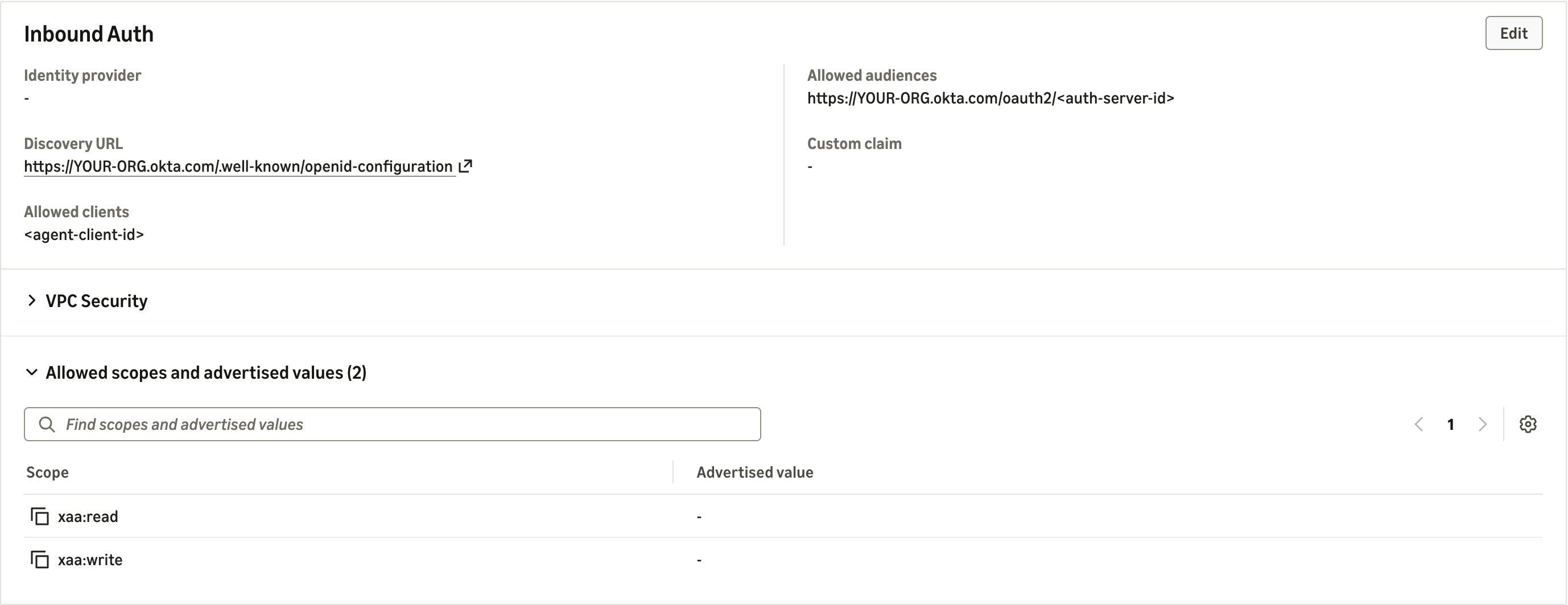
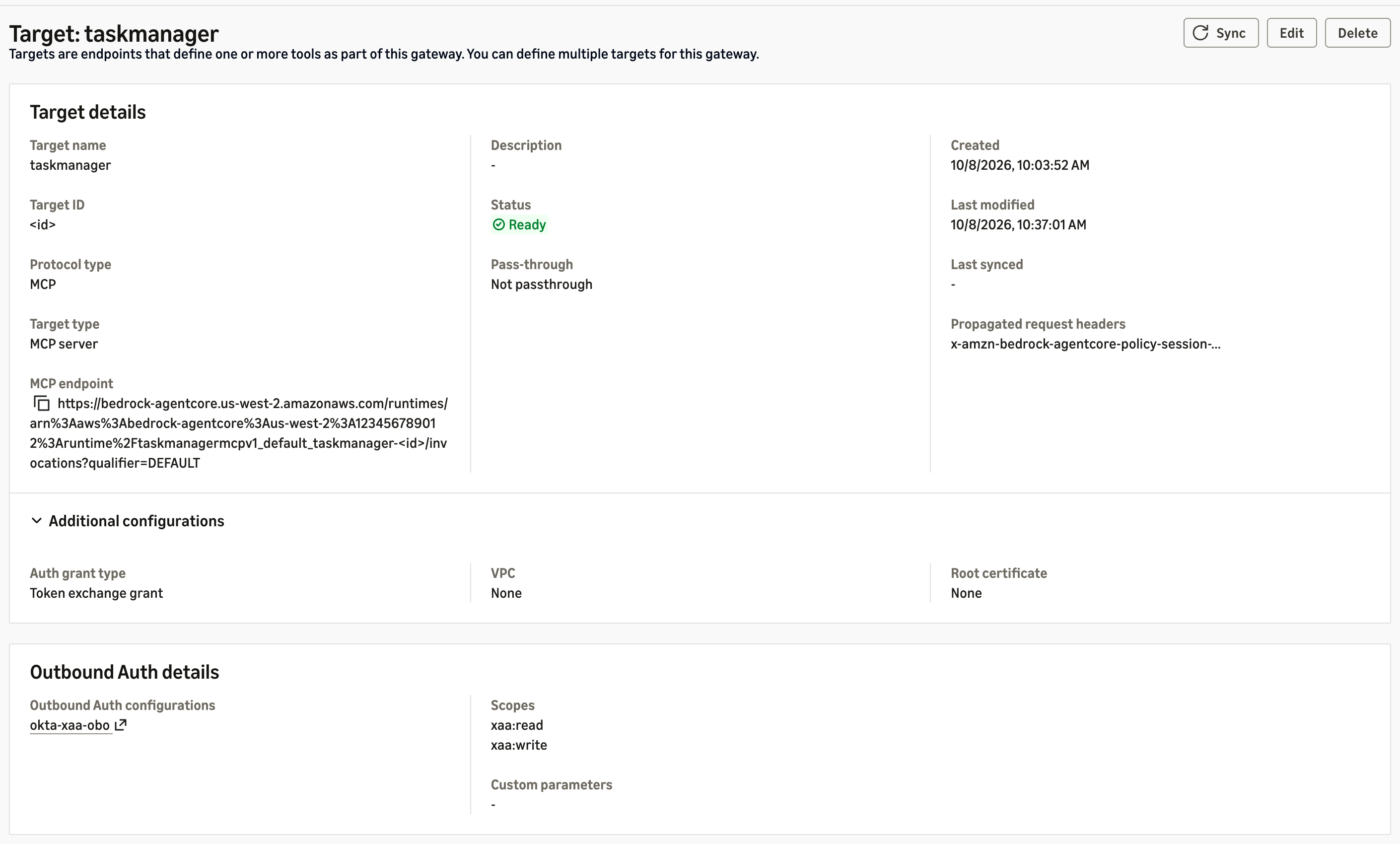
The transition to the Amazon Bedrock AgentCore Gateway addresses these scaling limitations by introducing a single front-door mechanism. In this updated architecture, agents no longer interact directly with backend MCP servers. Instead, they route requests through the Gateway, which acts as the authoritative intermediary. This change fundamentally alters the security posture: the agent’s execution role is stripped of sensitive token-exchange permissions and secret management duties. By offloading these responsibilities to the Gateway, the architecture ensures that the agent serves only as the request initiator, while the Gateway handles the complex task of redeeming Okta Cross App Access (XAA) grants for specific target resources.
This decoupling is reinforced by the implementation of Cedar, a policy-as-code language designed for fine-grained access control. By moving authorization logic out of individual MCP servers and into a centralized policy engine, organizations can enforce "default-deny" postures that are globally consistent and easily auditable. This removes the risk of policy drift, where identical rules copied across thousands of servers might eventually diverge due to human error or manual updates.
Chronology of Implementation and Integration
The integration process for this scalable framework involves a multi-step transition from the initial, isolated agent model to a distributed, Gateway-managed ecosystem. The process typically requires approximately 90 minutes of configuration, assuming the prerequisites of Okta Log Streaming, AWS Identity and Access Management (IAM) permissions, and container orchestration tools like eksctl and kubectl are already in place.
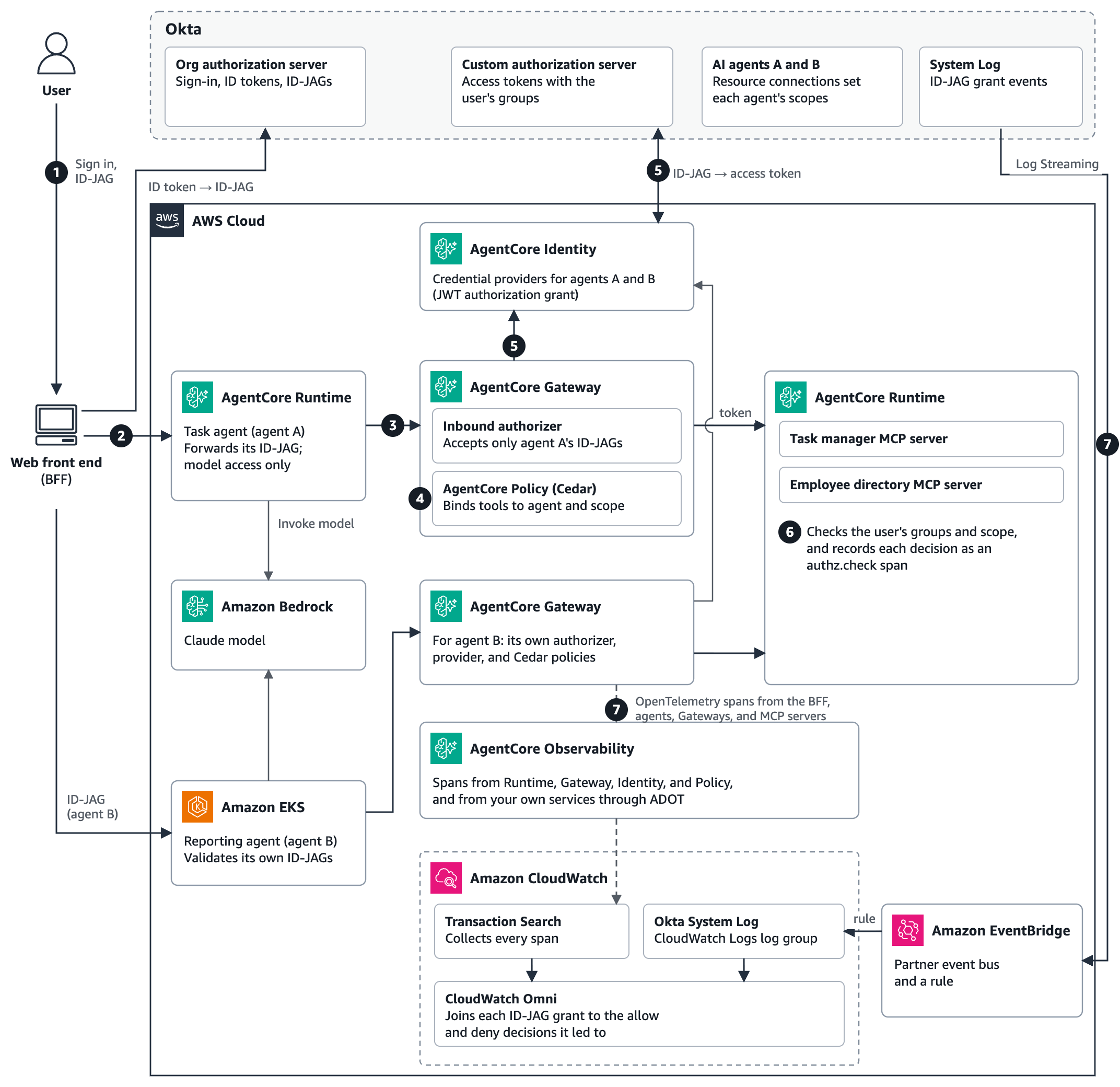
In the second phase of this deployment, organizations introduce a secondary agent, such as a reporting agent hosted on Amazon Elastic Kubernetes Service (Amazon EKS). This demonstrates the platform’s flexibility; the Gateway is "identity-agnostic," meaning it treats incoming requests based on validated credentials rather than the physical location of the agent. Whether an agent is running within the Amazon Bedrock AgentCore runtime or on an external EKS cluster, the security controls—comprising identity validation, policy evaluation, and token redemption—remain identical.
Data-Driven Performance and Security Analysis
Quantitative analysis of the Gateway-based architecture reveals that security enforcement does not come at an unreasonable latency cost. Performance metrics collected over 24-hour observation windows indicate that identity and policy checks for a single tool call add approximately 200 milliseconds to the total request time at the median. Given that the underlying tool execution (such as an MCP server invocation) often takes several seconds, this governance overhead is well within acceptable margins for most enterprise applications.
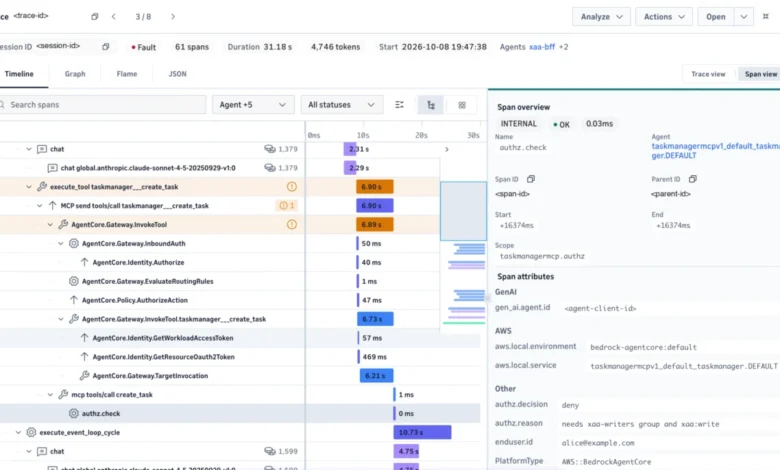
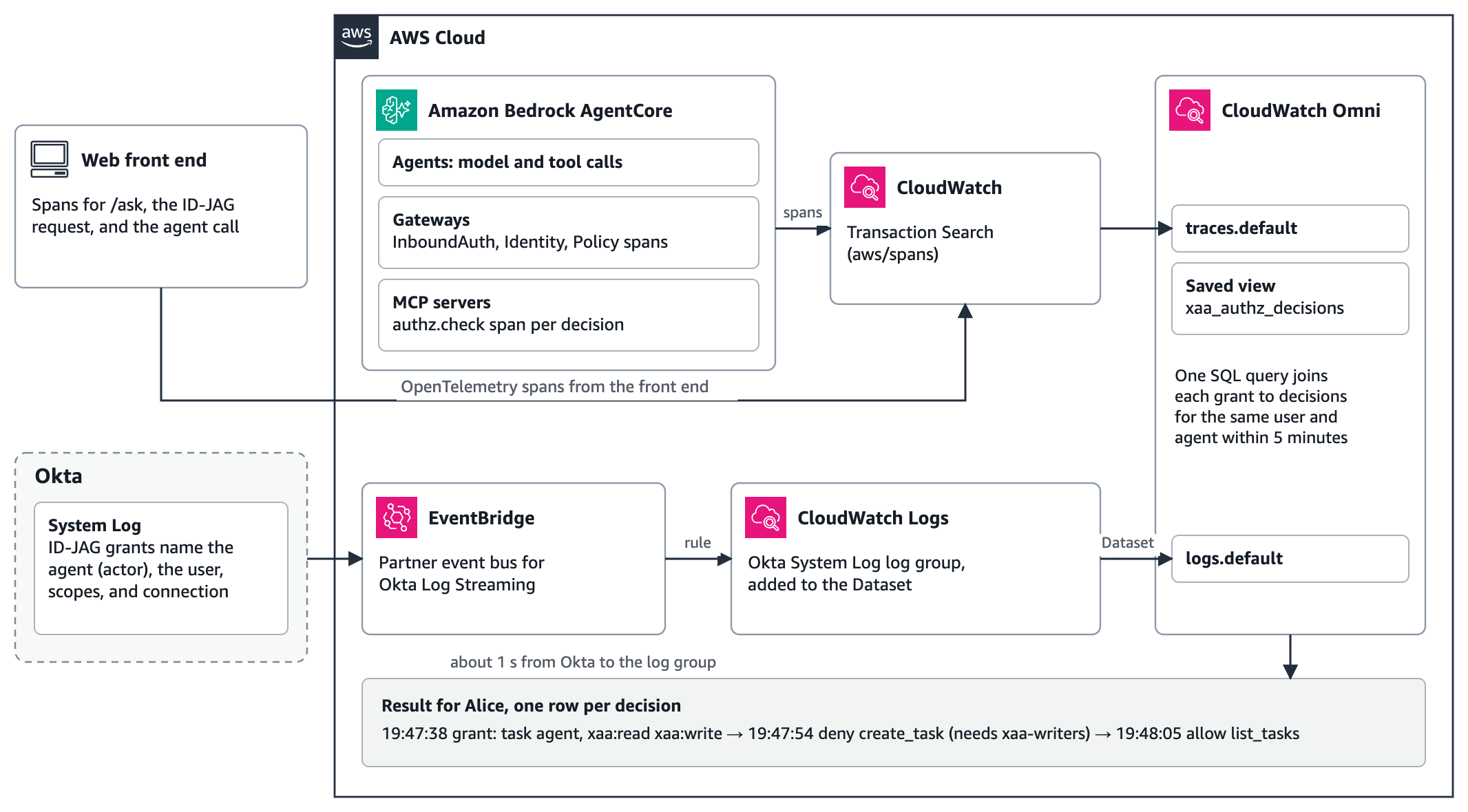
Furthermore, the audit trail provided by Amazon Bedrock AgentCore Observability allows for a high degree of transparency. By integrating these spans with Amazon CloudWatch, security teams can join Okta’s System Logs with internal AWS authorization decisions. This allows for a singular, unified query that maps an Okta grant (the "what") to a downstream authorization decision (the "how" and "why"). For example, if a user attempts to create a task they are not authorized to perform, the trace clearly shows the request passing the initial Gateway identity check, only to be blocked by the Cedar policy layer, providing an indisputable audit record of the denial.
Comparative Analysis: XAA versus Per-User Consent
A critical decision point for architects is determining when to use Cross App Access (XAA) versus traditional per-user OAuth consent. XAA is highly effective for scenarios where the target system’s authorization server can natively accept an ID-JAG (Identity-JSON Authorization Grant). In these cases, the Okta administrator maintains central control, and the user experience is seamless, as the system does not require redundant consent prompts.
Conversely, for applications that do not support this delegation, such as third-party services like GitHub, per-user OAuth consent remains necessary. The key difference lies in revocation behavior. Under XAA, an administrator can suspend a user in Okta, and the impact propagates almost immediately, as issued tokens are short-lived. In contrast, per-user OAuth consent tokens may persist until their natural expiration or until the connection is manually severed, which can introduce a lag in security response times. Organizations are advised to evaluate these mechanisms on a per-application basis rather than adopting a one-size-fits-all policy.
Broader Implications for Enterprise AI
The move toward a Gateway-centric governance model has profound implications for industries with strict regulatory requirements, such as financial services, healthcare, and media production. In these sectors, the ability to answer, "Which agents have access to which systems for which users?" is not merely an operational convenience; it is a compliance mandate.
By standardizing on a single Gateway, organizations can ensure that every agent—regardless of its purpose or origin—is subjected to the same rigorous scrutiny. This architecture provides a blueprint for "Governance at Scale," allowing for the rapid deployment of new AI capabilities without compromising the integrity of the enterprise security perimeter.
Future Directions: Observability and Automated Evaluation
While the current implementation focuses on authorization and identity, the roadmap for AgentCore involves expanding observability to include performance benchmarking and automated agent evaluation. Future iterations of this architecture will likely enable organizations to automatically score agent behavior against predefined criteria, such as "honesty" or "security compliance," while the agent is live.
As the number of AI agents continues to grow, the ability to automatically detect when an agent attempts to circumvent policy—or reports success after a denied tool call—will become paramount. The current reliance on manual log inspection is a necessary stepping stone, but the ultimate goal for enterprise infrastructure is to move toward real-time, automated monitoring that can flag anomalous agent behavior with the same precision that the Gateway currently uses to block unauthorized tool access.
Conclusion and Best Practices
The transition from a bespoke, agent-specific security model to a centralized, Gateway-based architecture is essential for any enterprise looking to industrialize its use of AI. By leveraging the Amazon Bedrock AgentCore Gateway and Cedar policy engine, organizations can achieve a level of governance that is both scalable and highly visible.
Key takeaways for engineering teams include:
- Centralize Governance: Use a single Gateway to act as the gatekeeper for all agent-to-tool interactions.
- Decouple Policy from Code: Move authorization logic out of the MCP servers and into centralized Cedar policies to prevent policy drift and ensure auditability.
- Prioritize Traceability: Use OpenTelemetry-based observability to link identity grants to authorization decisions, ensuring every action taken by an agent can be traced back to its origin.
- Evaluate on a Per-Target Basis: Choose the right authentication mechanism (XAA vs. OAuth consent) based on the target application’s capabilities and the desired user experience.
As organizations move beyond the experimentation phase and into full-scale production of AI agents, these architectural foundations will serve as the guardrails that enable innovation while maintaining the robust security posture required by modern enterprise standards.