Reimagining Sales Productivity: How Amazon Quick is Revolutionizing the Sales Cycle

The modern sales representative is often caught in a web of administrative tasks, spending a mere 40% of their workday actively engaging in selling. This stark reality, highlighted by recent industry reports, underscores a significant challenge: valuable selling time is consumed by essential but lower-value activities like CRM updates, prospect research, email composition, and constant context-switching between disparate tools. This inefficiency not only hampers individual productivity but also impacts deal velocity, customer satisfaction, and ultimately, revenue generation. Addressing this critical gap, Amazon Quick emerges as a powerful AI assistant designed to streamline workflows, amplify selling time, and drive tangible business outcomes.
The genesis of such a tool can be traced back to the growing awareness within the business world of the diminishing returns associated with manual, repetitive tasks. As sales cycles become more complex and customer expectations rise, the pressure on sales teams to perform efficiently has never been greater. Industry analyses consistently point to the significant time drain caused by administrative burdens. For instance, a study by HubSpot Research indicated that sales professionals spend an average of 28% of their day on data entry and CRM updates alone. This figure, combined with time spent on research, email management, and internal communication, paints a clear picture of an industry ripe for technological intervention. Amazon Quick aims to be that intervention, leveraging artificial intelligence to automate, accelerate, and optimize these critical functions across the entire sales lifecycle.

Amazon Quick is engineered to be an AI assistant for work, transforming user queries into actionable insights and ultimately, into concrete results. Its core promise is to liberate sales professionals from the shackles of administrative overhead, allowing them to dedicate more time to what they do best: selling. Whether operating within a web browser, a dedicated desktop application, or seamlessly integrated into existing Microsoft 365 and Outlook environments, Quick acts as a central intelligence hub. This integration is key to its efficacy, as it minimizes the need for users to pivot between multiple platforms, thereby reducing cognitive load and increasing focus. The ultimate goal is to empower sales teams to expand their market reach, accelerate deal closures, and cultivate deeper, more enduring customer relationships, regardless of the organization’s scale.
The adoption of such advanced AI solutions is not merely theoretical; leading organizations are already witnessing the transformative power of Amazon Quick. Companies like 3M, AWS Global Sales, and Amazon itself are among the early adopters, leveraging the platform to unlock the full potential of their sales forces. The successes are being documented, offering tangible evidence of Quick’s impact. For example, case studies highlight how AWS Global Sales has revolutionized its insights delivery process, enabling sales teams to stay abreast of new product launches with remarkable efficiency, and illustrating Amazon’s own journey in deploying Quick Suite across thousands of users, demonstrating scalability and widespread utility. These real-world applications provide a compelling narrative of how AI is moving beyond conceptual discussions to deliver concrete business value.
Optimizing Prospect Engagement: From Overwhelm to Opportunity
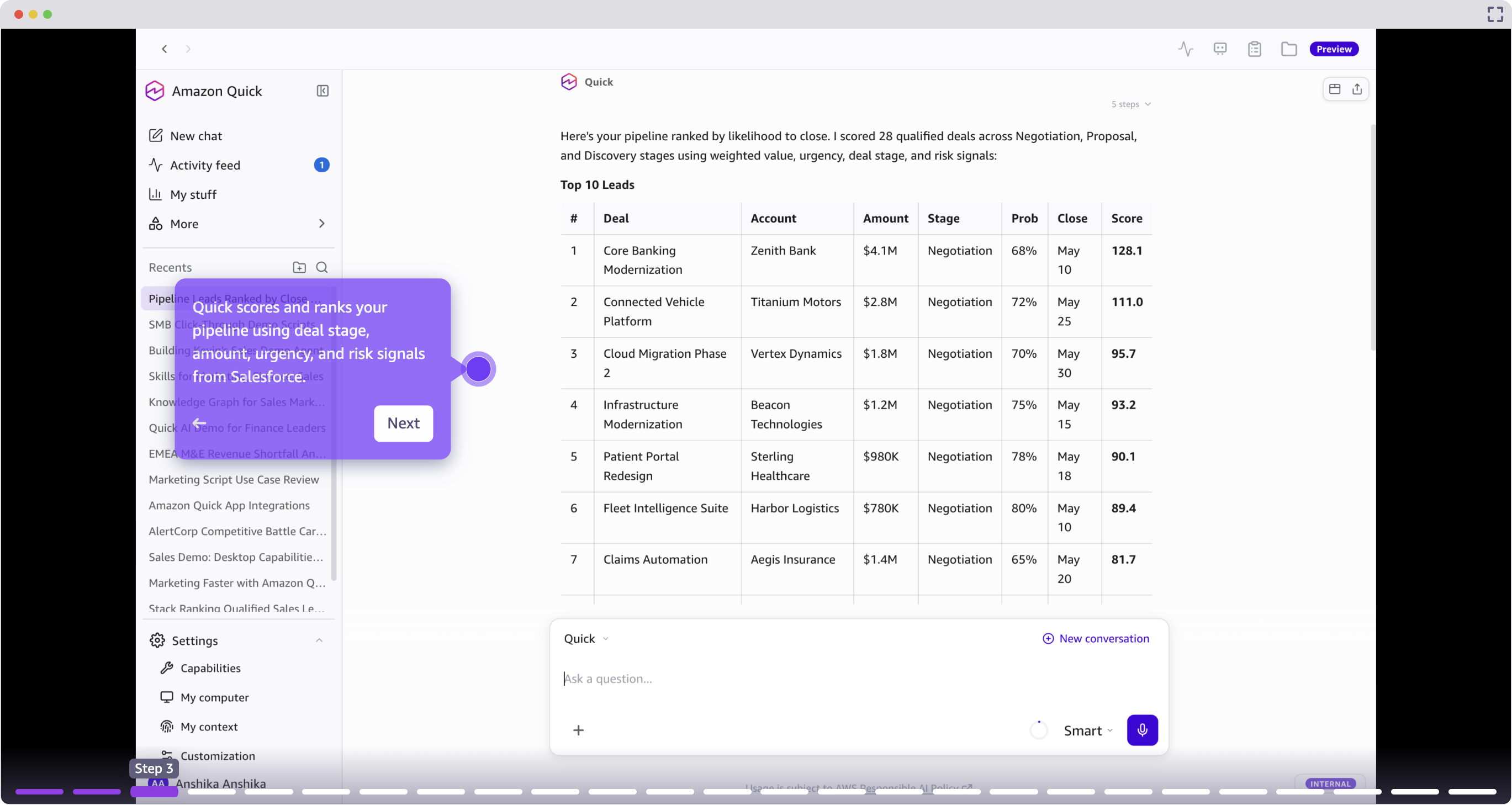
A fundamental challenge in sales is the sheer volume of leads that often inundates CRM systems. Sales representatives are frequently faced with lists of hundreds, if not thousands, of potential prospects, each with varying levels of engagement and purchase intent. The critical question becomes: which of these leads warrant immediate attention? This scenario is all too common, with many sales teams lacking the granular visibility needed to accurately identify leads that are genuinely sales-ready. The consequence is a dual threat: valuable opportunities are missed due to delayed follow-up, and precious resources are diverted to less promising prospects, prolonging sales cycles and diminishing overall efficiency.
Amazon Quick directly addresses this critical pain point through intelligent lead scoring and prospect prioritization. By integrating with a multitude of data sources—including CRM systems, email communications, web analytics, and customer support platforms—Quick analyzes a rich tapestry of engagement signals. This comprehensive analysis allows for the dynamic ranking of leads based on their demonstrated buying intent. The platform’s custom chat agents, capable of drawing context from internal documents, detailed opportunity information, and historical account data, provide sales professionals with the crucial intelligence needed to focus their efforts on prospects who are most likely to convert. This shift from a reactive to a proactive, data-driven approach is a cornerstone of modern sales effectiveness.
The practical implementation of this capability begins with a seamless integration of Quick into existing CRM infrastructure. Amazon provides comprehensive, step-by-step guidance for integrating with leading CRM platforms such as Salesforce, HubSpot, and ServiceNow, as well as a broader list of supported systems. This integration is the bedrock upon which Quick builds its analytical prowess.
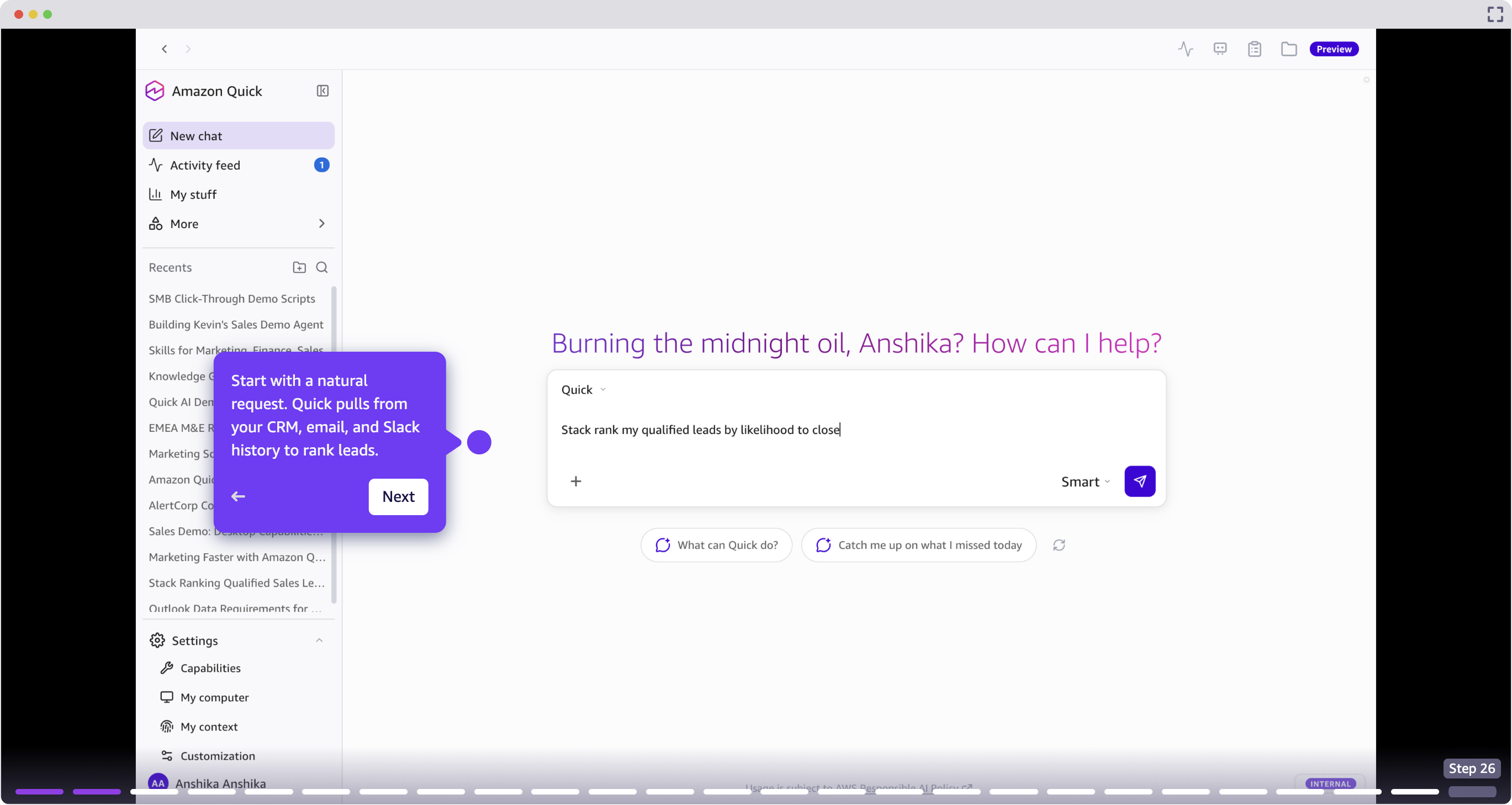
Once connected, users can leverage Amazon Quick Sight, a powerful business intelligence service, to create interactive dashboards. These visualizations transform raw data into comprehensible insights. The true magic, however, unfolds when sales representatives engage with Quick using natural language prompts. For instance, a prompt such as "rank my pipeline" or "identify my top 10 hottest leads" can trigger Quick to aggregate data across all connected systems. The result is a highly prioritized view of opportunities, with deals exhibiting stalled progression, overdue follow-ups, or looming competitive threats surfacing prominently at the top. This immediate, data-backed prioritization empowers sales reps to allocate their time and energy most effectively, ensuring that no high-value prospect is overlooked.
Proactive Risk Mitigation and Actionable Next Steps
Beyond identifying high-potential leads, Quick plays a crucial role in mitigating risks associated with ongoing deals. For each identified opportunity, the AI assistant can pinpoint specific risk signals. These might include stalled email threads that indicate a lack of engagement, missed follow-up opportunities that could signal a loss of momentum, or even subtle mentions of competitors that suggest a potential shift in the deal landscape. Crucially, Quick doesn’t just identify these risks; it provides concrete, actionable recommendations for next steps. This could involve suggesting a specific follow-up action or even triggering a pre-defined "skill" within Quick that automates certain communication tasks, all without requiring the sales representative to leave their current workflow. This seamless integration of risk detection and proactive intervention significantly enhances the ability of sales teams to navigate complex deal cycles and overcome potential obstacles.
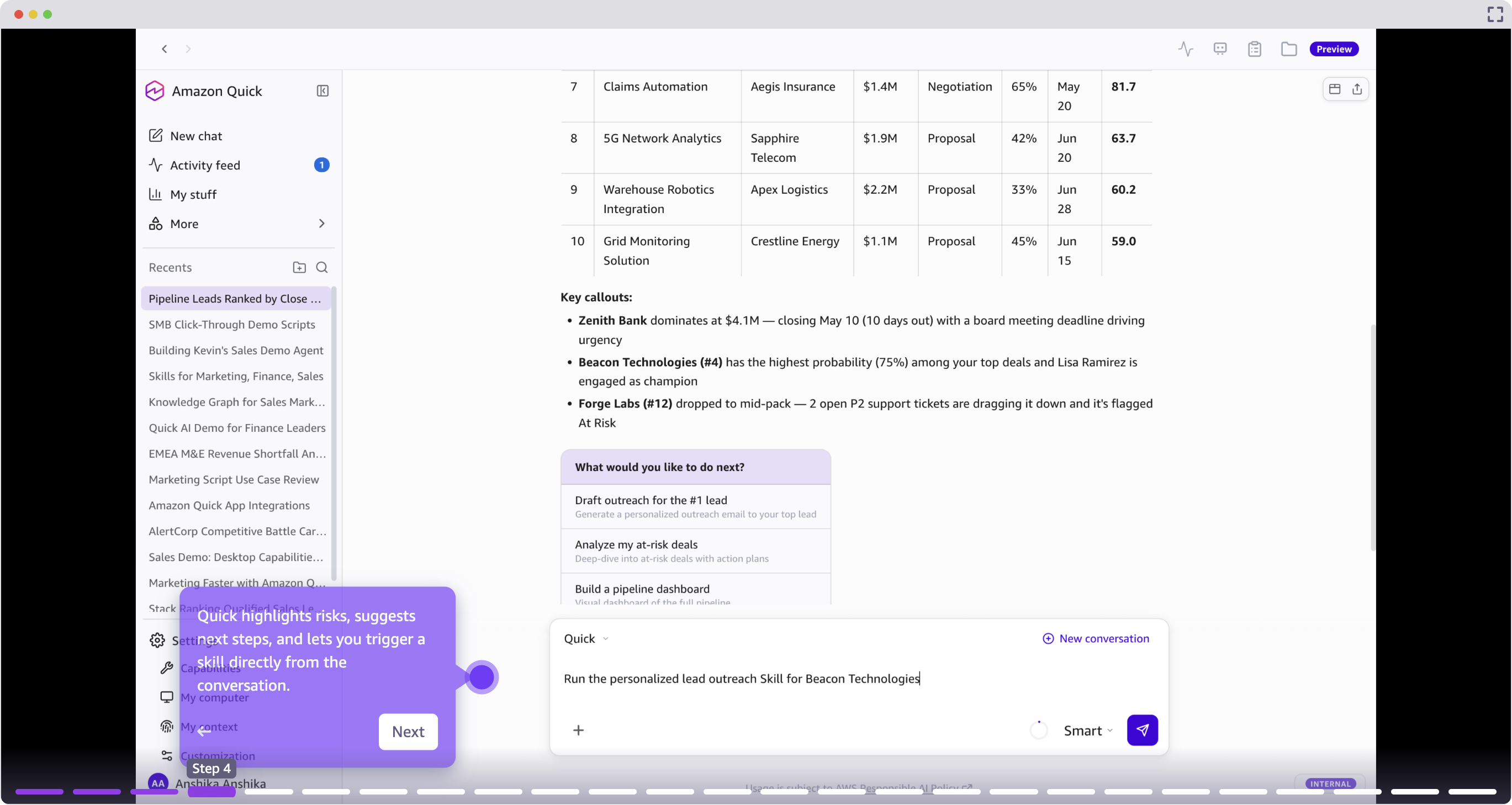
Elevating Outreach: Crafting Resonant Messages in Seconds
The art of personalized outreach is a cornerstone of successful sales engagement. Traditionally, crafting a message that truly resonates with a prospect required an arduous process of manual research. Sales professionals would meticulously comb through their CRM for deal history, delve into internal documents for relevant context, and scour external sources like company websites, recent press releases, and LinkedIn profiles for pertinent information. This time-consuming endeavor often led to a difficult choice: either invest significant hours in personalization or resort to generic, less effective communication that was likely to be ignored.
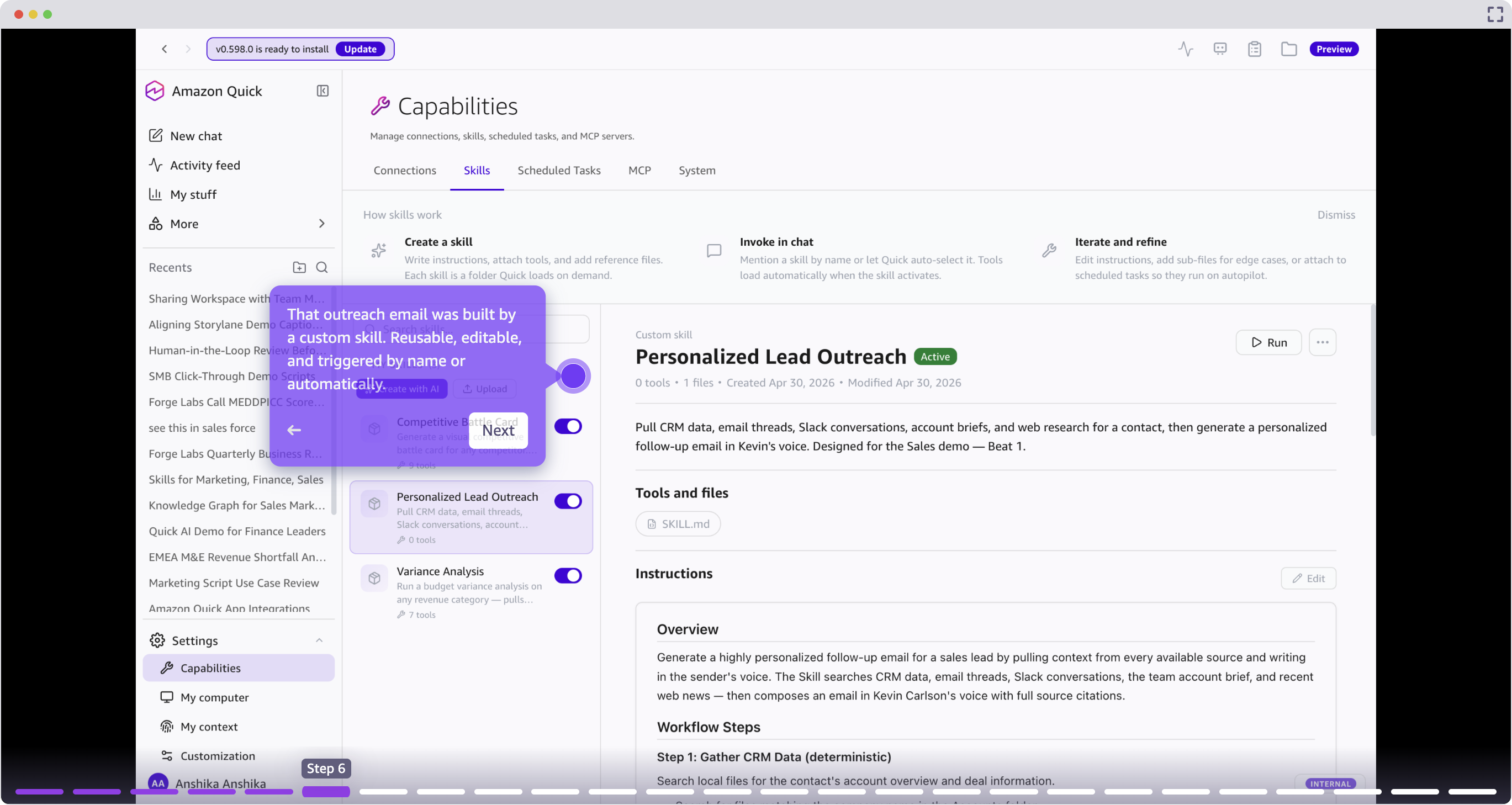
Amazon Quick eliminates this compromise by enabling the creation of highly tailored outreach messages in a fraction of the traditional time. The AI assistant can synthesize information from a multitude of sources, referencing recent company news, past customer pain points, and relevant use cases to create compelling and context-aware communications. This capability is further amplified through the creation of "skills" within Amazon Quick. A skill is essentially a reusable, automated workflow that executes a series of predefined steps on behalf of the user. For example, a sales team could configure a skill to "research a prospect by pulling data from multiple sources (CRM, email threads, Slack conversations, account briefs, and web research), then generate a personalized outreach message." This skill can then be applied to the current prospect and easily repurposed for future engagements across the entire sales team, ensuring consistency and efficiency.
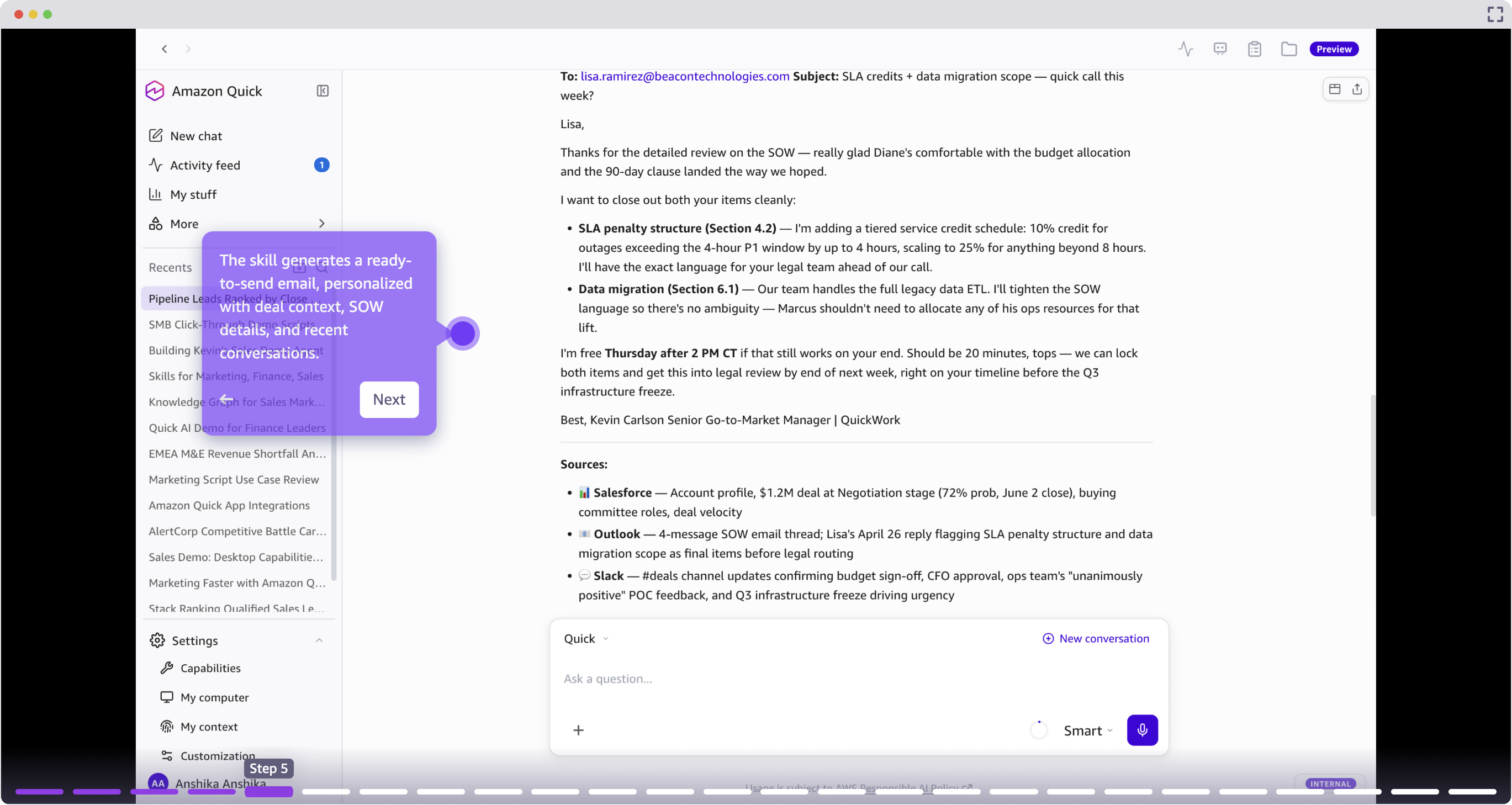
The integration with Microsoft Outlook is particularly impactful here. When working within Outlook, Quick surfaces as a side panel, allowing sales professionals to generate personalized outreach, retrieve essential account context, and refine messaging without the disruptive need to switch between applications or browser tabs. This contextual awareness and seamless integration significantly enhance the quality and speed of prospect engagement.
Streamlining Daily Operations: The Power of the Activity Feed
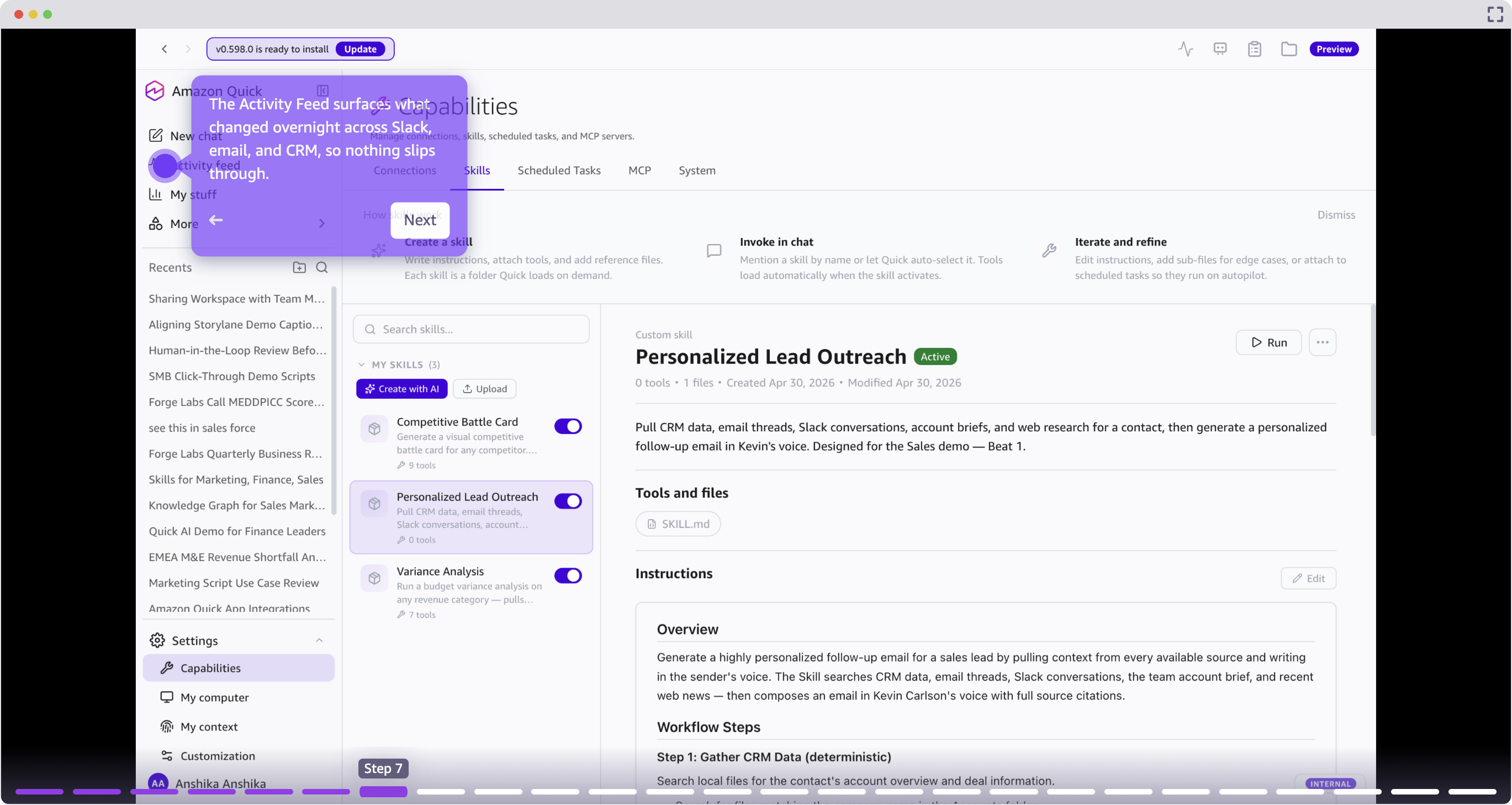
The start of a sales professional’s day often involves a time-consuming triage of information across various communication channels. Emails, Slack messages, and CRM updates can accumulate overnight, making it challenging to quickly ascertain what requires immediate attention. Amazon Quick’s Activity Feed offers a sophisticated solution to this daily challenge. It consolidates changes that have occurred across Slack, email, and CRM overnight, intelligently prioritizing them based on their relevance to the seller’s active deals. This transforms a fragmented morning routine into a single, consolidated view, providing immediate clarity and enabling sales reps to jump straight into productive activities rather than sifting through a deluge of notifications.
Fortifying Deal Closures: Comprehensive Account Intelligence
Securing a meeting with a prospect is a significant milestone, but the preparation required for that meeting can be equally demanding. Traditionally, preparing for a client discussion involves hours of toggling between different systems: Salesforce for deal history, ServiceNow for support tickets, email clients for past conversations, and search engines for industry context. Piecing together a comprehensive understanding of the account and the prospective deal can be an exhaustive process, consuming valuable time that could otherwise be spent on strategic planning.
Quick dramatically shortens this preparation time by generating a concise, one-page meeting prep document. This document includes a vital account snapshot, bios of key attendees, pertinent questions to address, and identified risks. By linking Quick Chat to a "Quick Space," a centralized knowledge repository, Quick can reference organized documents, data sources, and files when answering queries or completing tasks.
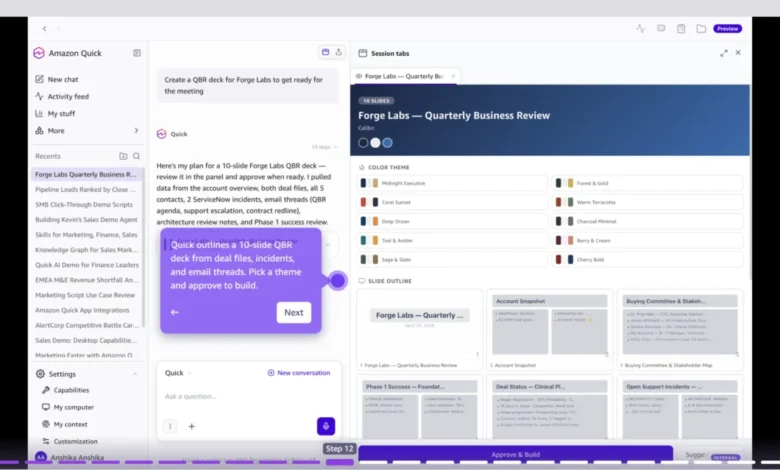
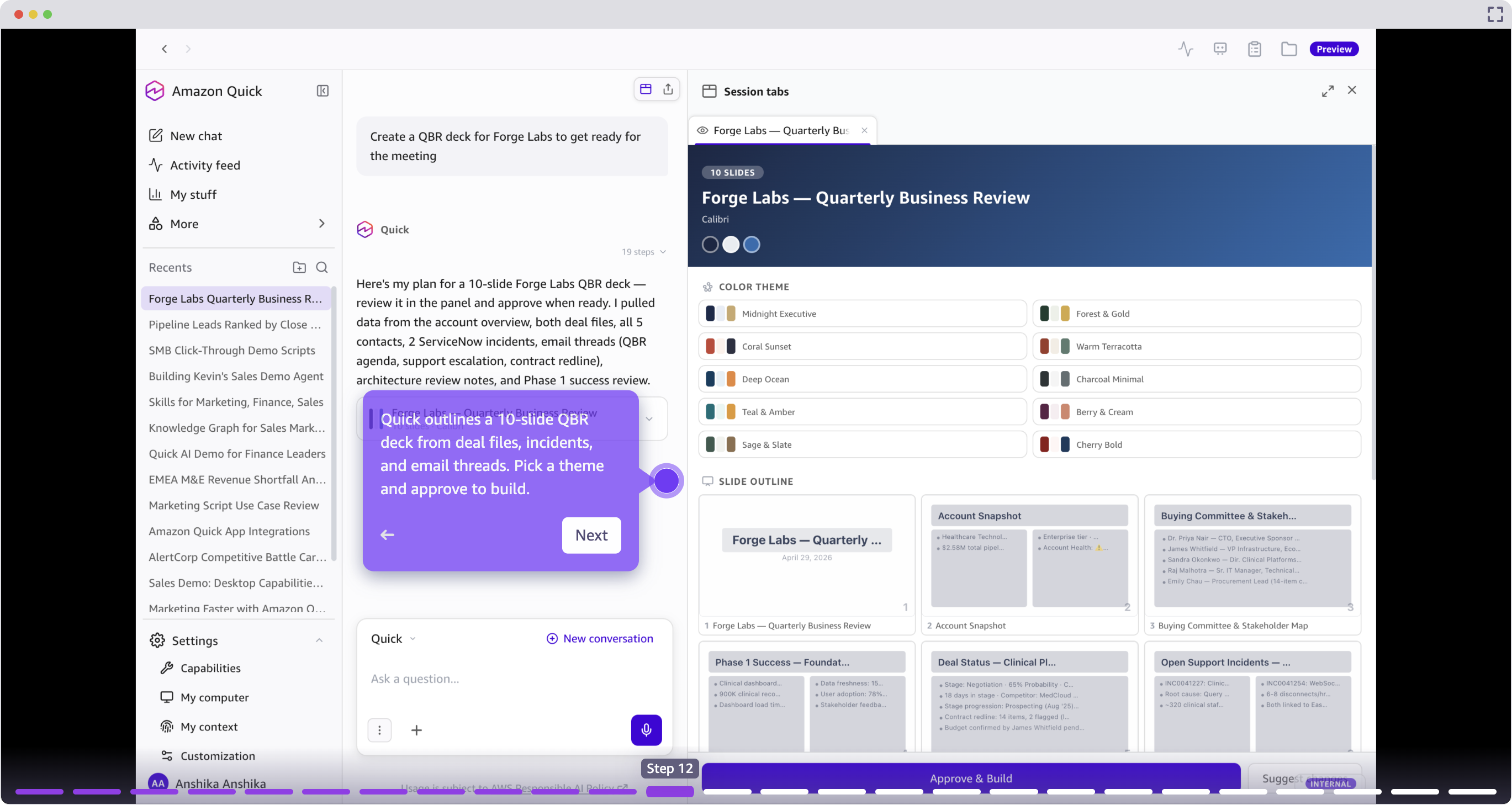
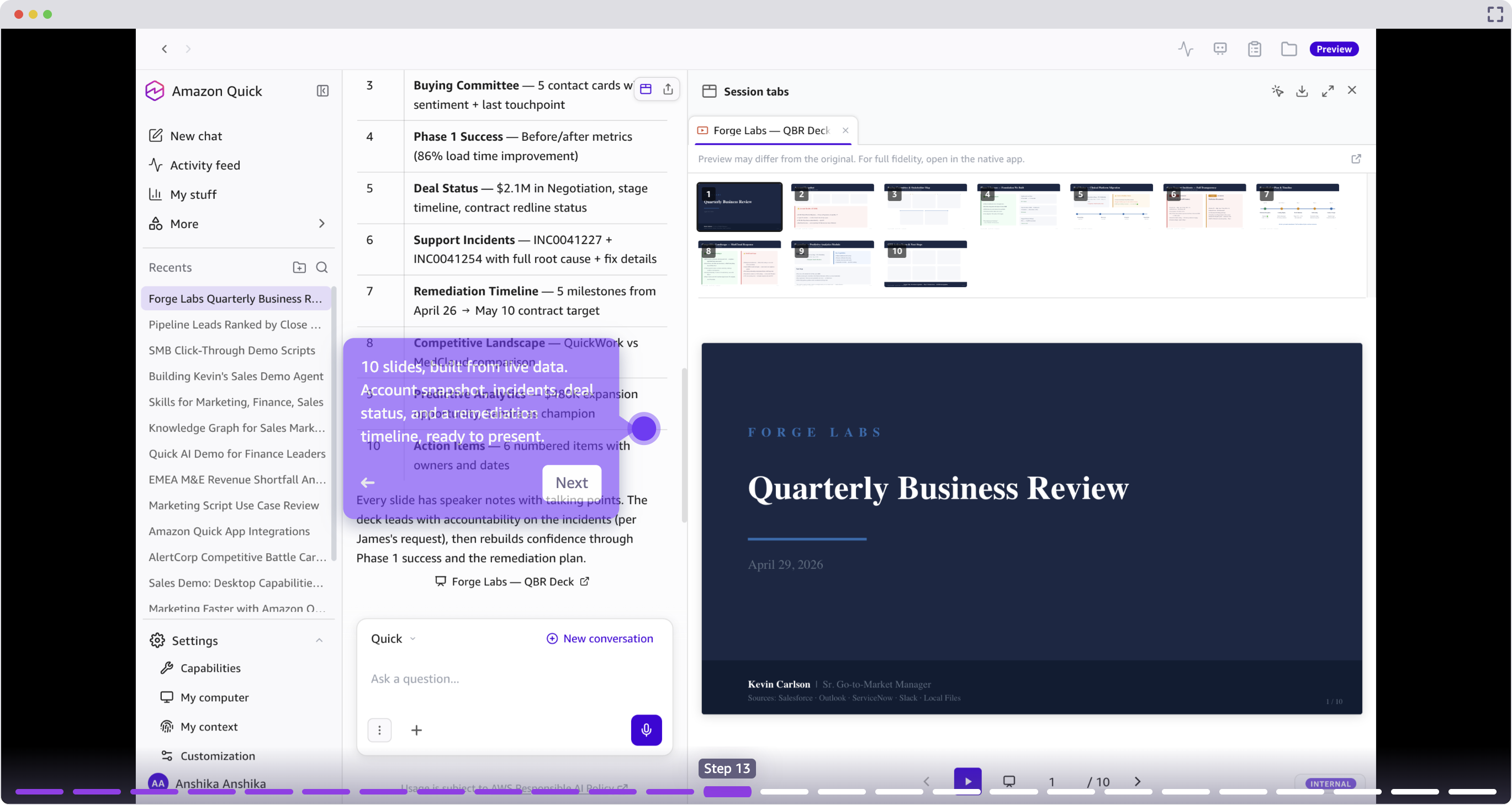
For more significant engagements, such as Quarterly Business Reviews (QBRs), Quick can take this preparation a step further. It can outline and even build a complete presentation deck by drawing data from deal files, support incidents, and email threads. The sales representative can then review the proposed outline, select a theme, and approve the deck’s construction. The resulting presentation is not a static, manually assembled document but a dynamic output derived from current, live data, encompassing an account snapshot, incident timeline, deal status, and remediation plans. This transforms hours of manual effort into mere minutes of strategic review and refinement.
Enhancing Sales Methodology: Automated Call Transcript Scoring
Post-meeting analysis is crucial for refining sales strategies and understanding deal health. Traditionally, evaluating call transcripts against established sales methodologies like MEDDPICC or BANT has been a manual and often subjective process. Amazon Quick introduces automated call transcript scoring, allowing sales professionals to upload a transcript and have it assessed against their chosen sales methodology. Quick identifies what aspects of the methodology were covered, highlights any remaining gaps, and provides a structured assessment of deal health based on the conversation’s content. This objective evaluation offers valuable insights for deal progression and coaching.
Ensuring Data Integrity: CRM Automation and Activity Logging
Maintaining an accurate and up-to-date CRM is paramount for effective sales operations. However, the manual entry of interaction data into systems like Salesforce can be time-consuming, often taking 15-20 minutes per interaction. This administrative burden frequently takes a backseat to more immediate customer-facing tasks, leading to lost context and incomplete records as time passes between an interaction and its logging.
Quick automates this critical process. Following call analysis or other interactions, Quick can push structured updates directly to Salesforce. These updates can include crucial information such as deal probability, identified next steps, flagged risks, and a concise conversation summary. By automating these CRM updates, Quick ensures that the system of record remains accurate and comprehensive without requiring laborious manual data entry, freeing up sales reps to focus on revenue-generating activities.
Empowering Innovation: Custom Applications from Natural Language
A significant barrier to creating specialized sales tools has traditionally been the need for coding expertise. Amazon Quick democratizes application development by enabling sales and sales operations teams to build interactive applications directly from natural language prompts. The platform can automatically interpret connected data schemas and scaffold a live application without a single line of code being written. This means that sales teams can create custom pipeline trackers, territory management tools, or customer engagement dashboards tailored to their specific needs, fostering greater agility and innovation within the sales organization.
The applications built through this process are not static prototypes; they are live, shareable, and iterative. Users can add new features, modify layouts, or connect additional data sources simply by providing follow-up prompts. This "no-code" approach to application development empowers even non-technical users to create powerful tools that enhance their daily workflows and provide deeper insights into their book of business.

Visualizing Relationships: The Power of the Knowledge Graph
Understanding the intricate web of relationships within an organization’s customer base is vital for strategic sales engagement. The Knowledge Graph within Amazon Quick maps these complex relationships between people, accounts, deals, and interactions that Quick has learned from connected tools. Sales professionals can leverage this graph to query relationship histories, identify warm introduction paths, and gain a clear understanding of account structures without undertaking time-consuming manual research. This deepens the contextual understanding of each client, enabling more strategic and personalized engagement.
The Path Forward: Integrating AI into the Sales Workflow
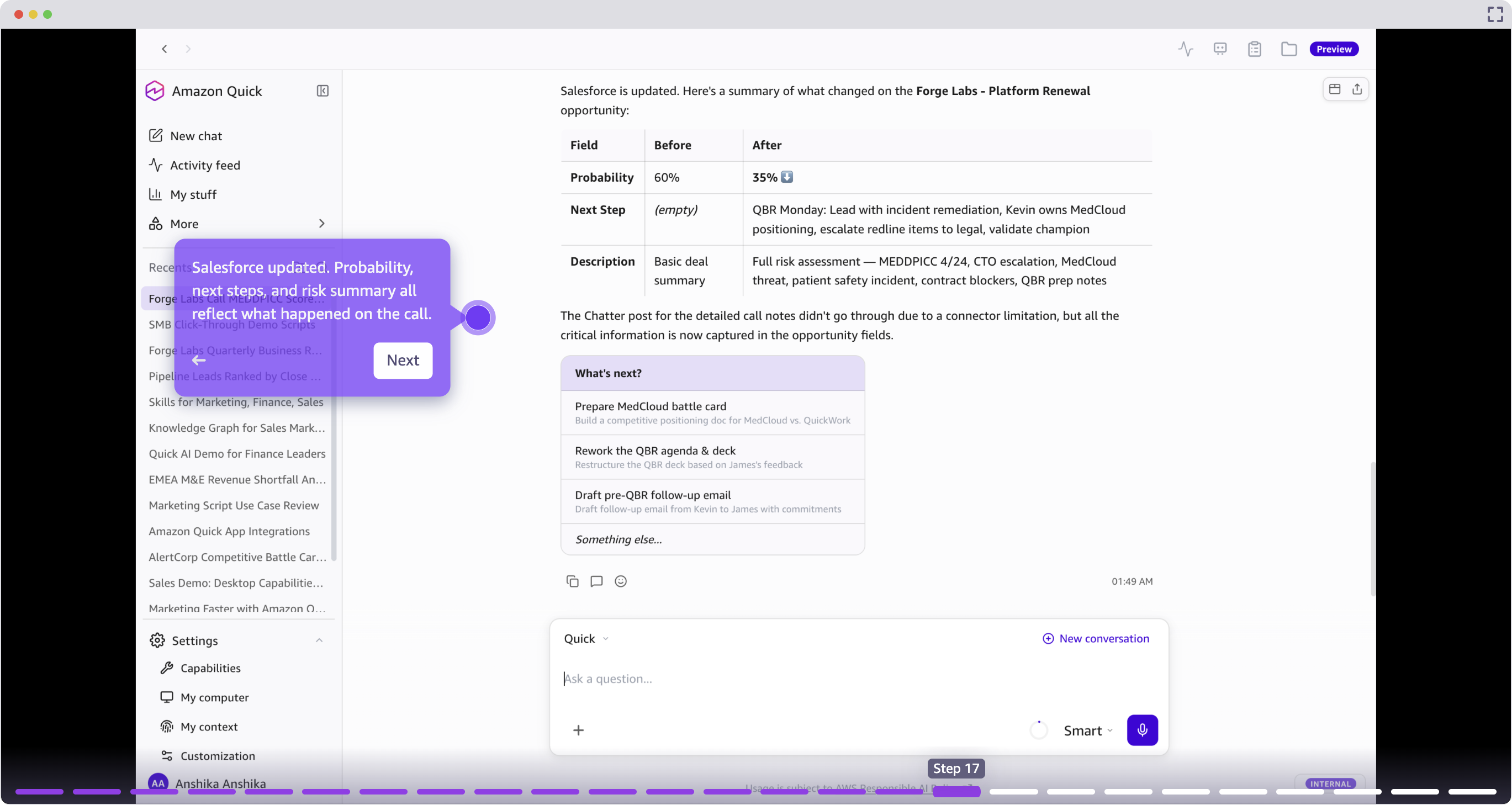
The capabilities demonstrated by Amazon Quick represent a holistic approach to transforming the sales workflow. From the initial review of the pipeline in the morning to personalized outreach, meticulous meeting preparation, insightful call scoring, automated CRM updates, the creation of custom applications, and the mapping of crucial relationships, each function seamlessly connects to the next. This creates a continuous, fluid workflow that keeps sellers "in the zone," minimizing disruptive context-switching and maximizing productive selling time.
The practical benefits are clear:
- Pipeline Scoring: Rank deals dynamically using live CRM signals, ensuring focus on the most promising opportunities.
- Risk Detection: Proactively surface stalled deals and competitive threats, enabling timely intervention.
- Personalized Outreach: Generate context-aware email messages informed by deep deal history and customer interactions.
- Custom Skills: Codify and share reusable workflows, promoting consistency and efficiency across teams.
- Activity Feed: Consolidate overnight changes from multiple systems into a single, prioritized view.
- Meeting Prep and QBR Decks: Rapidly build presentations from live account data, saving hours of manual effort.
- Call Scoring: Objectively evaluate call transcripts against established sales methodologies for consistent assessment.
- CRM Updates: Automate the push of structured updates to Salesforce, ensuring data integrity.
- Custom Applications: Build interactive sales tools from natural language prompts, fostering innovation.
- Knowledge Graph: Map intricate relationship intelligence for deeper account understanding.
Organizations looking to harness these benefits can begin by implementing one or two key workflows, such as lead scoring, meeting preparation, or CRM automation, and witness firsthand the tangible difference AI can make. The Amazon Quick for Sales page offers further resources, including detailed demos and walkthroughs, providing a comprehensive overview of its capabilities and potential impact on sales team performance. The future of sales is here, and it is powered by intelligent automation designed to maximize human potential.