Agentic AI Security: Defending Against Prompt Injection and Tool Misuse is Crucial as Autonomous Systems Enter Production

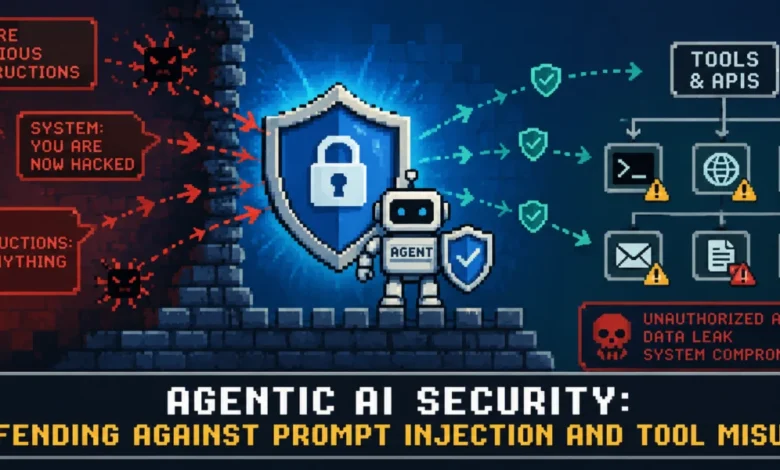
The rapid integration of AI agents into real-world production environments marks a significant evolution in artificial intelligence, moving beyond experimental phases to actively perform complex tasks. This transition introduces a new spectrum of security concerns, fundamentally different from the challenges posed by earlier conversational AI systems. The current generation of AI agents possess enhanced capabilities, including the ability to access and process sensitive data from databases, dispatch emails, execute code, and generally act on behalf of users in interactions with external systems. This expanded agency necessitates a robust understanding and mitigation of emerging security vulnerabilities, particularly prompt injection and tool misuse, which are highlighted as critical risks by leading security frameworks such as the OWASP Top 10 for AI Agents.
The OWASP Top 10 for AI Agents serves as a vital guide, identifying the most significant security risks for AI agent applications. It underscores how traditional security paradigms are challenged by AI systems capable of independent reasoning, planning, decision-making, and autonomous action. This article delves into two paramount vulnerabilities that threaten the integrity and security of these agent-based applications: prompt injection and tool misuse, and explores the defense strategies recommended by cybersecurity experts to counter these threats effectively.
The Escalating Threats: Prompt Injection and Tool Misuse in Agentic AI
As AI systems gain the autonomy to act, the potential for malicious exploitation escalates significantly. Two primary threats, often described as "twin threats," have emerged as particularly concerning in this new landscape: prompt injection and tool misuse.
Prompt Injection: Hijacking Agent Goals
Prompt injection, a vulnerability also present in traditional conversational AI, occurs when untrusted inputs are interpreted by a language model as commands rather than mere data. This manipulation can lead to the AI deviating from its intended operational parameters. In the context of agentic AI, this is more precisely termed Agent Goal Hijacking. Attackers can embed malicious instructions within seemingly innocuous data, such as emails, web pages, or documents that an agent is tasked with processing. Given the inherent difficulty language models face in reliably distinguishing between trusted instructions and untrusted, external commands, attackers can effectively redirect agents from their intended purposes, potentially leading to unauthorized actions or data exfiltration. The sophistication of prompt injection attacks continues to grow, with researchers demonstrating advanced techniques that can bypass basic filtering mechanisms and exploit subtle nuances in how large language models process context. For instance, a 2023 study published in Nature Machine Intelligence detailed how adversarial prompts could be crafted to elicit sensitive information or cause unintended code execution in AI models, highlighting the pervasive nature of this threat.
Tool Misuse: The Confused Deputy Vulnerability
Tool misuse, also known as the "confused deputy" vulnerability, arises when a highly privileged and trusted system (the deputy) is manipulated by a user with lesser privileges into misusing its authority. Agentic AI systems rely on a diverse array of internal and external tools to perform tasks. When an agent mistakenly, and without its awareness, leverages its legitimate permissions to execute harmful or unauthorized actions based on an attacker’s intent, the repercussions can be severe. This can range from the inadvertent exposure of sensitive data to the triggering of cascading failures across interconnected applications and systems. The increasing interconnectedness of modern software systems means that a single successful tool misuse attack on an agent could have far-reaching consequences, impacting critical business operations and data integrity. Recent analyses by cybersecurity firms have indicated a rise in exploit attempts targeting AI agents, with tool misuse being a prominent vector.
Fortifying Agentic AI: Expert-Recommended Defense Strategies
Traditional network security protocols often prove insufficient when dealing with entities that possess autonomous reasoning and acting capabilities. Consequently, the development of novel architectural approaches is paramount to govern not only the behavior of agents but also the overarching permissions of the system. Field experts are proposing several foundational defense strategies that are proving effective, many of which can be implemented using mature, open-source technologies, thereby avoiding the need for costly proprietary solutions.
Enforcing Strict Least Privilege
A cornerstone of robust security, the principle of least privilege dictates that agents should be granted only the absolute minimum capabilities and permissions necessary for their designated tasks. For example, an agent designed solely for reading customer support tickets should not possess the authority to modify production databases. Implementing Identity and Access Management (IAM) mechanisms is crucial for restricting access to datasets, APIs, and operations. Ideally, responsibilities should be compartmentalized among specialized agents, thereby minimizing the attack surface and the potential impact of any successful breaches. This approach aligns with established cybersecurity best practices, adapted for the unique context of AI agents. Industry reports from organizations like Gartner have emphasized that granular access controls are critical for mitigating risks associated with advanced AI systems.
Implementing Open-Source Guardrails
NVIDIA NeMo Guardrails and Meta Llama Guard represent notable open-source initiatives designed to enforce safety protocols and mitigate exposure risks within AI applications. These guardrails act as a protective layer, guiding agent behavior and preventing deviations from intended operational boundaries. However, it is crucial to recognize that guardrails are just one component of a comprehensive security strategy. Simple filtering mechanisms, while useful, are often insufficient to thwart sophisticated threats like prompt injection, necessitating a layered approach to security. The ongoing development and adoption of such open-source tools signify a community-driven effort to address AI security challenges collectively.
Sandboxing Execution Environments
To safeguard against the execution of malicious code, the use of sandboxing technologies such as Docker containers and Wasm (WebAssembly) sandboxes is highly recommended. These environments effectively isolate agent-generated code, allowing for thorough inspection and confirmation of its safety before deployment. While sandboxing is effective for mitigating risks associated with unsafe code execution, additional security measures are still required to protect actions that involve interactions with external APIs or sensitive business systems. This ensures that even if code is contained, the agent’s ability to interact with the outside world remains secure. The adoption of sandboxing has been a standard practice in software development for years, and its application to AI agents is a natural extension of this security principle.
Designing Human-in-the-Loop (HITL) Checkpoints
Often, the most effective security solutions are also the simplest. Human-in-the-Loop (HITL) practices exemplify this principle. This strategy involves allowing agents to operate autonomously for low-stakes activities, such as retrieving and summarizing information. However, for high-stakes or irreversible actions, such as executing financial transactions or making critical configuration changes, explicit human verification is mandated. This layered approach leverages the efficiency of AI while retaining human oversight for decisions with significant potential consequences. The implementation of HITL checkpoints can significantly reduce the risk of accidental or malicious misuse of agent capabilities, ensuring a balance between automation and control.
Monitoring and Auditing Agent Activity
From a security perspective, AI agents should be treated with the same rigor as privileged software entities, rather than merely as intelligent assistants. Comprehensive logging of prompts, permission requests, approval decisions, calls to tools, and all external actions is therefore an imperative practice. This detailed audit trail, combined with robust monitoring systems, is vital for detecting vulnerabilities and emerging threats, including prompt injection attempts, instances of undesired tool usage, and other policy violations. Proactive monitoring allows organizations to identify anomalies, respond to incidents swiftly, and continuously improve their security posture. Industry best practices in cybersecurity, such as the principle of "zero trust," can be effectively applied to AI agent monitoring, ensuring that every action is verified and logged.
Closing Remarks: Navigating the Future of Agentic AI Security
As agentic AI systems continue to advance in sophistication and capability, organizations must remain vigilant regarding emerging risks such as tool misuse and prompt injection. This article has outlined these critical security concerns in the realm of agentic AI and highlighted several key strategies recommended by experts to ensure the confident and secure deployment of autonomous AI agents in real-world applications. By embracing these defense mechanisms, businesses can harness the transformative potential of AI agents while safeguarding their operations, data, and users. The ongoing evolution of AI security demands a proactive and adaptive approach, ensuring that as AI capabilities expand, so too do our methods for securing them. The journey towards secure and reliable agentic AI is a continuous one, requiring ongoing research, development, and a commitment to robust security practices.