Mastering the Omnichannel Matrix: Why Modern Retailers Must Align Email and SMS Strategy

The modern retail checkout has evolved far beyond a simple transactional exchange of currency for goods, increasingly functioning as a sophisticated data-acquisition portal. When a consumer inputs a mobile telephone number or an email address at a digital or physical point of sale, they are not merely facilitating a receipt delivery; they are granting access to their most private digital environments. While an email inbox functions as a public corridor where commercial correspondence mingles effortlessly with personal and administrative mail, a direct-to-mobile phone number operates with the intimacy of a residential front room—a notification pinging on a device that rests beside a pillow at night or interrupts a professional meeting midday.
Historically, corporate founders and digital marketing executives have treated these two distinct communication vectors interchangeably. Strategy often defaults to a binary approach: deploying identical messaging simultaneously across both channels, or conversely, investing heavily in email due to its low marginal cost while allowing mobile messaging infrastructure to languish. Alternatively, some enterprises adopt SMS marketing reactively, driven by peer competition and high initial open rates, without establishing a cohesive framework. Industry analysts note that operating either channel in complete isolation results in substantial leakage of potential revenue and brand equity. Consequently, contemporary e-commerce architectures are shifting toward integrated omnichannel paradigms designed to leverage the distinct structural advantages of both mediums.
Structural Dynamics of Email Versus Short Message Service
Understanding the strategic imperative of omnichannel integration requires an examination of the structural mechanics inherent to each medium. Email remains the cornerstone of comprehensive brand storytelling. It provides expansive visual and textual architecture, allowing enterprises to articulate complex narratives, showcase product catalogues within rich contextual environments, and segment audiences meticulously based on historical purchase data. Furthermore, the operational cost per acquisition via email remains exceptionally low.
However, email suffers from inherent latency. A promotional campaign typically arrives in an inbox already crowded with dozens of unread notifications, rendering its delivery time unpredictable. A consumer may review the correspondence immediately, later that evening, or potentially never.
In sharp contrast, Short Message Service (SMS) exhibits a radically compressed temporal profile. Industry benchmarks indicate that text messages are frequently opened within minutes—and often seconds—of receipt, successfully cutting through competing digital noise. Nevertheless, SMS imposes severe operational constraints. Message length is strictly limited, precluding detailed explanations or nuanced product justification. Additionally, the marginal cost per send is significantly higher than email. Aggressive or indiscriminate text deployment rapidly degrades consumer goodwill, transforming an effective welcome touchpoint into an intrusive irritant and triggering swift permanent opt-outs.
Establishing the Chronology of Customer Engagement
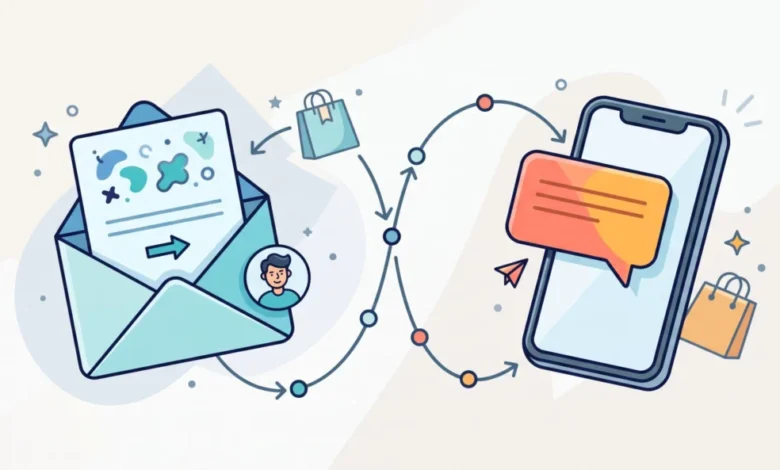
To mitigate the friction of dual-channel deployment, sophisticated marketing operations have moved away from parallel broadcasting—the practice of firing simultaneous emails and text messages upon a single trigger event—and toward sequential choreography. Simultaneous deployment yields diminishing returns, essentially expending two distinct communication assets to achieve a single operational outcome.
Data-driven automated workflows now govern the modern consumer lifecycle, establishing a precise chronological timeline from initial acquisition to long-term retention:
-
Day Zero: Acquisition and Immediate Introduction
Upon initial subscription or account creation, the primary channel engaged is email. This medium provides the foundational brand introduction, articulating corporate identity, value propositions, and introductory incentives without immediate urgency. -
Day One to Two: Behavioral Nudging
If the recipient fails to complete a transaction following the initial email sequence, a carefully timed, singular SMS notification is deployed. This acts as a gentle, non-invasive reminder, capitalizing on lingering purchase intent before it dissipates. -
Intermediate Touchpoints: Inventory and Fulfillment Management
Back-in-stock notifications frequently bypass email entirely, with SMS serving as the primary lead channel. This honors explicit consumer requests for immediate inventory alerts. Conversely, post-purchase communication is bifurcated: immediate dispatch confirmations and delivery milestones are transmitted via SMS for instant reassurance, while comprehensive tracking ledgers and logistics details reside within an accessible email receipt. -
Seasonal Surge: Black Friday and Cyber Monday (BFCM)
During high-intensity retail windows, communication cadences naturally accelerate. Email shoulders the heavy burden of broad campaign announcements, editorial storytelling, and comprehensive promotional catalogues. SMS is strictly preserved for high-value, time-critical milestones—such as flash sale openings or final-hour expiration warnings—safeguarding accumulated consumer goodwill for critical conversion intervals.
Economic Implications and Industry Analysis
The financial ramifications of mismanaged channel frequency are severe. While consumer tolerance for email saturation remains high—given that unread or deleted messages exact minimal emotional friction—mobile intrusion incurs immediate penalties. A late-night notification or an excessive weekly text frequency routinely provokes consumer irritation, resulting in permanent SMS subscription revocation. Once a consumer opts out of mobile messaging, brands permanently forfeit their most reliable conduit for time-sensitive conversion.
Consequently, marketing economists advocate for stringent restraint as a core strategic pillar. Maintaining a smaller, highly engaged mobile audience that retains implicit trust yields superior long-term lifetime value (LTV) compared to an expansive, fatigued list characterized by high churn rates. Industry platforms, such as Omnisend and comparable omnichannel automation suites, have responded to these market demands by consolidating email, SMS, and web push notifications into unified operational dashboards. This integration allows automated workflows—such as welcome series and abandoned cart recoveries—to execute seamless handoffs between channels within a singular sequence, preventing platform silos and ensuring unified behavioral segmentation.
Strategic Implementation for Emerging Enterprises
For emerging brands and resource-constrained founders, establishing a comprehensive omnichannel matrix can present formidable operational hurdles. Market analysts recommend a phased implementation strategy, prioritizing foundational automation flows that generate the highest immediate return on investment:
- The Welcome Flow: Designed to capture consumer interest at peak engagement, establishing long-term brand affinity.
- The Abandoned Cart Sequence: Engineered to recapture revenue from high-intent consumers whose transactions were interrupted prior to completion.
Industry standards dictate that these initial sequences should be constructed utilizing a primary email framework augmented by a single, strategic SMS backup. Once these automated flows demonstrate consistent profitability, secondary triggers—such as back-in-stock alerts and targeted cross-sell campaigns—can be progressively integrated.
Conclusion and Future Outlook
Ultimately, modern omnichannel marketing is defined by communicative discipline rather than messaging volume. By systematically categorizing communications based on temporal urgency—reserving email for enduring content that benefits from contemplative reading, and restricting SMS to time-sensitive alerts that demand immediate action—enterprises can harmonize consumer touchpoints. As digital privacy regulations tighten and consumer tolerance for digital noise diminishes, the brands that successfully navigate this delicate balance will secure sustained engagement within the most personal screens in the modern marketplace.