Decoding Strategies and Output Control in Inference Engines: A Technical Analysis of Runtime Costs


The rapid proliferation of Large Language Models (LLMs) in enterprise production environments has shifted the focus from merely achieving high-quality text generation to optimizing the underlying inference infrastructure. While previous discourse centered on the theoretical mechanics of greedy decoding, top-k sampling, and beam search, the operational reality of these algorithms is defined by their tangible impact on computational resources, memory bandwidth, and latency. By utilizing the vLLM serving engine, developers and engineers can quantify the hidden costs associated with different decoding policies, moving beyond algorithm selection to infrastructure efficiency.
At its core, an inference engine is tasked with a continuous loop of matrix multiplications followed by a token selection process. When a model generates a response, it performs a forward pass to compute logits—raw scores for every token in the vocabulary. The decoding policy then intervenes to select the next token based on these logits. This seemingly minor step is the primary driver of variance in inference cost. A decoding policy can add significant latency after every model call, spawn multiple concurrent sequences for a single user request, prolong the lifecycle of KV (Key-Value) cache blocks, or necessitate unique state management for every individual request.
The Mechanics of Decoding and Resource Allocation
To understand these costs, one must first look at the vLLM architecture, which decouples model execution from the sampling logic. When a user sends a request, the LLM object loads the model, while SamplingParams dictates the post-processing of logits. In a standard greedy decoding scenario, the engine selects the highest-probability token. This is the baseline for computational efficiency. However, once users introduce sampling techniques like temperature scaling or nucleus (top-p) sampling, the engine must perform additional operations: rescaling logits, calculating probability distributions, and performing stochastic sampling.
While the transformer forward pass is the most computationally expensive part of the process, the accumulation of sampling overhead is not trivial. In high-throughput serving environments, where thousands of requests are processed per second, the cumulative cost of these per-token operations can lead to noticeable degradation in tokens-per-second (TPS). Furthermore, techniques like repetition penalties—which modify logits based on previously generated tokens—require the engine to maintain a rolling window of history for every active sequence, increasing the memory footprint and CPU utilization per step.
Parallel Sampling and Beam Search: The Memory Multiplier
A critical distinction exists between simple sampling and more complex multi-output strategies. Using the n parameter in vLLM allows a single prompt to generate multiple independent continuations. While this provides higher variance and creative diversity, it effectively multiplies the computational and memory requirements. If a request generates four parallel sequences, the engine must manage four separate KV caches.
The KV cache is the memory consumed by the model to store the keys and values of previous tokens, allowing the model to avoid recomputing the entire history for every new token. When sequences diverge, the cache becomes private to each sequence. Consequently, parallel sampling can consume four times the memory of a single-sequence request once the continuations deviate significantly.
Beam search, by contrast, introduces a more complex state-management challenge. Unlike parallel sampling, where outputs are independent, beam search treats continuations as competing hypotheses. At each step, the engine must rank these hypotheses based on cumulative log-likelihood and prune the lower-performing ones. This cross-beam ranking process is significantly more expensive than independent sampling. It requires constant synchronization of scores and sequence state, adding a layer of control-flow latency that can bottleneck the GPU if the beam width is set too high.
The Impact of Stop Conditions and Structured Output
The duration of a request is the most significant factor in its total cost. Every additional token generated requires another model forward pass and more memory in the KV cache. Consequently, stopping rules—such as max_tokens, min_tokens, and string-based termination—are not merely user preferences; they are load-management tools.
Setting a high max_tokens limit reserves potential capacity that may or may not be used. If a model reaches an end-of-sequence (EOS) token early, the engine can reclaim those resources for other requests in the batch. However, when users implement complex stop conditions, such as searching for specific substrings, the engine must perform text-matching operations on every generated token. This adds a post-processing delay to each step.
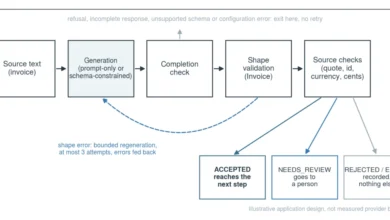
Structured output, such as forcing a model to return valid JSON, introduces a state-machine overhead. In this scenario, the engine masks invalid logits before selection to ensure the output conforms to a provided schema. While this ensures the reliability of the data for downstream applications, it forces the engine to maintain a constraint state for every request. If a JSON schema is complex, the state machine must compute valid token sets for every step, adding to the per-token latency. While this is computationally more expensive than unconstrained generation, it provides significant business value by reducing the need for post-inference parsing or error-correction retries.
Chronology of Inference Scaling
The evolution of inference engines has followed a distinct timeline:
- Initial Phase (Pre-2022): Basic inference focused on batch size and raw latency. Decoding policies were largely static.
- The Throughput Era (2023): The introduction of PagedAttention and vLLM revolutionized KV cache management, allowing for higher batch sizes by treating memory like a virtual memory system.
- The Efficiency Era (2024-Present): With the shift toward diverse decoding strategies and structured outputs, the industry is now focused on "control-plane" overhead—the cost of managing the logic that governs the model’s behavior rather than the model weights themselves.
Broader Implications for Infrastructure Planning
For organizations deploying LLMs at scale, the choice of decoding strategy should be treated as a configuration that impacts the total cost of ownership (TCO). A team that defaults to high-width beam search for every query will inevitably face higher memory pressure and lower concurrency limits than a team utilizing greedy or simple top-p sampling.
The performance of an inference engine is not a static number found in a benchmark report; it is a dynamic result of the interaction between the workload’s decoding complexity and the hardware’s capacity. When designing systems, engineers must weigh the requirement for output diversity (e.g., beam search) against the cost of memory fragmentation and increased latency.
As the industry moves toward more sophisticated agents that require structured outputs and iterative reasoning, the "cost per token" will increasingly be defined by the efficiency of these logic-heavy sampling wrappers. The vLLM engine, with its ability to profile these operations using standard tools like the PyTorch Profiler, provides a necessary lens for developers to inspect the memory and computational footprints of their specific configurations.
Ultimately, the most efficient inference system is one that aligns its decoding policy with the actual requirements of the application. By stripping away unnecessary beam widths, optimizing stop conditions, and understanding the memory impact of parallel sampling, developers can maximize the utility of their GPU clusters. In an environment where compute resources remain a constrained and expensive commodity, the granular control of decoding strategies represents the next frontier in AI optimization.