Unfinished Thoughts From the Podcast: Ten Critical Shifts Redefining the Artificial Intelligence Economy and Enterprise Software


The artificial intelligence landscape is undergoing a structural transformation that extends far beyond incremental software updates, fundamentally altering the economics of global enterprise operations, workforce deployment, and venture capital investment strategies. During a recent recording of the industry-leading weekly podcast featuring hosts Harry Stebbings and Rory O’Driscoll, dense pacing and time constraints left several critical industry developments undiscussed. These unaddressed talking points—ranging from unprecedented labor efficiency metrics at emerging artificial intelligence firms to systemic cybersecurity vulnerabilities and shifting small-and-medium-business purchasing behaviors—illustrate a broader, silent displacement occurring across the technology sector. Rather than executing loud, public platform migrations, modern enterprises are quietly bypassing legacy software vendors in favor of autonomous agents, fundamentally reshaping how value, labor, and capital are distributed in the digital economy.
Historic Labor Efficiency and the Anthropics Valuation Paradox
A primary point of discussion centers on the shifting relationship between corporate valuation, revenue generation, and headcount. Historical milestones in the technology sector have long been defined by massive labor expansion alongside revenue growth. When historical giants like Google and Meta reached the $100 billion annual revenue threshold, their respective workforces stood at approximately 81,000 and 71,000 employees. Projections for foundational artificial intelligence leader Anthropic indicate the enterprise is on a trajectory to reach comparable revenue milestones with a workforce numbering fewer than 6,000 employees.
This staggering disparity—operating with roughly one-twelfth of the human capital of previous technological eras—signals a permanent compression of go-to-market and operational teams. While industry skeptics argue that traditional service firms and non-tech enterprises cannot operate under such extreme labor ratios due to the persistent costs of human oversight, market dynamics suggest a different reality. Companies do not necessarily need to operate identically to Anthropic; they simply must compete against agile, artificial intelligence-native competitors whose go-to-market teams are up to 90 percent leaner than traditional counterparts.
The economic flip side of this hyper-efficiency is extraordinary value concentration. When massive enterprise revenues are divided among a fraction of the traditional headcount, employee compensation packages escalate dramatically. Early projections suggest median employee payouts during initial public offerings could reach unprecedented figures, creating an elite tier of highly compensated professionals while drastically reducing total job creation. Consequently, forward-looking enterprise planning must abandon legacy organizational charts built by pre-artificial intelligence competitors, instead adopting a "minimal viable headcount" model that justifies every single human hire against autonomous capabilities.
Venture Capital Liquidation Preferences and M&A Backstops
The venture capital ecosystem is facing a parallel reckoning regarding exit strategies and market liquidity. For the past two years, the early-stage artificial intelligence market operated with an unspoken, highly reliable structural backstop: major hardware and infrastructure titans, spearheaded by Nvidia and strategic software consolidators like Salesforce, routinely stepped in to fund subsequent rounds, acquire struggling infrastructure plays, or absorb high-burn research teams. High-profile entities such as Reflection, Poolside, and Hugging Face navigated turbulent capital markets under the comforting assumption that liquidation preferences offered a virtually risk-free safety net for investors.
However, shifting executive leadership and evolving macroeconomic pressures threaten to remove these reliable buyers from the board. With prolonged executive transitions and strategic shifts among major enterprise buyers, the appetite for acquiring pre-revenue or high-burn artificial intelligence startups at $15 billion to $17 billion valuations is waning significantly. Recent admissions from entities like Poolside—which conceded it pursued acquisition paths primarily due to insurmountable capital-raising gaps in the $10 billion to $20 billion range—illustrate the fragility of relying on corporate bailouts.
Financial analysts emphasize that a liquidation preference is only as valuable as the actual market demand for the underlying corporate assets. If primary strategic acquirers pull back from aggressive acquisition sprees, startup founders and venture capitalists must urgently stress-test their financial models, recalculating exit math under the assumption that traditional corporate rescue mechanisms may no longer exist.
Founder-Led Turnarounds and the B2B Growth Ceiling
The technology sector has long championed the concept of "founder mode," pointing to high-profile executive returns—such as Eoghan McCabe’s return to Intercom—as definitive proof that original founders can successfully re-inject growth and vision into maturing software-as-a-service (SaaS) businesses. Intercom’s aggressive pivot toward agentic workflows and immediate rationalization of legacy pricing models certainly stabilized operations, ultimately leading to a high-profile acquisition by Salesforce that generated approximately $100 million in agent-driven revenue.
Despite these localized successes, broader market indicators question whether founder-led operational overhauls can permanently alter the growth trajectories of pre-artificial intelligence business-to-business (B2B) giants. Industry data reveals a persistent ceiling: no legacy B2B enterprise from the pre-artificial intelligence era has successfully re-accelerated organic revenue growth above a 30 percent annualized rate following a maturation plateau. While iconic founders possess the unique authority to make radical organizational decisions that professionalized management teams often avoid, the ultimate metric of success remains net new customer acquisition. For established platforms attempting to navigate the transition—such as HubSpot and Workday—true revitalization will not be measured by internal cultural shifts, but by whether quarterly net new customer additions can return to historical benchmarks.
The Disappearance of Transparency Metrics in Public Markets
A recurring symptom of underlying enterprise strain is the quiet removal of key performance indicators from public reporting disclosures. A prime example involves enterprise software giant Salesforce, which systematically ceased disclosing its total active customer count approximately four years prior to reaching its current $50 billion revenue scale. Market analysts note a consistent corporate pattern: whenever a publicly traded company stops reporting a foundational operational metric, it is almost invariably signaling underlying deceleration in that specific category.
While enterprises like HubSpot continue to transparently report net new customer additions—revealing a distinct decline from historical highs of 10,000 quarterly additions to guided projections falling below 5,000—companies that obscure customer counts often rely on aggressive multi-product bundling, sustained net revenue retention (NRR), and steady price increases to mask slowing logo acquisition. This expansion-heavy revenue model can successfully camouflage decelerating new customer acquisition for years, shielding underlying market stagnation from casual observers. Consequently, financial analysts and corporate governance boards must rigorously scrutinize historical reporting patterns, ensuring that foundational transparency metrics—such as net new logos—remain central internal governance benchmarks regardless of shifting public disclosure strategies.
Small Business Budget Shifts: From CRM to Autonomous Agents
Perhaps the most unanticipated shift in enterprise software consumption involves small-and-medium-sized businesses (SMBs) bypassing traditional customer relationship management (CRM) and work management infrastructure entirely. Historically, deploying enterprise software tools like HubSpot, Monday.com, or Salesforce was considered a non-negotiable operational prerequisite for any newly formed commercial enterprise. Today, however, budget-conscious SMBs are consciously deferring legacy software purchases, opting instead to manage initial operations via rudimentary tools like Google Sheets or ad-hoc data analysis platforms.
Crucially, this trend does not represent a temporary slowdown in software spending, but a fundamental reallocation of capital budgets. The primary operational bottleneck for an SMB is rarely the absence of a sophisticated Kanban project management board; rather, it is persistent operational friction, such as front-office staffing shortages and administrative overhead. Consequently, SMBs are aggressively deploying vertical and horizontal AI agents priced between $500 and $1,000 per month that completely replace human administrative roles—handling 24/7 client inquiries, appointment rescheduling, and billing operations autonomously. This dynamic proves that the operational budget has not vanished; rather, it has migrated permanently from software designed to assist human workers to autonomous software that entirely replaces the human labor function.
The Silent Displacement of Marketing Automation
The enterprise software replacement cycle is increasingly occurring through silent, unannounced attrition rather than competitive displacement. Historically, organizations routinely allocated substantial budgets—often exceeding $100,000 annually—toward complex marketing automation platforms designed to execute lead generation, campaign tracking, and client outreach. Today, advanced horizontal agentic systems are absorbing these core workflows natively.
Corporate teams are discovering that general-purpose autonomous agents can directly interface with internal CRM databases, curate targeted prospect lists, and execute complex outreach campaigns in a fraction of the time required by human marketing teams, and at a dramatically lower operational cost. When companies realize that an advanced AI assistant can execute 70 percent of a marketing automation platform’s core functions out of the box, they simply choose not to renew their legacy enterprise software contracts. Crucially, this displacement never appears in market share reports as a competitive win; it manifests solely as a missing annual renewal, reflecting a structural transition where human-centric software is quietly phased out without formal corporate announcements.
Overengineered Consumer Applications and Enterprise Scalability
The rapid evolution of consumer-facing artificial intelligence applications, such as the advanced workflow automation platform Muse, highlights a significant architectural overengineering trend. While mainstream media frequently categorizes such applications as narrow consumer utilities—such as automated restaurant reservation tools—underlying technical analyses reveal sophisticated execution architectures capable of handling complex multi-step digital workflows, persistent browser interactions, and autonomous task completion without constant human intervention.
Industry analysts observe that early enterprise adopters utilizing advanced horizontal agents to run dozens of concurrent daily workflows represent a preview of standard operational behavior for the broader workforce within two to three years. However, this high-frequency utilization introduces critical infrastructure challenges, particularly regarding runaway computational costs. While dominant technology conglomerates with massive capital reserves can subsidize continuous agentic operations, standalone software startups must rigorously model their pricing architectures and underlying infrastructure costs against extreme power users to ensure long-term unit economic viability.
The Consolidation of Vertical Agents into Horizontal Platforms
The artificial intelligence M&A landscape is rapidly shifting away from narrow, vertical application wrappers toward massive, consolidated horizontal platforms. Following significant strategic moves, such as OpenAI’s acquisition of specialized travel agent Adessia, industry insiders anticipate a wave of similar consolidation throughout the coming year. Specialized vertical assistants—once viewed as standalone venture-backed category winners—are increasingly being absorbed as native features within foundational horizontal models.
This structural shift dictates that early-stage founders building vertical agentic solutions must proactively evaluate whether generalized platforms can natively replicate their core use cases. If foundational models achieve feature parity, the most viable strategic exit is an early corporate acquisition. Consequently, specialized startups are advised to accelerate strategic exit discussions rather than attempting to scale standalone distribution against heavily capitalized horizontal ecosystems.
Workforce Inversion: Integrating Humans Into Agentic Workflows
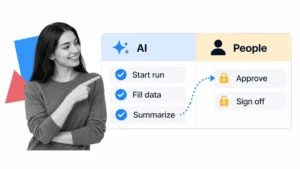
Corporate adoption of artificial intelligence is currently traversing a critical transitional phase characterized by a fundamental inversion of operational workflows. Historically, organizations attempted to integrate artificial intelligence tools into existing human-centric processes, requiring traditional employees to learn how to prompt, supervise, and collaborate with software. Emerging operational models, however, are inverting this hierarchy entirely: organizations are routing tasks to autonomous agents first, utilizing human labor exclusively to bridge unresolvable execution gaps.
This operational shift redefines human resources strategy. Rather than executing disruptive layoffs, progressive enterprises are simply allowing natural workforce attrition to occur, choosing not to backfill administrative, collections, or customer support roles whose underlying functions are now handled entirely by autonomous systems.
Cybersecurity Vulnerabilities and the One-Person Billion-Dollar Enterprise Paradox
As the technology sector romanticizes the emergence of the "one-person billion-dollar startup"—facilitated entirely by rapid code generation and autonomous agent deployment—a severe, unresolved contradiction threatens enterprise stability: the absolute incompatibility of radical operational velocity with institutional-grade cybersecurity. True production-grade software security requires rigorous oversight, continuous auditing, and robust defensive engineering. Yet recent high-profile security compromises across established B2B infrastructure providers—impacting major global media outlets, technology platforms, and enterprise data pipelines—demonstrate that modern digital attack surfaces are expanding exponentially.
Compounding these credential vulnerabilities are systemic infrastructure risks, exemplified by massive cloud service outages triggered by anomalous computational load spikes. With malicious actors now capable of autonomously spinning up thousands of agents to test enterprise server resilience, cascading infrastructural failures represent one of the most severe operational threats to modern digital commerce. Consequently, prudent Chief Information Security Officers are implementing strict governance protocols, heavily restricting the integration of third-party plugins, auxiliary analytics tools, and unvetted software vendors to safeguard corporate attack surfaces against systemic compromise.