From November 30th to December 4th, 2026, the technology world will converge in Las Vegas for Amazon Web Services (AWS) re:Invent, the annual premier learning event that serves as the primary stage for the company’s cloud computing and artificial intelligence roadmap. This year’s conference arrives at a critical juncture in the AI industry, characterized by a shift from initial generative AI experimentation to the large-scale deployment of autonomous, agentic systems that aim to drive measurable business outcomes. With over 2,000 sessions available to attendees, the event is positioned to be the most comprehensive showcase of AWS’s end-to-end AI stack, spanning from silicon-level infrastructure to sophisticated, ready-to-use agentic solutions.
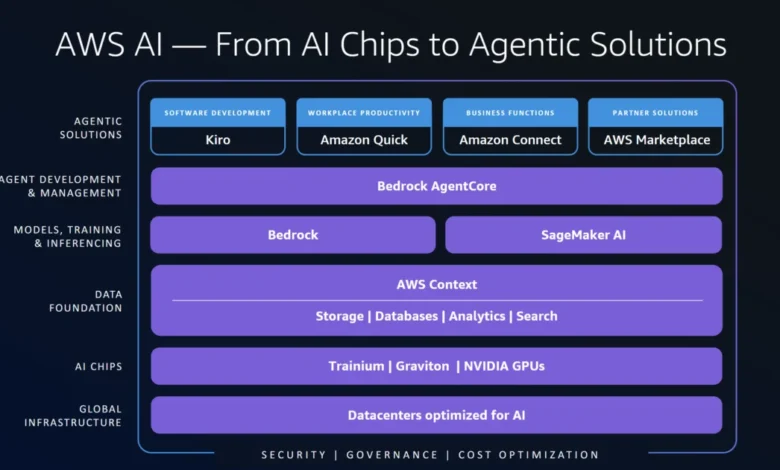
The evolution of re:Invent reflects the rapid maturation of the cloud ecosystem. While early iterations of the conference focused heavily on basic server migration and storage, re:Invent 2026 highlights the integration of AI into every facet of the enterprise stack. AWS’s strategic focus this year is centered on the concept of the "AI stack," a hierarchical framework that includes global data center infrastructure, purpose-built AI silicon, data foundations, model training and inference platforms, agent development tools, and, ultimately, domain-specific AI solutions.
A central pillar of this year’s programming is the AI/ML (AIM) track, which boasts more than 140 unique sessions. These sessions are designed to cater to a spectrum of expertise, ranging from entry-level architectural overviews to 500-level deep dives into kernel optimization and distributed systems design. For those unable to attend in person, the inclusion of live-streamed keynotes and a comprehensive library of on-demand content ensures that the technical insights disseminated during the week remain accessible to a global audience.
The Chronology of the AWS AI Stack
Understanding the AWS AI stack is essential for navigating the current landscape of AI deployment. The foundation begins with Global Infrastructure—data centers specifically engineered to manage the extreme thermal, power, and networking requirements of modern large language model (LLM) training and inference. AWS has significantly scaled its capacity in this area to accommodate the growing demand for low-latency, high-throughput environments.
Moving up the stack, the focus shifts to AI Chips. AWS continues to push its proprietary silicon, AWS Trainium, as a high-performance, cost-effective alternative to traditional GPU setups. By offering both Trainium and a robust suite of NVIDIA GPU instances, AWS is providing organizations the flexibility to optimize their workloads based on specific performance requirements and budget constraints. This hardware layer is supported by AWS Neuron, a software stack that allows developers to run deep learning frameworks like PyTorch without the need for extensive code rewrites, effectively bridging the gap between hardware and application.
The Data Foundation layer, anchored by services like AWS Context, is arguably the most critical component for enterprise AI. AI performance is intrinsically linked to data quality and accessibility. By connecting disparate data sources—including storage, databases, analytics, and search services—AWS is enabling models and agents to operate with high-fidelity, real-time context. This shift from static data lakes to active "data intelligence" is a key theme for enterprise architects attending this year’s event.
Model Training and Deployment
The middle tier of the stack is dominated by Amazon Bedrock and Amazon SageMaker AI. Bedrock has emerged as the preferred choice for organizations seeking managed access to a diverse portfolio of foundation models from multiple providers through a unified API. Conversely, SageMaker AI remains the platform of choice for developers requiring granular control over model customization, fine-tuning, and deployment on dedicated infrastructure.
A significant portion of the re:Invent 2026 agenda is dedicated to the integration of these two services. Industry experts note that as organizations scale their AI operations, the ability to transition between managed services and custom-built environments becomes a competitive advantage. Sessions such as AIM364 directly address this, providing architectural frameworks for teams deciding when to leverage Bedrock’s simplicity versus the flexibility of SageMaker.
The Rise of Agentic Solutions
The most transformative theme at re:Invent 2026 is the transition to agentic systems. Amazon Bedrock AgentCore serves as the central hub for this development, allowing teams to build, deploy, and manage AI agents capable of multi-step reasoning, tool usage, and autonomous decision-making. Unlike simple chatbots, these agents are designed to execute complex business processes, from supply chain management to software development.
The introduction of purpose-built agentic solutions, such as Kiro for spec-driven development and AWS Quick for personalized knowledge graphs, signals a maturation of the AI product category. By integrating these agents into business workflows, companies are moving beyond the "chat" interface and into the realm of automated operations. This shift has prompted a parallel focus on security and governance, as the increased autonomy of these systems necessitates robust guardrails and auditability.
Official Perspectives and Industry Implications
Industry observers and AWS leadership emphasize that the primary challenge for enterprises in 2026 is no longer model capability, but rather the operationalization of AI at scale. According to preliminary statements from the AWS community, the focus for the coming year is "Trust in Depth." This philosophy aims to give agents more autonomy while maintaining strict control over data privacy and compliance.
The impact of this focus is evident in the inclusion of sessions dedicated to responsible AI, such as those detailing the use of Amazon Bedrock Guardrails. By automating the verification of model outputs against regulatory and corporate policies, AWS is attempting to lower the barrier to entry for highly regulated industries like finance and healthcare. The success of these initiatives will be measured by the speed at which organizations can transition from proof-of-concept to production-ready deployments.
Supporting Data and Event Logistics
The sheer scale of re:Invent 2026 highlights the massive growth in demand for AI/ML talent. With over 2,000 sessions, the logistical complexity of the event is significant. To manage this, AWS has implemented a sophisticated session-types framework:
- Breakout sessions: Recorded presentations focusing on strategic and architectural topics.
- Chalk talks: Interactive, whiteboard-heavy sessions led by AWS experts.
- Builder sessions: Hands-on, laptop-required workshops where attendees work through specific technical challenges.
- Workshops: Multi-hour deep dives into complex implementations.
For attendees planning their schedules, the event catalog provides a granular filter for skill level, from 100-level "foundations" to 500-level "expert" deep dives. The high demand for these sessions means that attendees are encouraged to reserve spots early, though the introduction of "walk-up" availability for popular sessions provides a buffer for those who may have missed initial booking windows.
Broader Impact: Sustainability and Infrastructure
A notable evolution in the 2026 event is the increased focus on sustainability. As AI workloads become more compute-intensive, the environmental impact of data centers has become a top-tier concern for corporate boards. AWS’s focus on energy-efficient custom silicon (like Trainium) and machine-learning-optimized data center cooling reflects a proactive approach to sustainability. Sessions such as AIM205 and AIM321 explore how organizations can measure and reduce the carbon footprint of their AI pipelines without sacrificing performance.
Furthermore, the expansion of local zones and AI factories underscores the importance of physical proximity for specific AI use cases. For industries like autonomous driving, robotics, and real-time gaming, the ability to run inference at the edge—closer to the data source—is a necessity. The cross-pollination of these infrastructure strategies with agentic development represents a significant expansion of the cloud’s traditional boundaries.
Conclusion
AWS re:Invent 2026 serves as a bellwether for the broader technology industry. By providing a clear, structured path through the complexities of the modern AI stack, the event empowers developers and architects to move from theoretical application to scalable, secure, and sustainable AI operations. Whether through the optimization of AI silicon or the deployment of autonomous agents, the discussions held in Las Vegas this November will likely define the architectural standards for the enterprise for the next several years. For organizations looking to remain competitive in the AI era, the insights gathered at re:Invent 2026 will be instrumental in navigating the transition from the era of AI curiosity to the era of AI-driven productivity.