Trovata Transforms Corporate Treasury Operations Through Autonomous AI Integration on Amazon Bedrock

For decades, the global corporate treasury function has been defined by the cumbersome nature of manual labor, trapped in a cycle of spreadsheet-heavy reconciliation and fragmented data silos. Large enterprises, often managing hundreds of bank accounts across dozens of financial institutions, have historically relied on legacy Treasury Management Systems (TMS) that struggle to adapt to the velocity of modern finance. These legacy systems frequently act as static record-keepers rather than dynamic decision-making engines, forcing treasury teams to dedicate countless hours to mundane tasks such as manual data entry, variance analysis, and cash positioning. This operational friction has long hindered the ability of financial leaders to make real-time decisions, leaving organizations vulnerable to liquidity gaps and inefficient capital allocation.
However, a significant shift is currently underway, driven by the maturation of generative AI and the emergence of autonomous agentic workflows. Trovata, a pioneer in the cash and liquidity management sector, has moved beyond the hype of basic generative AI to implement a robust, agent-based infrastructure designed to automate the core responsibilities of the corporate treasurer. By leveraging Amazon Bedrock and Amazon Bedrock AgentCore, Trovata has transitioned from providing simple insights to deploying active, autonomous agents capable of performing complex treasury functions with minimal human intervention.
The Evolution of Treasury Technology
The trajectory of Trovata’s technological advancement reflects a broader trend in financial services: the transition from "systems of record" to "systems of action." In 2023, the industry saw the debut of the first generation of treasury-focused generative AI. At the time, the focus was primarily on natural language processing—enabling treasury professionals to "ask" their data questions rather than building complex manual queries. While this was a breakthrough in user accessibility, it remained a reactive process.
The current iteration of Trovata’s platform marks a departure from that reactive model. By utilizing Amazon Bedrock’s advanced LLM (Large Language Model) capabilities combined with the orchestration power of AgentCore, Trovata has created a framework where AI agents work continuously in the background. These agents do not merely answer questions; they monitor cash flows, detect anomalies in banking data, explain variances, and execute predefined workflows. For the modern enterprise, this means that the "close" process or the daily cash positioning report—which previously required hours of human oversight—is now handled autonomously.
Architectural Foundations and Security Governance
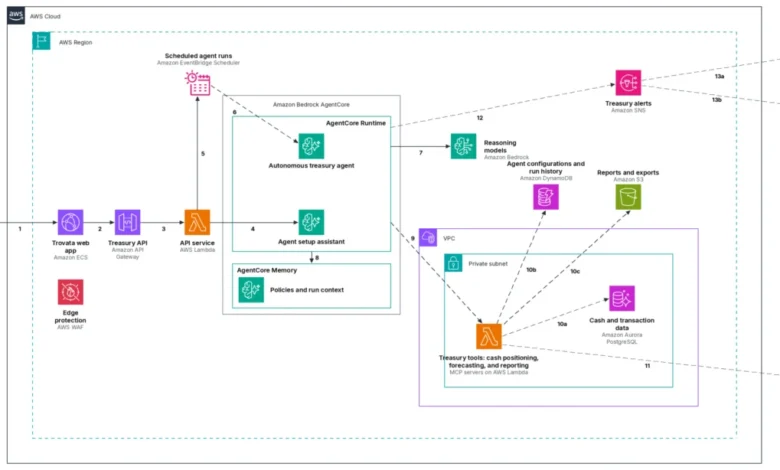
The move to an AI-native architecture in the highly regulated treasury environment requires a rigorous approach to security and data integrity. Financial institutions and global enterprises are understandably risk-averse when it comes to integrating AI into their capital management systems. To address these concerns, Trovata’s architecture is built on a "privacy-first" foundation.
Rather than relying on generic, public-facing AI tools, Trovata utilizes a secure, isolated runtime environment powered by Amazon Bedrock AgentCore. A critical design choice is the implementation of a verified API layer. In this architecture, the AI does not have direct, raw access to the underlying databases. Instead, it retrieves data exclusively through Trovata’s established, secure API layer. This ensures that every piece of data processed by the AI is governed by strict Role-Based Access Control (RBAC) protocols.
This security framework also facilitates "bank-branded" deployments. Because the system is built with modularity in mind, banks can offer these sophisticated AI tools to their corporate clients under their own branding, providing the banks with a high-value service differentiator while maintaining enterprise-grade security. This model allows for a seamless integration of AI, where the user benefits from advanced automation without the enterprise having to build, train, or maintain complex AI infrastructure in-house.
Quantifiable Operational Impact
The shift toward agentic workflows has yielded measurable results for early adopters. According to recent performance metrics, the deployment of autonomous treasury agents has delivered substantial cost and time savings. Organizations utilizing these tools have reported annualized cost savings exceeding $1 million, a figure driven largely by the reduction in the overhead associated with maintaining expensive legacy TMS platforms.
Furthermore, the productivity gains are stark. Accounting teams have seen a reduction of more than five hours per day in manual tasks, allowing high-value staff to pivot from data gathering to strategic financial analysis. Perhaps the most significant metric is the reduction in reporting timelines: tasks that previously consumed hours or days of effort are now completed in under 60 seconds. This capability provides treasurers with "real-time" visibility, a standard that was previously unattainable when dealing with the latency inherent in legacy banking data reporting.
The Agentic Playbook: Practical Use Cases
Trovata has codified these advancements into what they term an "AI Agents Playbook," a library of ten primary agent patterns that have proven effective in production. These patterns cover the most common pain points in treasury, including:
- Automated Cash Positioning: Agents continuously aggregate balances across thousands of accounts to provide an instantaneous view of global liquidity.
- Anomaly Detection: AI agents monitor daily transactions to flag unexpected variances, potential fraud, or reporting errors that would typically go unnoticed until a month-end reconciliation.
- Liquidity Forecasting: By analyzing historical patterns and external variables, agents provide rolling forecasts that adjust in real-time as new data flows in from the banking network.
- Bank Fee Reconciliation: Agents automatically audit bank service charges against negotiated contracts to identify overbilling or discrepancies.
- Intercompany Netting: Managing the complex web of internal debt and payments between global subsidiaries is automated through agents that trigger settlement workflows based on preset thresholds.
These workflows are not "set and forget"; they are persistent, meaning they operate on a continuous loop, ensuring that the treasury function remains aligned with the enterprise’s cash reality 24/7.
Implications for the Financial Services Sector
The implications of this technological leap are profound for both software vendors and their corporate clients. For the software industry, Trovata’s success with Amazon Bedrock demonstrates that the future of B2B SaaS lies in "vertical AI"—highly specialized, domain-specific intelligence that is embedded directly into the workflow. Unlike general-purpose chatbots, which often struggle with the nuances of enterprise financial data, embedded agents benefit from context-aware training.
For corporate treasury departments, the implications are equally significant. We are witnessing the end of the era where treasury teams were defined by their ability to manage spreadsheets. In the near future, the treasurer’s role will shift toward "AI management"—designing the rules, thresholds, and governance models that the agents operate within, and then focusing on high-level capital strategy and risk management.
However, this transition requires a culture of change. Implementing autonomous agents is not merely a technical upgrade; it is an organizational transformation. It requires trust in the underlying technology and a fundamental shift in how internal controls are audited. As Trovata continues to expand its agent patterns and deepen its integration with Enterprise Resource Planning (ERP) systems, the barrier between banking data and automated decision-making will continue to shrink.
Looking Ahead
As the financial landscape becomes increasingly volatile, the ability to act on data in real-time is shifting from a competitive advantage to a necessity. Trovata’s roadmap suggests a future of even tighter integration with the global banking ecosystem. By continuing to leverage the cloud-native, scalable infrastructure of AWS, the company is positioned to scale its offerings to meet the needs of the most complex multinational corporations.
The success of these autonomous agents marks a milestone in the "AI-native" evolution of enterprise software. By abstracting away the complexity of 10,000+ bank connections and replacing manual processes with intelligent, governed agents, Trovata is setting a new benchmark for financial efficiency. For the CFO and the corporate treasury team, the message is clear: the era of the manual, retrospective treasury function is drawing to a close, replaced by an autonomous, predictive, and real-time financial operating environment. As more organizations adopt these agentic workflows, the standard for treasury operations will undoubtedly be permanently elevated, forcing the industry to move past the limitations of the past toward a more agile, data-driven future.