Optimizing Large-Scale Reinforcement Learning for Mixture-of-Experts Models on AWS

The rapid ascent of Mixture-of-Experts (MoE) architectures has fundamentally altered the trajectory of Large Language Model (LLM) development. By utilizing sparse activation, these models allow for trillion-parameter scales while maintaining efficient inference. However, the post-training phase—specifically Reinforcement Learning from Human Feedback (RLHF) and Group Relative Policy Optimization (GRPO)—has introduced a new tier of infrastructure complexity. Engineering teams are increasingly finding that the traditional bottlenecks of pre-training are being superseded by communication-heavy constraints, particularly as expert-parallelism (EP) requirements scale across hundreds of accelerators.
To address these challenges, AWS has outlined a specialized architecture that leverages Amazon Elastic Kubernetes Service (EKS) and Elastic Fabric Adapter (EFA). By integrating these tools with DeepEP, organizations can effectively harmonize the disparate needs of asynchronous rollout generation and tightly coupled policy training.
The Evolution of MoE Infrastructure Constraints
Historically, LLM training was primarily compute-bound. As models grew, engineers focused on Tensor Parallelism (TP) and Pipeline Parallelism (PP) to manage the memory footprint of dense weight matrices. The emergence of MoE has introduced a paradigm shift: because experts are dynamically routed across devices, training workflows now face high-frequency, fine-grained communication patterns that traditional NCCL all-to-all collectives struggle to handle efficiently at scale.
In a modern RLHF pipeline, the infrastructure must simultaneously support two competing workloads. First, rollout generation requires distributed inference to produce vast quantities of experience data. This process prioritizes aggregate throughput over low-latency token generation. Second, policy training requires rigid synchronization, where every worker must progress in lockstep to update model weights. When these two workloads share underlying hardware, any network latency or straggler node can cause cascading performance degradation, leading to idle GPUs and wasted capital expenditure.
Chronology of the RL Optimization Shift
The transition toward highly sparse, large-scale MoE models accelerated throughout 2024 and 2025 as developers sought to minimize inference costs. As these models expanded, the industry encountered a "communication wall." Standard collective communication libraries, originally designed for dense neural networks, proved insufficient for the non-deterministic, all-to-all token routing inherent in MoE models.
By mid-2026, the focus shifted toward topology-aware communication. Engineering teams began replacing generic collective primitives with specialized kernels capable of differentiating between intra-node NVLink traffic and inter-node EFA traffic. This evolution allowed for the development of DeepEP v2, which serves as a critical bridge in managing the sparse communication overhead that characterizes modern MoE architectures.
Performance Data and Throughput Gains
Technical benchmarking conducted on 48 P5en instances highlights the efficacy of this specialized orchestration. In a controlled test comparing a legacy stack—comprising CUDA 12.9, PyTorch 2.9.1, and NCCL 2.27—against an optimized stack featuring DeepEP v2, CUDA 13.0, and EFA 1.49, the results were definitive.
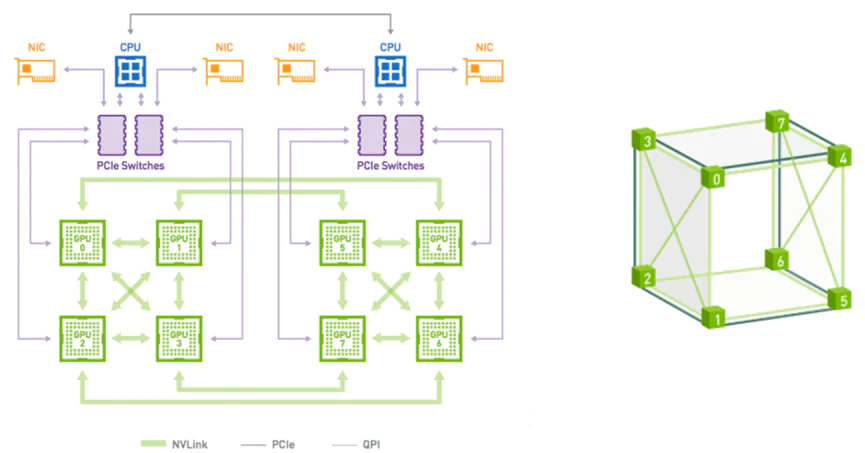
The optimized configuration, which enabled DeepEP over EFA, demonstrated a 40 percent increase in aggregate RL rollout throughput. This improvement is attributed to the replacement of standard NCCL all-to-all collectives with custom dispatch and combine kernels. These kernels effectively utilize NVLink for local communication while offloading inter-node traffic to EFA via libfabric. This reduction in per-message overhead ensures that the sparse traffic patterns generated by Expert Parallelism do not throttle the policy-training engine.
Architectural Framework: The EKS Approach
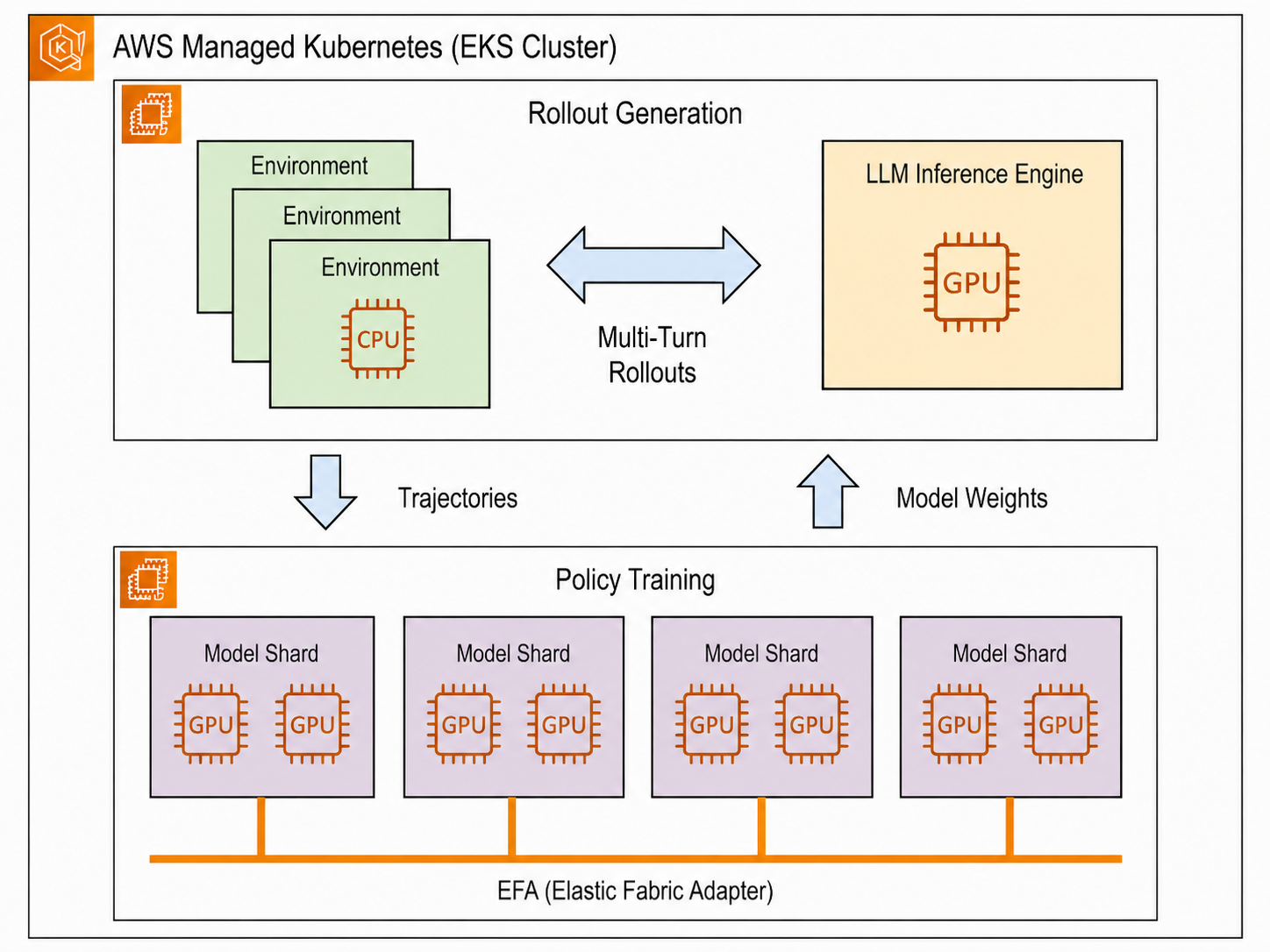
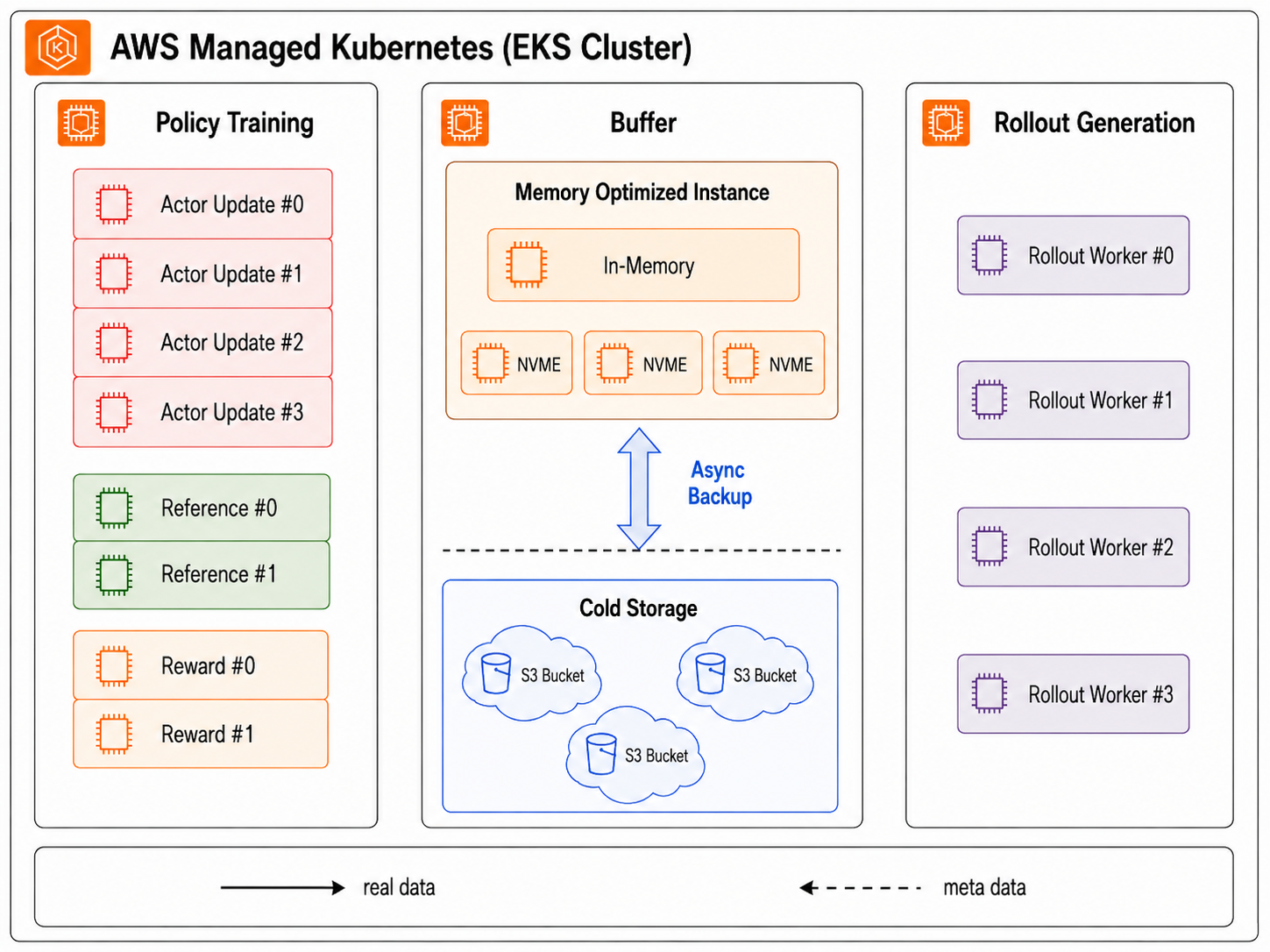
To sustain these performance gains in a production environment, the deployment architecture relies on a decoupled EKS topology. This design separates the lifecycle of rollout generation from the policy-training engine.
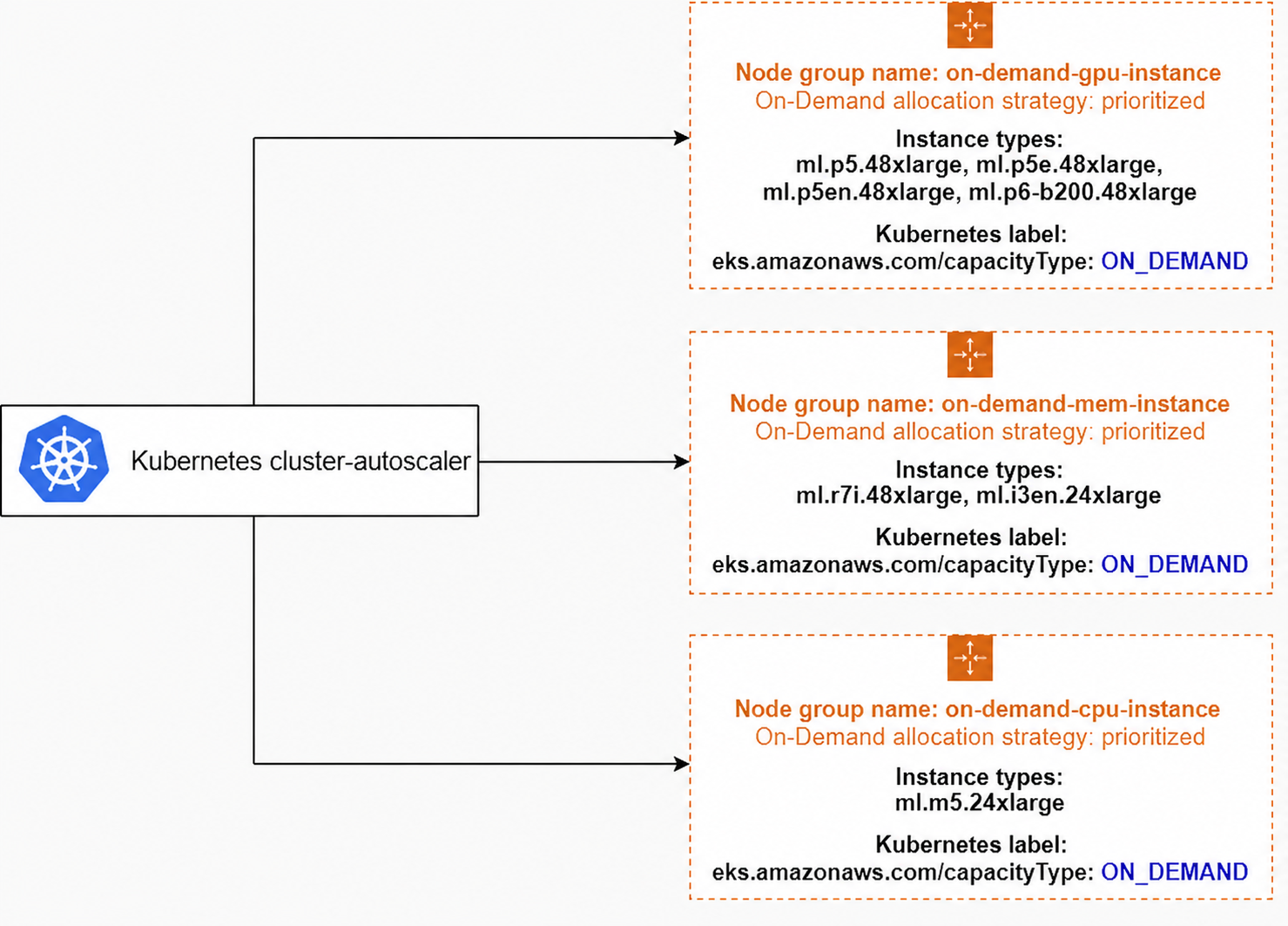
- Node Group Isolation: The architecture employs separate EKS managed node groups. GPU-accelerated instances are reserved for policy training and rollout generation, while CPU-based instances handle environment interactions and preprocessing. This ensures that resource-intensive RL tasks do not compete with orchestration overhead.
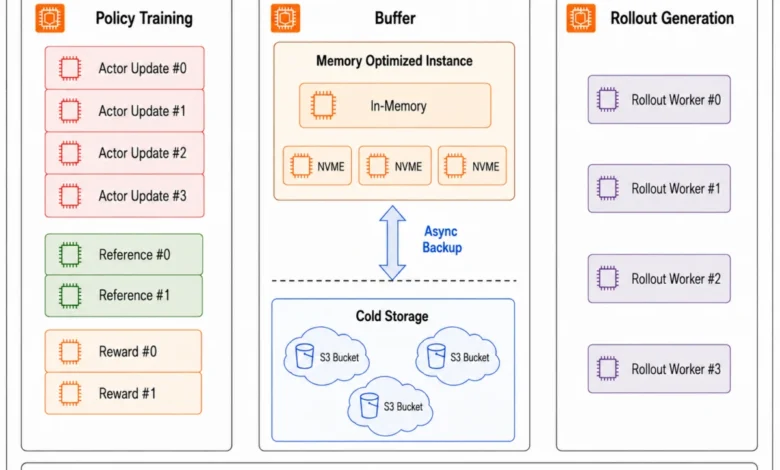
- Memory-Optimized Buffers: By utilizing memory-optimized instances for experience buffers, the system ensures that producers and consumers can exchange data without writing to durable storage (like S3) on the critical path, which would otherwise introduce unacceptable latency.
- Spot Instance Utilization: Because rollout generation is inherently partitionable, it is highly resilient to preemption. Organizations can leverage Amazon EC2 Spot Instances for these workers, significantly reducing operational costs without impacting the stability of the core training job.
Implications for the AI Industry
The implications of this architectural shift are significant for AI laboratories and enterprises scaling frontier models. As models exceed the hundred-billion-parameter threshold, the "infrastructure tax" of training becomes a major factor in the total cost of ownership. By optimizing communication paths, organizations can effectively lower the cost-per-token of model fine-tuning and RLHF.
Furthermore, the shift toward libfabric-based transport layers for DeepEP signals a move toward hardware-agnostic, portable communication primitives. This allows developers to maintain a consistent training stack even as they migrate between different generations of accelerated compute hardware, such as the progression from NVIDIA P5 to P6 instances.
Official Guidance and Strategic Recommendations
Industry experts from AWS emphasize that success in large-scale RL training is not merely a matter of hardware procurement, but of sophisticated software-defined networking. The integration of the EFA Kubernetes device plugin is described as a mandatory requirement for any organization aiming to scale beyond a single node.
The strategy of using TorchX for job submission is also highlighted as a best practice. By separating application configuration from infrastructure provisioning, teams can iterate on model architectures—such as adjusting the number of experts in a DeepSeek-style MoE—without necessitating a full reconfiguration of the underlying EKS cluster. This modularity is essential for experimental environments where hyperparameters are frequently adjusted.
Future Outlook and Conclusion
The convergence of EKS, EFA, and DeepEP provides a robust blueprint for the next generation of LLM development. As Reinforcement Learning becomes a standard component of the post-training pipeline, the ability to balance elastic rollout generation with synchronous policy training will become a primary competitive advantage.
Looking ahead, the industry is expected to continue focusing on reducing the "straggler effect" in distributed training. Future iterations of these frameworks will likely incorporate even more advanced telemetry to predict network congestion before it impacts training throughput. For now, the integration of specialized communication kernels like DeepEP represents the current state-of-the-art in overcoming the inherent inefficiencies of sparse, expert-parallel models.
Organizations looking to implement this architecture are advised to follow a phased integration: first, by establishing the EFA device plugin in their EKS environment; second, by containerizing their training stacks using the updated libraries mentioned; and finally, by migrating rollout generation to cost-optimized Spot Instances. Through this disciplined approach, firms can achieve the performance required for modern AI research while maintaining the fiscal discipline necessary for sustainable, long-term model development. As the boundaries of model size continue to expand, this synergy between high-performance networking and elastic orchestration will remain the bedrock of large-scale artificial intelligence.