Building a Robust JSON Serialization Pipeline for Scalable Machine Learning Infrastructure

In the contemporary landscape of machine learning engineering, the primary hurdle for production-grade systems is rarely the mathematical sophistication of the model architecture, but rather the architectural integrity of the data plumbing that supports it. As data pipelines evolve from localized research scripts into distributed microservices, the necessity for a standardized, resilient method of data serialization has become paramount. Developers frequently encounter the limitations of the JavaScript Object Notation (JSON) format when handling Python-specific types such as datetime objects, sets, pathlib instances, and enumerations. Addressing these limitations through a formal serialization pipeline is a critical step in ensuring that configuration metadata, experiment parameters, and feature sets remain consistent across disparate computing environments.
The challenge of data serialization in Python is rooted in the inherent mismatch between the language’s rich type system and the primitive nature of the JSON specification, which natively supports only strings, numbers, booleans, arrays, and objects. When a machine learning engineer attempts to store a configuration object containing a Path or a datetime object, the standard library’s json.dumps() function inevitably returns a TypeError. This failure point, while seemingly trivial, can lead to catastrophic system downtime if not managed correctly, particularly in automated training environments where configuration files are generated and parsed programmatically.
The Evolution of Serialization Requirements in AI Pipelines
The necessity for robust serialization has grown in tandem with the complexity of modern MLOps frameworks. Historically, simple key-value pairs were sufficient for configuring basic algorithms. However, as organizations transition toward MLOps 2.0, where experiment reproducibility and versioning are enforced through immutable configuration files, the need to serialize complex objects—such as hyperparameter search spaces or hardware-specific file paths—has become non-negotiable.
Industry standards for data interchange have shifted significantly over the past decade. While XML once dominated, JSON became the industry preference due to its lightweight structure and human-readability. However, the lack of a standardized schema-validation layer in basic JSON has often led to the "broken pipe" syndrome in ML pipelines, where an upstream process updates its data format, inadvertently causing downstream deserialization crashes. By implementing a custom serialization framework, engineers can effectively decouple the storage layer from the application logic, allowing for seamless schema evolution and backward compatibility.
Constructing the Custom Encoder Architecture
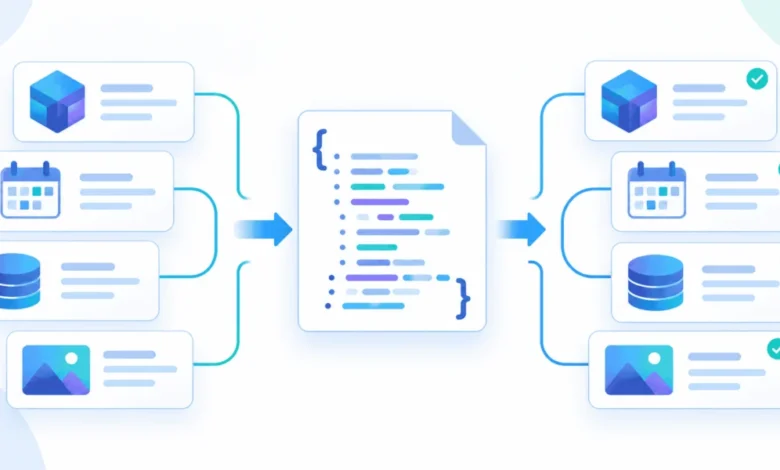
To bridge the gap between Python types and JSON primitives, the first step is the development of a custom encoder class inheriting from the standard json.JSONEncoder. This approach is superior to ad-hoc conversion scripts because it centralizes the logic, ensuring that any object passed into the encoder is handled consistently regardless of its position within the JSON hierarchy.
The implementation involves overriding the default method within the encoder class. By utilizing a series of conditional checks using isinstance, the encoder can identify specific types and transform them into a serialized "metadata-aware" format. For instance, rather than simply converting a set into a list, the encoder wraps the data in a dictionary containing a type identifier, such as "type": "set", "value": […]. This tagging mechanism acts as a schema contract, informing the decoder exactly how to reconstruct the data upon arrival at the destination.
This design pattern addresses a recurring issue in high-performance computing: the loss of type precision. When a set of feature names is converted to a list for serialization, the unique property of the set is lost, which can lead to logic errors in downstream model feature extraction. By preserving the type metadata, the pipeline ensures that the data is not only transported but is correctly re-instantiated, maintaining the structural integrity of the application state.
The Role of the Object Hook in Secure Deserialization
The inverse of serialization—deserialization—is inherently more dangerous. Accepting untrusted JSON data from external sources can introduce security vulnerabilities if the parser is not properly constrained. Utilizing the object_hook parameter within the json.loads() method allows for a controlled, recursive reconstruction of objects.
In a production environment, the decoder must be hardened against malformed inputs. Instead of assuming that the JSON structure is pristine, the decoder should incorporate exception handling to catch TypeErrors or ValueErrors during the re-instantiation phase. For example, if a timestamp string is malformed or corrupted during transmission, the decoder should catch the failure, log the incident, and either provide a fallback value or raise a descriptive error. This "fail-gracefully" approach is essential for long-running batch jobs where a single malformed configuration file should not result in the termination of a multi-day training process.
Managing Schema Migrations and System Evolution
As machine learning models iterate, the associated configuration schemas rarely remain static. New hyperparameters are introduced, old features are deprecated, and nested configurations are expanded. A rigid serialization system will break under these conditions. The most effective mitigation strategy is the implementation of a factory pattern for loading configurations that includes a built-in migration layer.
This migration layer operates by passing the raw, deserialized dictionary into a validator function that acts as a gatekeeper. By leveraging dictionary methods such as .get(), developers can define default values for missing keys, effectively "patching" older configuration files to match the current system requirements. This allows for seamless compatibility between legacy experiments and updated model architectures, a critical requirement for maintaining a long-term audit trail of machine learning model performance.
Implications for MLOps and Data Governance
The implications of robust serialization extend beyond simple error prevention. In highly regulated industries such as finance and healthcare, the ability to reconstruct the exact state of a machine learning experiment at any point in time is a compliance requirement. If an model’s decision-making process is audited, the ability to parse historical, serialized configuration files—even if the underlying codebase has changed significantly—is invaluable.
Furthermore, the shift toward standardized, self-describing JSON objects enhances the interoperability of machine learning tools. When different microservices within an organization use the same serialization protocol, the friction associated with data hand-offs is significantly reduced. Data scientists can focus on model architecture, knowing that the infrastructure layer is capable of handling the underlying data transport reliably.
Future-Proofing Data Pipelines
As the industry moves toward more automated, "self-healing" data infrastructures, the techniques discussed here represent the baseline for reliable system design. While specialized formats like Protobuf or Apache Avro offer more advanced features for schema enforcement and binary serialization, they often introduce significant overhead in terms of development time and toolchain integration. For the vast majority of machine learning applications, a well-engineered, custom JSON pipeline provides the optimal balance between simplicity, human readability, and system robustness.
Ultimately, the goal of any engineering team should be to move away from fragile, manual data processing and toward automated, contract-driven systems. By mastering the nuances of custom JSON serialization, engineers ensure that their machine learning pipelines are capable of scaling to meet the demands of modern data science, providing a stable foundation upon which complex, data-driven applications can thrive. The transition from "scripting" to "engineering" is defined by such attention to detail, transforming the mundane task of data plumbing into a sophisticated, resilient, and highly reliable architecture.