The rapid evolution of generative artificial intelligence and large language models (LLMs) has fundamentally altered the requirements for modern data infrastructure. As organizations pivot to integrate semantic search, retrieval-augmented generation (RAG), and recommendation engines into their product stacks, they face a critical architectural dilemma: should they extend their existing relational databases with vector capabilities or migrate to specialized, purpose-built vector databases? This debate, often fueled by marketing rhetoric rather than empirical evidence, requires a rigorous examination of performance metrics, operational complexity, and long-term scalability.
The Rise of the Vector Search Requirement
The integration of vector embeddings—mathematical representations of unstructured data—into standard database workflows gained significant momentum around 2022. As developers began building AI-powered applications, the primary challenge became the storage and retrieval of high-dimensional vectors. Historically, this necessitated the implementation of specialized systems, such as Pinecone, Milvus, or Weaviate. However, the introduction of pgvector, an open-source extension for PostgreSQL, provided a compelling alternative. By allowing developers to store vector embeddings directly alongside traditional relational data, pgvector promised to simplify the stack, reduce latency associated with network hops, and maintain ACID compliance for hybrid search queries.
Understanding the Architectural Divide
To evaluate the two approaches, one must first distinguish between their core design philosophies. A dedicated vector database is architected from the ground up for high-dimensional vector search. These systems often utilize optimized storage engines and distributed indexing algorithms—such as HNSW (Hierarchical Navigable Small World) or IVF (Inverted File Index)—designed to minimize latency at scale. Their primary selling point is performance specialization, often offering native support for GPU acceleration, advanced metadata filtering, and multi-tenancy.
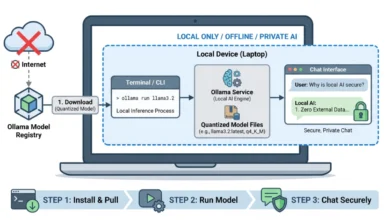
In contrast, pgvector functions as an extension to PostgreSQL. It leverages the extensibility of the Postgres ecosystem, allowing developers to perform vector similarity searches (such as cosine distance, L2, or inner product) within the same SQL queries used to fetch relational data. This eliminates the need for maintaining separate infrastructure, synchronizing data across disparate systems, and managing complex distributed clusters.
Benchmarking at Scale: Methodology and Findings
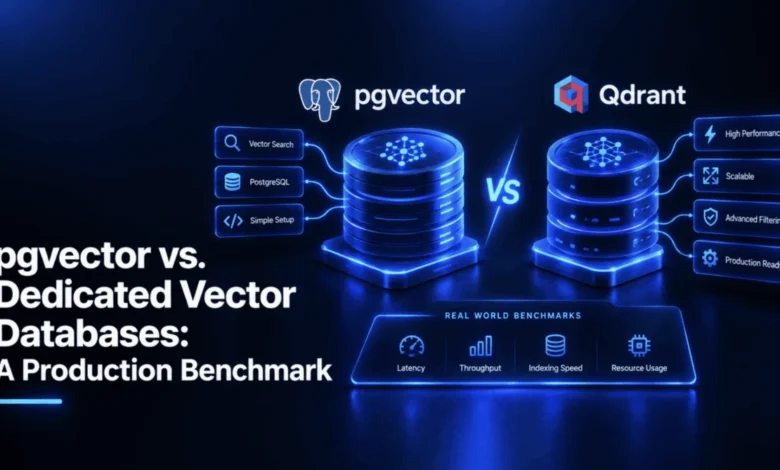
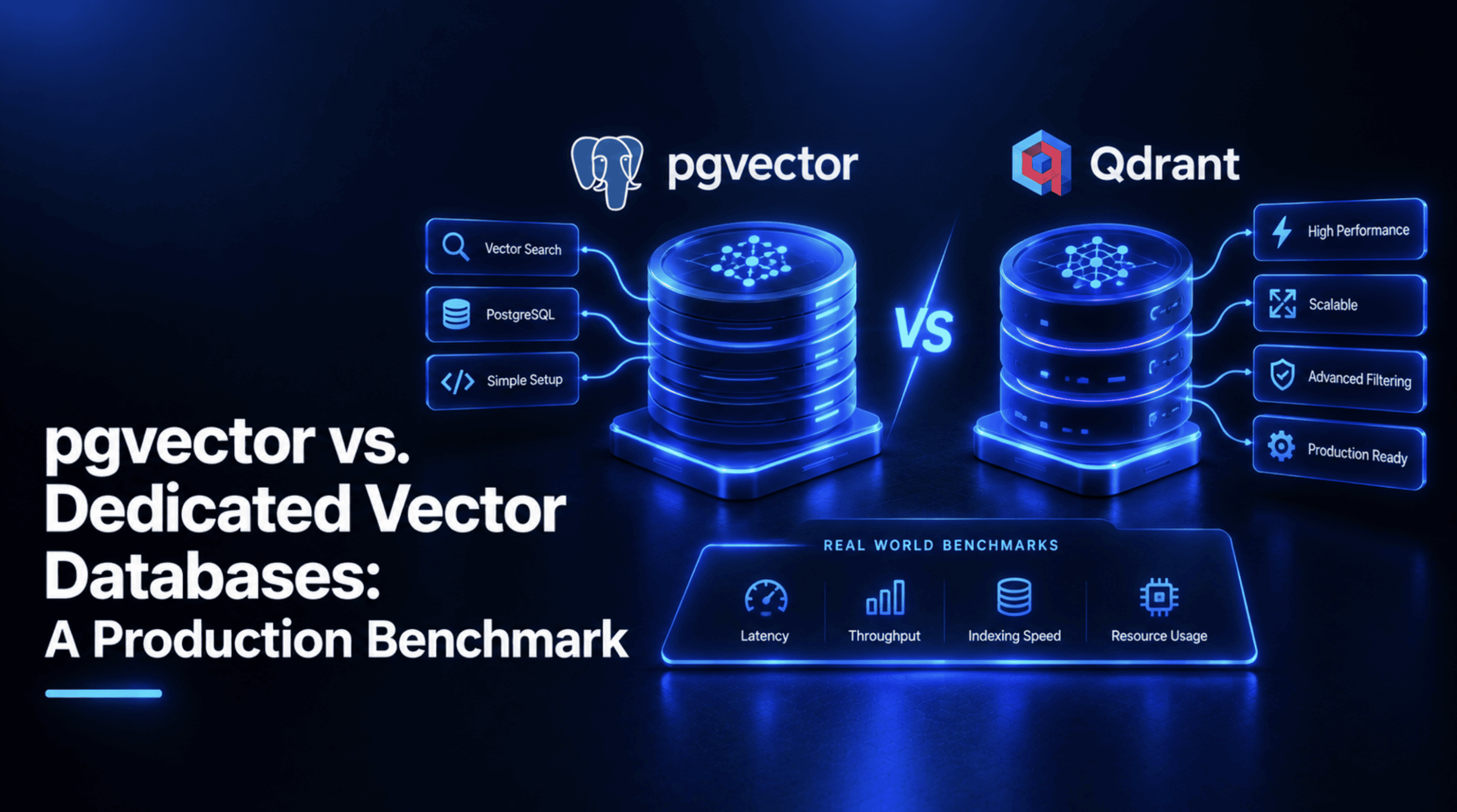
The technical community has long sought a definitive performance comparison. Recent industry testing, particularly involving large-scale datasets, provides the clarity needed to navigate this decision. A comprehensive benchmark analysis using 50 million Cohere embeddings (768 dimensions) on AWS r6id.4xlarge instances (16 vCPUs, 128GB RAM) offers a representative view of production-grade performance.
It is crucial to note that modern performance benchmarks for PostgreSQL frequently utilize pgvectorscale, an additional extension that introduces advanced index types like StreamingDiskANN. When evaluating these systems at 99% recall, the data indicates a nuanced reality. At this level of accuracy, PostgreSQL configurations often outperform specialized competitors in pure throughput. For instance, testing has demonstrated that optimized Postgres configurations can handle significantly higher queries-per-second (QPS) compared to standalone vector databases, primarily due to the maturity of the Postgres query optimizer and its ability to handle complex, combined metadata-vector filtering in a single execution plan.
However, the "dedicated" advantage becomes evident when examining tail latency. In high-concurrency environments, specialized systems like Qdrant frequently exhibit more stable P99 latency figures. While Postgres may excel at aggregate throughput, specialized databases are engineered to prioritize the consistency of the slowest 1% of queries, a critical requirement for enterprise-grade applications with strict Service Level Agreements (SLAs).
Operational Implications and Strategic Selection
Choosing between these two paths is not merely a question of milliseconds; it is an organizational decision involving maintenance, talent acquisition, and infrastructure lifecycle management.
For teams operating at a scale of 5 to 10 million vectors, pgvector is frequently the superior choice. The operational burden of managing a dedicated vector database is often disproportionate to the performance gains achieved at this volume. When a team already employs a seasoned DBA or has deep expertise in managing PostgreSQL, adding vector search via an extension represents a minimal increase in operational risk. Furthermore, the ability to maintain transactional consistency—ensuring that a user’s relational profile update and their vector-based history remain in sync—is a major advantage for applications requiring high data integrity.
Conversely, the argument for dedicated vector databases strengthens as the workload approaches the "billion-scale" threshold. Organizations managing hundreds of millions of vectors face significant challenges regarding index construction, memory management, and distributed query execution. In these scenarios, the specialized features of systems like Milvus or Pinecone—such as native GPU acceleration for indexing and horizontal scaling capabilities—become necessary rather than optional. Furthermore, for companies that prioritize a "zero-ops" environment, managed services provide a clear path to deployment that avoids the complexities of tuning Postgres for non-relational, high-dimensional search tasks.
The Role of Metadata Filtering
A frequently overlooked aspect of the comparison is the performance impact of metadata filtering. Most real-world applications do not perform pure vector searches; they filter results based on relational attributes (e.g., "find products similar to X that are also in stock and priced under $50"). PostgreSQL is arguably the most advanced system in existence for handling this type of hybrid filtering. Its ability to combine traditional B-tree indexes for filtering with HNSW indexes for vector search allows for a sophisticated query execution plan that specialized databases often struggle to match without significant overhead.
Economic and Future-Proofing Considerations
The decision-making process must also account for the total cost of ownership (TCO). A dedicated vector database introduces a new system to the stack, which implies additional costs for licensing or cloud infrastructure, monitoring, and, most importantly, the engineering time required to maintain the system. For many organizations, the "hidden" cost of keeping two systems in sync—where a failure in the synchronization pipeline results in stale or missing search data—is the most significant risk factor.
As the ecosystem matures, the gap between these approaches is expected to narrow. The development community is actively porting advanced indexing techniques from specialized databases into the Postgres ecosystem, while dedicated vendors are adding more robust relational capabilities to their platforms.
Conclusion: Moving Beyond Vendor Narratives
The prevailing narrative that either pgvector or a dedicated vector database is universally "better" is a fallacy. The data demonstrates that performance is a function of specific workload characteristics, query patterns, and scale.
- Choose pgvector if: You are already invested in the PostgreSQL ecosystem, your dataset is under 10 million vectors, your application requires strong transactional consistency, or your engineering team prefers a simplified, unified technology stack.
- Choose a dedicated vector database if: Your data scale is in the hundreds of millions or billions, your application demands consistent tail-latency SLAs that are difficult to tune in a general-purpose database, or you require specialized hardware acceleration (e.g., GPUs) that is natively supported by the dedicated provider.
Ultimately, the most successful implementations are those that prioritize the specific requirements of the application over the ideological purity of the infrastructure. By focusing on objective metrics—throughput, P99 latency, and index build times—and matching these to the actual demands of the business, organizations can avoid the pitfalls of premature optimization and build a robust, future-proof AI data pipeline. The choice is not between a general-purpose database and a vector database; it is a choice between two distinct toolsets, each with its own place in the modern software architecture. As the technology continues to mature, the priority for developers should remain on transparency in benchmarking and the alignment of technical capabilities with long-term operational sustainability.