Speculative Decoding: Accelerating Large Language Model Inference through Parallel Verification

The deployment of large language models (LLMs) has revolutionized artificial intelligence, yet a persistent technical bottleneck continues to hinder their widespread adoption in latency-sensitive applications. Modern transformer models generate text in an autoregressive fashion, producing one token at a time. This constraint, while fundamental to the architecture of models like GPT-4, Llama 3, and Claude, creates a significant hardware utilization challenge. As these models scale to billions of parameters, the time required to generate each token—the "time-per-token" (TPT) latency—has become the primary hurdle for developers building real-time coding assistants, customer service agents, and interactive virtual environments.
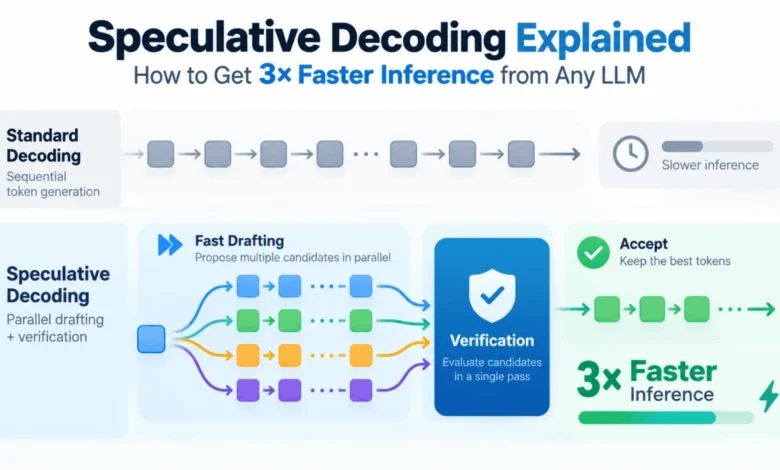
Speculative decoding has emerged as a high-impact solution to this latency crisis. By decoupling the generation process into a dual-stage system of "drafting" and "verification," this technique allows practitioners to achieve speedups of 2x to 3x without sacrificing the mathematical integrity of the model’s output.
The Latency Bottleneck: Understanding Memory Bandwidth
To comprehend the necessity of speculative decoding, one must first understand the operational limitations of modern GPU hardware. While the industry often focuses on FLOPs (floating-point operations per second) as the primary metric for GPU performance, LLM inference is predominantly "memory-bandwidth bound."
When an LLM generates a token, the entire set of model weights must be moved from the high-bandwidth memory (HBM) of the GPU to the processing cores. Because the model must read these billions of parameters to predict each single token, the GPU spends a vast majority of its time waiting for data to arrive rather than performing actual computation. In this environment, even the most powerful hardware, such as the NVIDIA H100, remains underutilized, with its massive parallel compute capacity sitting idle for most of the generation cycle. This architectural mismatch creates a linear cost of generation that scales poorly as models increase in size.
The Evolution of Speculative Decoding: A Chronology
The concept of speculative decoding gained significant traction in early 2023, following seminal research papers from Google DeepMind and independent teams at Meta. The core innovation was the proposal of a two-model architecture: a small "draft" model and a large "target" model.
- Early 2023: Initial research introduced the "Speculative Sampling" framework, demonstrating that a smaller model could be used to guess a sequence of tokens, which a larger model could then verify in parallel.
- Late 2023: Adoption began in earnest within the open-source community, specifically through implementations in
llama.cppandvLLM, allowing researchers to experiment with different draft-target model pairings. - 2024: The emergence of "self-speculation" techniques, such as Medusa and Eagle, marked a shift away from needing external, secondary models. These methods allowed a single model to act as its own drafter by appending auxiliary heads, further simplifying the deployment stack.
Mechanism: How Parallel Verification Functions
Speculative decoding operates through a rhythmic, iterative loop. In the first phase, a draft model generates a short sequence of tokens—typically four to eight—in a fraction of the time the target model would require. This sequence represents a probabilistic prediction of the next segment of text.
In the second phase, the target model receives this entire sequence as a single batch. Because modern hardware is highly optimized for parallel matrix multiplication, the target model can evaluate all eight candidate tokens in a single forward pass. This is where the efficiency gain is realized: the target model performs a verification step that is mathematically designed to be identical to the output of a standard autoregressive process.
Each candidate token is assigned a probability score. If the target model’s confidence in a candidate aligns with the draft model’s prediction, the token is accepted. If there is a discrepancy, the target model corrects the token. Crucially, the mathematical framework ensures that the probability distribution of the final, corrected text remains identical to what would have been generated had the target model acted alone. This "exactness" is a critical feature, as it allows developers to gain performance without losing the reasoning quality or accuracy of the larger, primary model.
Supporting Data and Performance Metrics
Empirical testing across various benchmarks reveals that the efficacy of speculative decoding is highly dependent on the "acceptance rate"—the percentage of drafted tokens that the target model approves.
In controlled environments, such as code completion tasks (using datasets like HumanEval), speculative decoding has demonstrated significant throughput improvements. For example, when pairing a large model like Llama-3-70B with a tiny 1B-parameter draft model, developers often observe:
- Average Acceptance Rates: 60% to 80% on standard English prose.
- Inference Speedup: 2.2x to 2.8x measured in tokens per second.
- Compute Utilization: An increase in GPU utilization from roughly 10-15% to 30-40%, as the compute units are fed data more efficiently.
However, these gains are not universal. Research suggests that if the draft model is poorly matched to the target model—or if the task is highly creative and unpredictable, leading to low acceptance rates—the overhead of generating the draft sequence can lead to a marginal decrease in overall performance.
Beyond Two Models: Modern Implementations
As the technology has matured, the industry has moved beyond the "two-model" requirement to simplify production pipelines.
Medusa (Minimal Extra Decoding for Upstream Architectures) has become a leading alternative. Instead of running a separate model, Medusa adds extra "heads" to the existing target model. These heads predict multiple future tokens simultaneously. Because these heads share the same underlying architecture as the main model, they have a high correlation with the target model’s logic, often resulting in higher acceptance rates than an external, unrelated draft model.
Prompt Lookup Decoding represents another approach, favoring simplicity over complexity. By scanning the user’s prompt for repeating patterns, the system uses the prompt itself as a "draft." This is exceptionally effective in document summarization or long-form writing, where the model is likely to repeat terminology or structured headers found in the initial input.
Broader Implications and Strategic Analysis
The adoption of speculative decoding has profound implications for the economics of AI deployment. By increasing the number of tokens a single GPU can serve per second, companies can effectively double or triple their capacity without purchasing additional hardware. In an era where H100 availability is often constrained, this optimization acts as a force multiplier for cloud service providers and enterprise AI teams.
Furthermore, the integration of these techniques into standard frameworks like Hugging Face’s text-generation-inference and vLLM signals a shift in the industry’s focus. The challenge of LLMs is no longer merely about "how to build larger models," but rather "how to deploy existing models more efficiently."
Conclusion: A New Standard for Inference
Speculative decoding represents a pivotal shift in the lifecycle of language models. By reframing the generation process from a rigid, serial constraint into a flexible, parallel verification challenge, researchers have unlocked a path to lower latency and higher throughput. As these methods become standard features in deployment libraries, the barrier to creating responsive, high-quality AI agents continues to lower, setting the stage for a new generation of real-time, compute-efficient applications. Whether through specialized hardware, better drafting models, or architectural innovations like Medusa, the era of "one-token-at-a-time" computing is effectively coming to an end.
Related posts: