Stack Overflow Co-Founder Jeff Atwood Reflects on the Evolution of Developer Communities and the Future of AI in Software Engineering

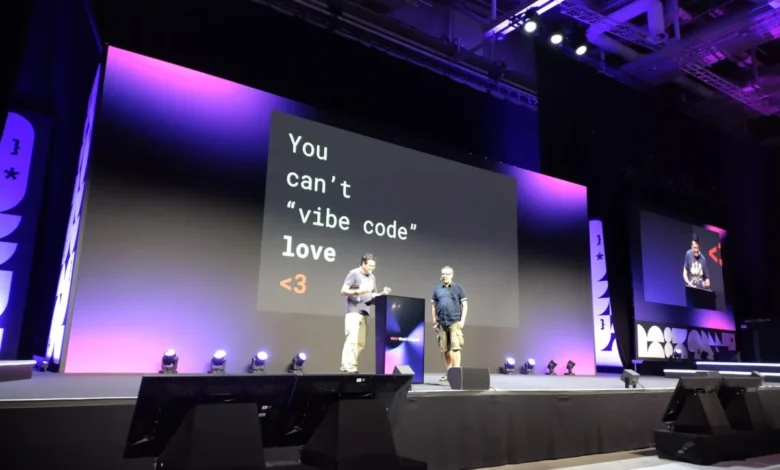
The intersection of human collaboration and artificial intelligence took center stage at the CityCube in Berlin during the WeAreDevelopers World Congress, where software pioneer and Stack Overflow co-founder Jeff Atwood delivered a keynote address alongside early community hire Ben Dumke-von der Ehe. The presentation, titled "None of Us Is As Dumb As All of Us: Community And Knowledge Go Hand In Hand," explored the foundational philosophy of crowdsourced technical knowledge, the transformative impact of Large Language Models (LLMs) on developer workflows, and the long-term sustainability of the digital commons.
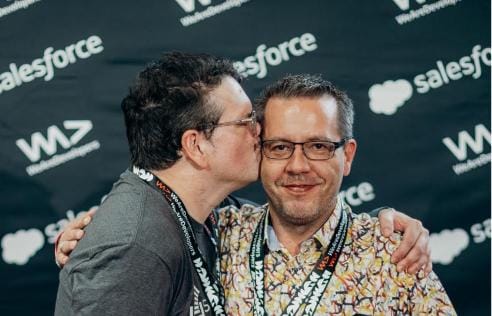
For Atwood, who rarely accepts international speaking engagements, the Berlin conference provided a timely platform to reunite with Dumke-von der Ehe, a pivotal figure in Stack Overflow’s early history. Their joint appearance was not merely a retrospective on the early days of online developer forums, but a critical examination of how the software engineering ecosystem is shifting as generative artificial intelligence reshapes how programmers seek, consume, and validate technical information.
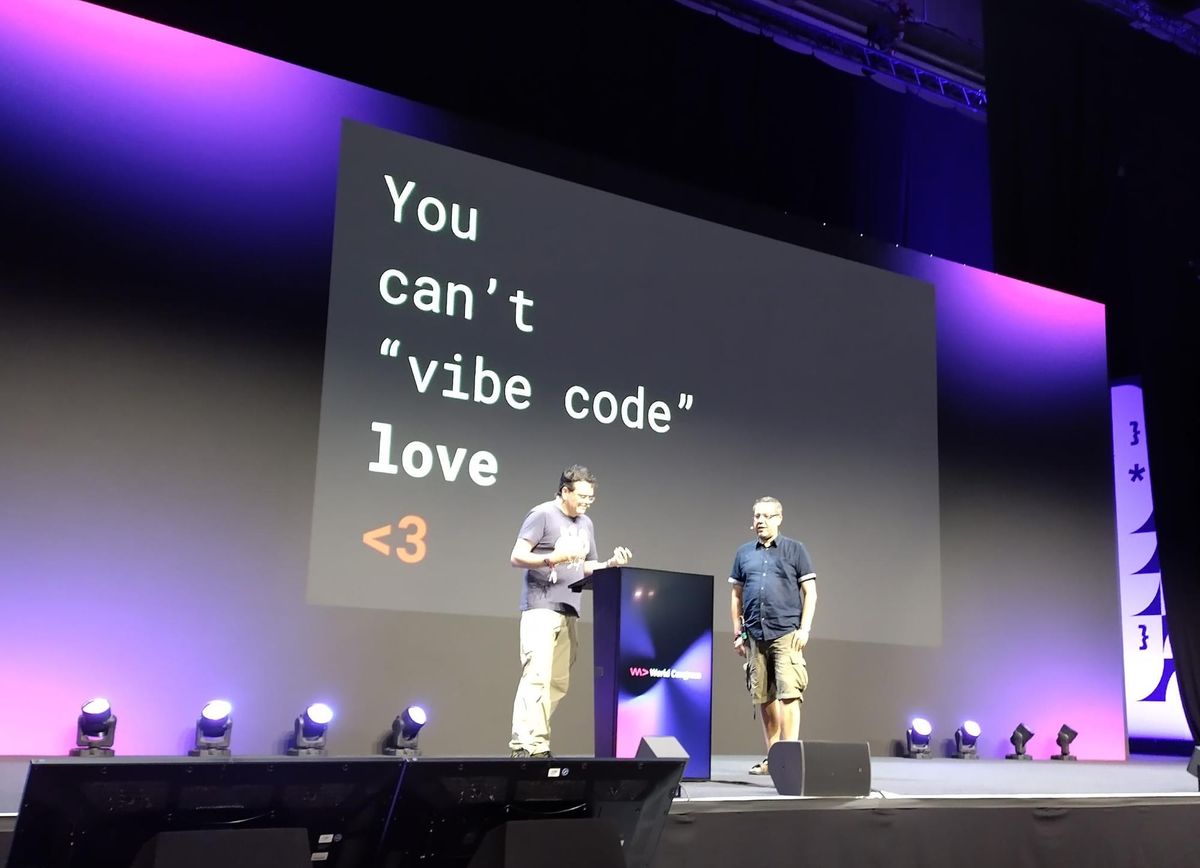
Main Facts and the Berlin Reunion
The keynote presentation, delivered on Friday, July 10, centered on the deeply intertwined personal and professional histories of Atwood and Dumke-von der Ehe. Reflecting on their partnership, Atwood described their meeting as a life-altering event enabled by the emergence of online programming communities. Dumke-von der Ehe, based in Berlin, was among the earliest community hires at Stack Overflow, embarking on a turbulent career trajectory that saw him leave the company, return, and eventually depart again—all while remaining an influential voice in the European developer scene.
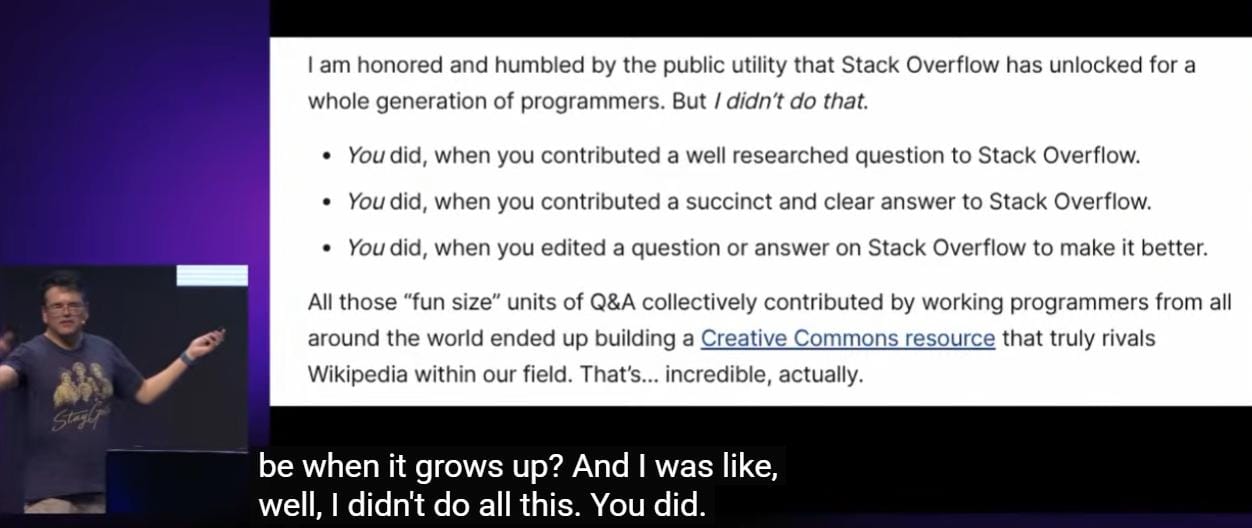
At its core, the presentation addressed the mechanics of how Stack Overflow was built. The platform’s success relied on a bedrock Creative Commons license, which protected and respected the collaborative efforts of millions of contributors who freely shared their expertise. This decentralized digital commons ultimately created one of the most valuable datasets in the history of software development—a dataset that would later become foundational for training the very AI models that now dominate the industry.
The Evolution of Search and the Role of LLMs
A significant portion of the discourse focused on the relationship between traditional Q&A platforms and modern artificial intelligence. Atwood noted that the primary long-term goal of Stack Overflow has always been efficient information retrieval rather than endless user engagement. According to historical platform objectives, an ideally functioning Q&A site should allow 98% of programmers to find the answers they need simply by reading existing search result pages, eliminating the need for individuals to ever ask or answer a question themselves.

In this context, the rise of LLMs is viewed not as an existential threat to Stack Overflow’s original mission, but as an evolution of it. Generative AI tools have effectively solved a long-standing logistical challenge within online communities: the problem of duplicate questions.
As a platform scales from one million to ten million, and eventually over one hundred million questions, the problem space expands exponentially. Navigating this vast landscape of prior art to ask a genuinely unique question becomes a daunting task, fraught with the risk of violating duplicate policies. LLMs possess the unique capability to map a user’s query—phrased using entirely novel terminology—directly to an existing, pre-solved answer. This capability dramatically reduces content duplication, accelerates problem resolution, and streamlines the developer workflow, aligning with the broader philosophy that accessing correct information quickly is the ultimate objective.
Chronology of Stack Overflow and the Open Web
To understand the current tension between AI and human communities, it is necessary to examine the chronology of online developer knowledge-sharing:
- Early 2000s: Programmers rely heavily on fragmented web forums, mailing lists, and static documentation like MSDN or man pages to troubleshoot coding errors.
- 2008: Stack Overflow is launched by Jeff Atwood and Joel Spolsky as an open, community-driven alternative to walled-garden expert networks. Creative Commons licensing is adopted to protect user contributions.
- 2010s: The platform scales rapidly, establishing a massive repository of programmatic solutions. Early community members, such as Ben Dumke-von der Ehe, help institutionalize moderation standards and community culture.
- Late 2010s to 2020: The growth of duplicate questions creates friction for moderators, leading to stricter closure guidelines and an increasingly complex landscape for new contributors.
- 2023–Present: The proliferation of Large Language Models shifts developer traffic away from traditional search engine result pages toward conversational AI interfaces, prompting questions about the sustainability of public data generation.
Supporting Data and Industry Implications
The transition of developer queries from public forums to private AI chat interfaces introduces significant economic and sociological questions for the technology sector. Industry data indicates a measurable shift in developer behavior: a growing percentage of routine syntax, debugging, and algorithmic questions are now resolved instantaneously via coding assistants integrated directly into Integrated Development Environments (IDEs) such as Visual Studio Code and JetBrains.
While this drastically reduces friction for individual developers, it creates a systemic challenge regarding the origin of future training data. AI models require continuous streams of high-quality, human-validated technical text to maintain accuracy and adapt to emerging programming languages, frameworks, and architectural paradigms. If programmers cease participating in public forums and shift entirely to private AI interactions, the pipeline of novel, peer-reviewed human knowledge risks drying up.
Industry analysts suggest that the future of technical education and problem-solving will depend on symbiotic models where AI platforms actively support, fund, or integrate with open community repositories. Without a healthy public commons, the foundational data supply chain for future AI generations could face severe stagnation.
Broader Impact and the Future of the Developer Commons
Atwood’s keynote concluded with a philosophical reflection on the irreplaceable nature of human community. While artificial intelligence excels at pattern matching, code generation, and duplicate resolution, it cannot replicate the organic mentorship, camaraderie, and shared passion that develop within active technical communities.
The rhetorical question posed in Berlin—regarding where future LLMs will source their training data if public ecosystems are abandoned—underscores a pressing responsibility for technology leaders. Protecting the digital commons requires robust governance, sustainable economic models that reward human contributors, and a cultural commitment to preserving open knowledge-sharing platforms.
Ultimately, the dialogue at the WeAreDevelopers World Congress highlighted a transition phase in software engineering. Artificial intelligence has fundamentally transformed how code is written and debugged, but the underlying social fabric of the programming community remains the indispensable anchor of technological progress. As the industry moves forward, the challenge will lie in balancing the individual efficiencies of generative AI with the collective preservation of the human networks that made modern software possible.