The Economic and Privacy Case for Local AI
In the current landscape of generative AI, the cost of automation is often hidden in a per-token pricing model. For individual developers, researchers, or small businesses, frequent interaction with sophisticated LLM-based agents can result in monthly bills ranging from $5 to $20, or significantly higher for intensive workflows. Beyond the fiscal impact, the "cloud-first" paradigm mandates that proprietary codebases, private documents, and internal project data be transmitted to external servers. This architecture creates a persistent security risk, as intellectual property becomes subject to the data retention policies and security protocols of the service provider.
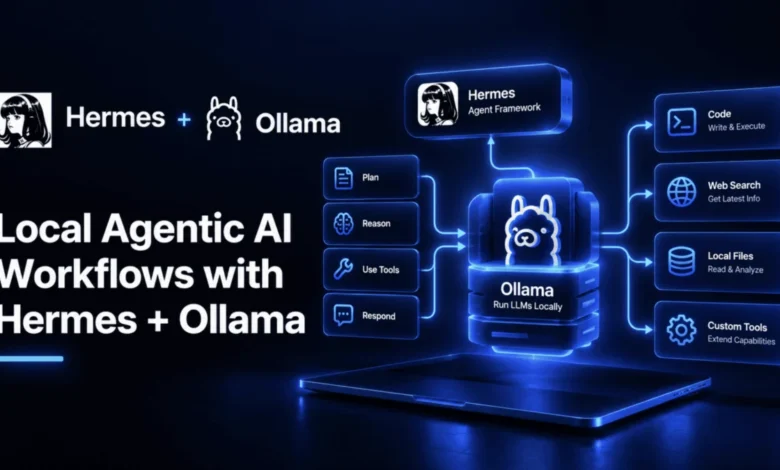
The movement toward local-first AI is a direct response to these vulnerabilities. By utilizing open-source frameworks such as Nous Research’s Hermes Agent and the Ollama model-serving platform, users can replicate the functionality of cloud-based assistants while maintaining absolute physical control over their information. This transition represents a shift in power dynamics, allowing the user to own the entire stack, from the model weights to the execution environment.
Understanding the Technical Stack: Hermes and Ollama
The proposed workflow relies on the synergy between two distinct pieces of software. Hermes Agent, currently maintained by Nous Research, acts as the intelligent orchestration layer. It is designed specifically for autonomous task execution, including file editing, command-line interface (CLI) interactions, and web navigation. Its architecture supports persistent memory, allowing it to "learn" user preferences and project structures over time, effectively reducing the need for redundant context-setting in subsequent sessions.
Underneath this orchestration layer lies Ollama, a lightweight tool optimized for serving open-weight large language models locally. Ollama bridges the gap between raw hardware and the agentic layer by exposing an OpenAI-compatible API. This compatibility is critical; it allows the Hermes Agent to treat a local model as if it were a high-end cloud provider, simply by pointing its configuration to a local host address. This interoperability ensures that users can upgrade or swap models without modifying the agent’s core logic.
Deployment Chronology and Configuration
The implementation of a local agentic workflow follows a structured path. Initially, the user must establish the Ollama server environment. Upon installation, the user pulls an LLM that supports "tool calling"—a technical prerequisite that allows the model to interact with the outside world rather than merely generating text. Models such as Gemma4:31b are preferred for these tasks because they demonstrate the reasoning depth required to navigate complex file structures or execute terminal commands accurately.
Once the model is active, the user configures the Hermes Agent’s configuration file, typically located within the user’s home directory. By specifying the local URL for Ollama and defining the agent’s operational parameters, the user creates a self-contained ecosystem. The agent is then capable of performing tasks ranging from directory analysis and code refactoring to complex data retrieval, all without internet-dependent latency or API authentication.
Comparative Analysis of Hardware Requirements
Transitioning to a local workflow necessitates an assessment of hardware capabilities. Performance is directly proportional to the available computational resources, specifically regarding VRAM (Video RAM) and system memory.
| Component | Minimum Specification | Recommended Specification |
|---|---|---|
| RAM | 8 GB | 32 GB or higher |
| CPU | 4 Cores | 8+ Cores |
| GPU | N/A | NVIDIA GPU (8 GB+ VRAM) |
| Storage | 5 GB | 30 GB (for model diversity) |
For users lacking dedicated GPUs, modern CPUs can handle smaller, more efficient models, though at a reduced token-generation speed. A 9B parameter model on a contemporary 8-core CPU can typically output approximately 10 tokens per second, which is adequate for asynchronous tasks. Conversely, a 31B model requires significant VRAM to function efficiently; without it, inference speeds may drop to 2 to 5 tokens per second, making real-time interaction less fluid.
Optimization Strategies for Professional Workflows
To maintain efficiency, users must move beyond default settings. A primary bottleneck is the model’s context window. By default, many local implementations limit the context to 2,048 tokens, which is insufficient for agentic workflows involving multiple files. By creating a custom "Modelfile," users can extend this context to 64,000 tokens or more, allowing the agent to "read" entire project repositories in a single pass.
Furthermore, managing memory persistence is vital. By utilizing commands to keep the model loaded in active memory for extended periods, users eliminate the latency caused by reloading large models between requests. When coupled with hardware-level GPU offloading, these optimizations allow even complex agentic workflows to operate at speeds comparable to, or in some cases faster than, cloud-based alternatives.
Extending Functionality: Gateways and Fallbacks
The utility of a local agent is maximized when it is accessible outside the primary workstation. The Hermes Agent’s messaging gateway enables integration with platforms like Telegram or Slack. This effectively transforms a private, local agent into a portable, personal assistant. By deploying the agent as a bot, a user can query their home or office server from their mobile device, ensuring that sensitive data never leaves the local machine while providing the convenience of cloud-based accessibility.
Finally, the architecture supports a "hybrid" model for scenarios where local resources may be insufficient. By configuring a fallback provider—such as an external API that is only triggered when the local model fails to produce a satisfactory answer—the user creates a fail-safe. This maintains the "zero-cost" objective for 90% of tasks while ensuring that the most complex, high-reasoning requirements are met by powerful, albeit paid, external systems.
Broader Implications and Future Outlook
The shift toward local-first AI is indicative of a broader trend in the technology sector: the reclamation of user autonomy. As regulatory scrutiny over data privacy increases, the ability to process information locally provides a clear compliance advantage for enterprises. Furthermore, as open-source models continue to narrow the performance gap with proprietary models, the "all-cloud" dependency of the last few years is likely to be replaced by a hybrid landscape where local execution becomes the default for standard operations.
This technological evolution underscores a fundamental change in how software developers perceive AI. It is no longer viewed merely as a remote service to be consumed, but as a local utility that can be integrated into one’s own hardware infrastructure. As tools like Hermes and Ollama mature, the barrier to entry for building sophisticated, autonomous, and private AI agents will continue to fall, marking a significant milestone in the democratization of artificial intelligence.