The Evolution of Document Intelligence
The history of document retrieval has progressed through several distinct stages. In the early 2000s, Optical Character Recognition (OCR) revolutionized the ability to search within scanned PDFs. However, OCR often struggled to maintain the semantic relationship between a paragraph of text and an adjacent chart or graph. By 2020, the emergence of Large Language Models (LLMs) allowed for natural language querying of document databases. Yet, these models often suffered from "contextual amnesia" regarding visual data, as they prioritized textual tokenization over pixel-based analysis.
The current shift toward Multi-Modal RAG represents a paradigm shift. According to industry research from organizations like KDnuggets, modern AI architectures are now being designed to treat visual and textual information as peers rather than silos. By integrating computer vision with natural language processing, developers can create pipelines that maintain the "spatial awareness" of a document, ensuring that when an AI answers a query about revenue growth, it can cross-reference the narrative text with the underlying visual trend line in a Q3 chart.
Technical Architecture and Data Workflow
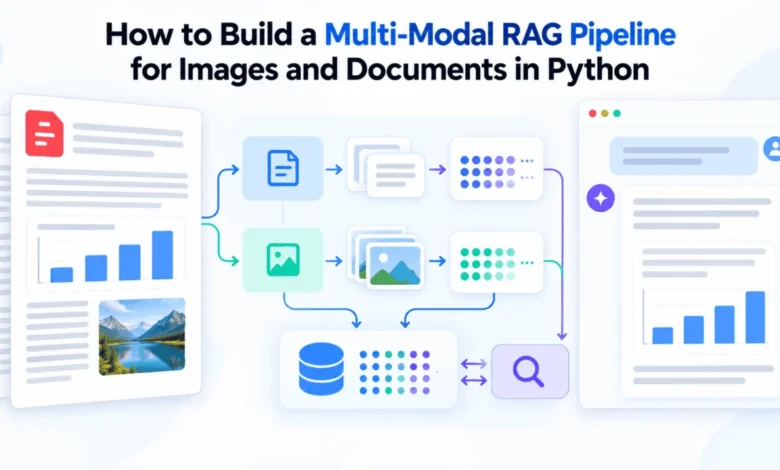
The architecture of a multi-modal RAG pipeline is fundamentally different from a text-only approach. Instead of a linear ingestion process, it employs a sophisticated four-stage lifecycle: Parsing, Summarization, Vectorization, and Multimodal Retrieval.
Phase 1: Intelligent Parsing
The process begins with the unstructured library, a pivotal tool in the modern data engineering stack. Unlike primitive text extractors, unstructured partitions a PDF into granular elements. It identifies the document’s hierarchy—separating body text, headings, tables, and images. The system effectively labels these components, allowing the developer to store them with appropriate metadata. This ensures that when a table is encountered, the system retains the spatial structure necessary for a model like GPT-4o to interpret rows and columns accurately.
Phase 2: Generating Semantic Proxies
A common challenge in vector databases is that raw image files lack semantic density; they cannot be embedded in a vector space alongside text. To solve this, the pipeline generates "semantic proxies." By passing each extracted image to a vision-enabled model, the system generates a detailed text summary of the image’s content. These summaries are then embedded, creating a searchable bridge between a natural language query and the visual asset. This methodology ensures that even if a user doesn’t know the exact file name of a chart, the system can retrieve it based on the visual information it contains.
Phase 3: The Multi-Vector Retrieval System
Standard RAG systems rely on a single vector store. A multi-modal pipeline, however, requires a MultiVectorRetriever. This component acts as a traffic controller, managing two distinct storage layers:
- The Vector Store: Houses the embeddings of text chunks and image summaries, facilitating rapid similarity searches.
- The Document Store: An
InMemoryStorethat holds the original, raw content—the text paragraphs and the actual image files—linked to the embeddings via unique identifiers (UUIDs).
This dual-layer structure ensures that the system remains performant without sacrificing the fidelity of the original data.
Implementation Requirements and Prerequisites
To deploy this architecture, developers must ensure a robust environment. Beyond the standard Python stack—including langchain, langchain-openai, and chromadb—the system requires the poppler-utils dependency. This system-level package is essential for rendering PDF pages into images that the unstructured library can then parse.
# Essential installation command for the pipeline
pip install langchain langchain-openai unstructured[pdf] chromadb pillow
apt-get install -y poppler-utils
Strategic Implications for Enterprise Data
The adoption of multi-modal RAG has significant implications for sectors reliant on dense, visually complex documentation. In the financial sector, analysts can query thousands of annual reports simultaneously, asking for comparative analysis of EBITDA across multiple years—a task that would previously require manual inspection of dozens of tables and charts.
Furthermore, in the manufacturing and aerospace industries, maintenance manuals often contain complex schematic diagrams. A multi-modal RAG system allows technicians to ask, "Show me the correct sequence for replacing the hydraulic pump," and receive both the step-by-step text instructions and the precise visual diagram of the component layout.
Addressing Costs and Performance
A critical fact-based analysis of this pipeline reveals a trade-off between accuracy and computational cost. Every image extracted from a document triggers an API call to a vision-language model (e.g., GPT-4o) during the indexing phase. For large-scale document repositories, this can lead to significant API expenditures.
Best practices dictate that developers should implement a filtering mechanism. By discarding images below a certain pixel threshold—such as logos, icons, or decorative elements—the system can reduce noise and lower costs without impacting the quality of the retrieved information.
Future Trajectories
The field is currently moving toward "native" multimodal retrieval. While the current pipeline relies on generating text summaries of images, newer models like ColPali are beginning to allow for the embedding of document pages as visual images directly. This approach bypasses the parsing stage entirely, potentially offering higher accuracy for documents with complex, non-standard layouts.
As this technology matures, we can expect to see a shift away from manual document labeling toward fully autonomous, vision-first indexing. For developers, the goal remains the same: to minimize the distance between the user’s question and the most accurate evidence, regardless of whether that evidence resides in a line of text or a pixelated chart.
Conclusion
Building a multi-modal RAG pipeline is no longer an experimental luxury; it is a necessity for organizations attempting to leverage their existing data assets in the era of Generative AI. By treating images as first-class citizens in the retrieval process, developers can bridge the gap between human intuition—which relies heavily on visual information—and machine-driven data processing. This architectural approach, centered on parsing, summarization, and multi-vector storage, provides a scalable and reliable framework for transforming document management into a dynamic, queryable intelligence system.