Automating Knowledge Graph Population: Extracting Entities and Triples from Unstructured Text with an LLM

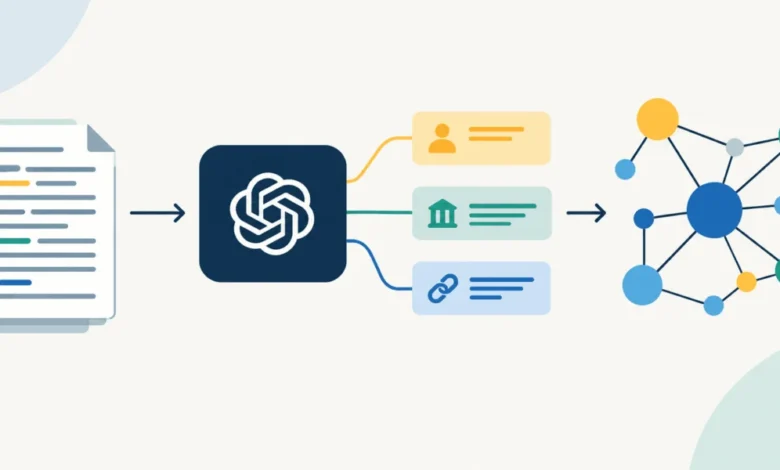
The evolution of Retrieval-Augmented Generation (RAG) systems has reached a critical juncture where standard vector-based search is no longer sufficient for enterprise-grade accuracy. As organizations grapple with the inherent non-determinism of Large Language Models (LLMs), the industry is shifting toward Graph-RAG architectures. This paradigm utilizes knowledge graphs to anchor LLM responses in verifiable, structured data. Central to this transition is the automated extraction of information from the vast repositories of unstructured text that define the modern internet, such as Wikipedia or internal documentation. By utilizing local LLMs through platforms like Ollama, developers can now systematically transform narrative text into SPOC (Subject-Predicate-Object-Context) quads, effectively populating high-fidelity knowledge graphs without the need for expensive, proprietary cloud APIs.
The Problem of Hallucination in Vector Search
Traditional RAG systems function by converting text into high-dimensional vectors, which are then stored in a vector database. When a user submits a query, the system retrieves semantically similar chunks of text. While effective, this process is purely statistical. If the retrieved context is ambiguous or contradictory, the LLM may hallucinate, generating plausible but factually incorrect assertions. Deterministic Graph-RAG mitigates this by enforcing a structural layer: the knowledge graph. By breaking down information into explicit triples—and adding a context "quad"—developers can provide the LLM with a rigid framework of ground-truth facts. The challenge has historically been the labor-intensive nature of creating these graphs. Automating this via local LLMs represents a significant advancement in data pipeline efficiency.
Technical Foundation and Setup
The implementation of an automated extraction pipeline requires a local inference engine. Ollama has emerged as the standard for local LLM deployment, offering a lightweight, containerized environment that supports models such as Llama 3.2. For developers working within environments like Google Colab or local Python IDEs, the process begins by installing necessary dependencies, specifically the wikipedia library for data acquisition and the requests library for local API communication.
To begin, the local Ollama server must be initialized. Using the Python subprocess module, developers can trigger the server as a background process. Once active, the Llama 3.2 model is pulled into the local environment. This model is particularly well-suited for this task due to its ability to operate in a strict JSON output mode. Structured outputs are mandatory for reliable data parsing; without them, downstream database insertion processes would consistently fail due to format inconsistencies.
From Narrative Text to Structured Quads
The transformation of raw text into a SPOC format involves four distinct components:
- Subject: The primary entity being described.
- Predicate: The specific relationship or action connecting the subject to an object.
- Object: The target entity or value.
- Context: A metadata tag defining the source, date, or specific domain of the fact.
This fourth dimension is arguably the most critical for modern knowledge management. By tagging a fact with its source—for instance, "Wikipedia_Alan_Turing"—the system retains provenance. If the source information is later updated or deemed unreliable, the entire branch of the knowledge graph associated with that context can be purged or corrected without affecting the rest of the database.
The Extraction Workflow: A Practical Example
The process begins with the extraction of a summary from a trusted knowledge base. Using the wikipedia Python library, a script can pull the first few paragraphs of an article, ensuring the auto_suggest feature is disabled to maintain data integrity. This raw text is then passed to the Llama 3.2 model through a prompt engineering template designed to enforce JSON output.
The prompt instructs the model to act as an "expert data extraction algorithm," forcing it to identify atomic facts and structure them into an array of objects. Upon receiving the response, the system performs a validation check. It verifies that the JSON is well-formed, extracts the relevant triples, and appends the predefined context_label to create the final quad. This normalized data is then ready to be inserted into a QuadStore—a lightweight, Python-based graph database that supports both insertion and filtered querying.
Data Integrity and Model Performance
In initial testing with the Alan Turing Wikipedia entry, the pipeline successfully extracted 11 discrete facts, including biographical details and professional contributions. While the LLM is highly effective at identifying these relationships, it is important to acknowledge the inherent variability of generative models. Even with a temperature set to 0.0 (the most deterministic setting), the model may occasionally phrase predicates differently or combine facts.
From an analytical perspective, this variance highlights why the "human-in-the-loop" or "validation-layer" approach is necessary for production environments. Before populating a mission-critical database, developers should implement a filtering step that verifies entities against known ontologies or Wikidata IDs. This ensures that "Alan Mathison Turing" and "Turing" are recognized as the same subject, preventing the fragmentation of nodes within the graph.
Broader Implications for Enterprise AI
The ability to build a knowledge graph from scratch using only open-source tools has profound implications for data sovereignty. Previously, companies were reliant on cloud-based AI services to perform entity extraction, which presented privacy risks and recurring costs. By moving the extraction pipeline to local infrastructure, organizations can now process sensitive internal documents, legal contracts, or proprietary research without the data ever leaving their secure network perimeter.
Furthermore, the integration of these quads into a 3-tiered Graph-RAG architecture allows for more sophisticated query resolution. Tiered systems can first query the graph for absolute facts, and only if the information is missing, fall back to vector search for more nuanced or subjective analysis. This hierarchical approach effectively minimizes hallucinations by creating a "truth-gate" that the LLM must pass through before generating a final response.
Future Outlook: Scaling and Optimization
As this technology matures, the focus will likely shift toward scaling the extraction process. The current method of processing one article at a time is sufficient for small-scale applications, but enterprise deployment will require parallelization and distributed processing. Future iterations may include the use of smaller, task-specific language models trained exclusively on relationship extraction, which would offer higher throughput and lower latency than general-purpose models like Llama 3.2.
Ultimately, the democratization of knowledge graph construction marks a shift away from the "black box" era of AI. By prioritizing structural integrity and deterministic retrieval, developers are building systems that are not only smarter but also more accountable. The transition from unstructured text to a clean, queryable knowledge base is no longer a luxury reserved for large research institutions; it is a fundamental capability available to any developer with a local machine and a commitment to data accuracy. As the ecosystem of Python-based graph databases continues to expand, the barrier to entry for building robust, fact-based AI systems will continue to fall, paving the way for a new generation of reliable, enterprise-grade applications.