Kazakhstans Rapid Ascent as a Central Asian AI Powerhouse Highlighted by NVIDIA CEO Jensen Huangs Landmark Astana Visit


Kazakhstan is rapidly transitioning from foundational infrastructure planning to full-scale technological deployment, marking a major milestone in Central Asia’s digital economy. This evolution across the entire artificial intelligence stack—spanning high-performance hardware, localized large language models, and enterprise-grade applications—was thrown into sharp relief during a landmark diplomatic and industrial visit to Astana by NVIDIA founder and CEO Jensen Huang. The high-profile visit underscored the nation’s surging capacity for accelerated computing and its growing ambition to become a globally competitive AI nation.
The sequence of announcements made during the trip signals a paradigm shift for the country. By leveraging its vast energy reserves to power massive data centers and prioritizing the preservation of its linguistic and cultural identity through indigenous models, Kazakhstan is positioning itself not merely as a consumer of foreign technology, but as a sovereign producer and exporter of digital intelligence.
A High-Level Dialogue at Alem.AI
On Friday, October 23, NVIDIA CEO Jensen Huang arrived in the Kazakh capital of Astana, where his itinerary combined high-level state diplomacy with grassroots industry engagement. Huang held official discussions with President Kassym-Jomart Tokayev at the Akorda Presidential Palace, focusing on the strategic integration of artificial intelligence into the national economy. Following the presidential meeting, Huang participated in a public fireside chat at Alem.AI, Kazakhstan’s premier international center for artificial intelligence, alongside Deputy Prime Minister Zhaslan Madiyev, who also serves as the minister of AI and digital development.
The conversation between Madiyev and Huang centered on Kazakhstan’s strategic roadmap to evolve into a fully realized AI economy. Madiyev emphasized the government’s commitment to developing technological systems that authentically represent the country’s linguistic and cultural heritage.

"We want AI that understands and speaks Kazakh and captures cultural contexts and cultural specifics," Madiyev stated, detailing ongoing national initiatives to train sophisticated Kazakh-language models that reflect local idioms, history, and societal values.
Responding to these ambitions, Huang provided a visionary perspective on how Kazakhstan can leverage its traditional industrial strengths for the digital age. He suggested that the nation could pivot from simply exporting raw energy commodities to transforming that energy into computational intelligence for global export.
"Instead of just exporting energy, in the future, you could transform energy into intelligence and export intelligence," Huang remarked. He further stressed the critical importance of data sovereignty, asserting that a nation’s indigenous data serves as its most valuable natural resource. "Your country’s data is your natural resource. It belongs to you."
Scaling the Infrastructure Layer
The momentum of Huang’s visit was matched by concrete industrial commitments, highlighted by a major investment agreement signed at the presidential palace between the government of Kazakhstan and infrastructure firm Firebird. Building upon its pioneering AI factory model established in Armenia, Firebird is officially expanding its footprint into Kazakhstan. The firm has successfully secured a U.S. export license to deploy 45,000 NVIDIA Grace Blackwell GPUs.
The initial construction phase of this ambitious project is currently underway in collaboration with Kazakhtelecom at the country’s designated Data Center Valley. Commercial launch for this first phase is targeted for the third quarter of 2027. A planned second development phase is projected to scale Firebird’s total potential AI infrastructure capacity within Kazakhstan to approximately 500 megawatts. Additionally, the company will establish Firebird Labs Kazakhstan to foster local tech startups, academic research, and talent development through targeted funding and compute access.

Razmig Hovaghimian, co-founder and CEO of Firebird, reflected on the rapid acceleration of the project during the signing ceremony at the Akorda Presidential Palace.
"What began as a seed of an idea 180 days ago has grown into a major investment in Kazakhstan’s AI future," Hovaghimian said. "President Tokayev’s vision gave us the confidence to think bigger about what we can build together. With Jensen Huang here today, that ambition feels more tangible than ever. We’re building the infrastructure for Kazakhstan’s talent and ideas to reach the world."
Telecommunications giant Kazakhtelecom is similarly accelerating the nation’s hardware capabilities. The company has already deployed 400 NVIDIA H200 and 480 NVIDIA B300 GPUs across facilities in Astana and Almaty. Looking ahead to the coming year, Kazakhtelecom plans to deploy over 1,000 additional GPUs within Data Center Valley, alongside more than 1,000 NVIDIA Vera Rubin GPUs in the northern industrial region of Ekibastuz, providing scalable, high-performance computing resources for local enterprises, academic institutions, and independent developers.
Physical AI and Autonomous Mobility
Beyond traditional data processing and language models, the discussions in Astana explored the vast potential of physical AI—the integration of machine intelligence into robotics, manufacturing, and transport systems. Deputy Prime Minister Madiyev pointed to Kazakhstan’s robust industrial sectors, including heavy manufacturing, mining, agriculture, transportation, and logistics, as prime candidates for automation and optimization. He queried how the nation could position itself as a regional hub for training models dedicated to physical systems and autonomous machinery.
Huang enthusiastically endorsed the concept, noting that physical AI holds the potential to radically transform traditional resource extraction, mineral processing, and agricultural yields. He emphasized that while advanced robotics and algorithms are designed to augment human capability, national ambition will ultimately dictate the extent to which these economic opportunities are realized.
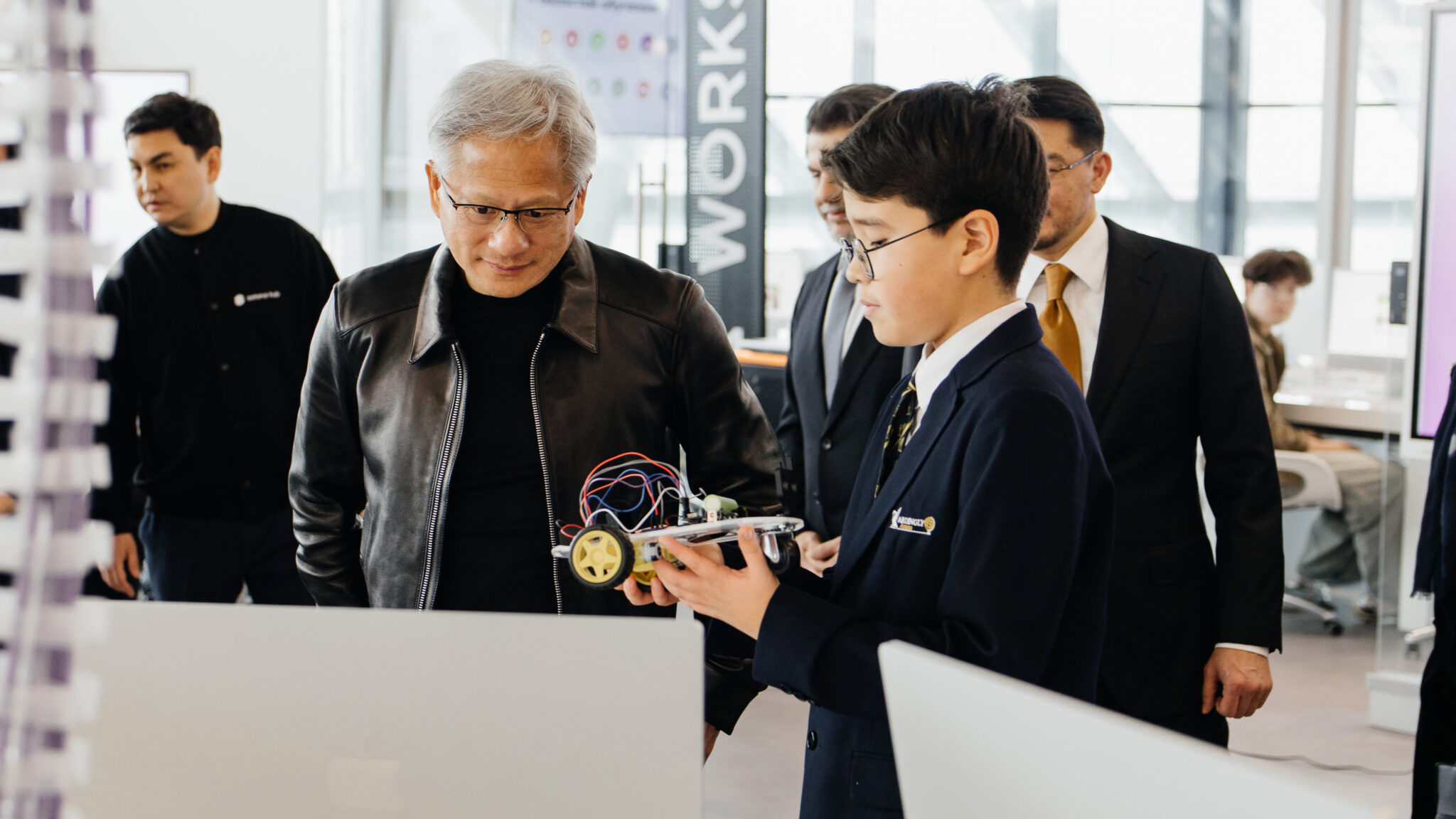
"If you have ambition, and I believe you do, AI will lift your nation," Huang told the audience. "AI will lift your people."
This vision of physical AI is already translating into real-world pilot projects across the country. In a notable mobility development, ride-hailing platform inDrive and autonomous driving technology firm Pony.ai announced a strategic collaboration to explore autonomous mobility services in Kazakhstan, with Astana selected as the primary deployment city. The partnership will evaluate the operational feasibility of integrating Pony.ai’s seventh-generation robotaxis directly into the inDrive application. This autonomous initiative will be powered by robust NVIDIA AI infrastructure, utilizing the NVIDIA Hyperion sensor and compute platform alongside the NVIDIA Halos safety framework to ensure high standards of operational reliability and passenger security.
Ecosystem Growth and Venture Investment
As hardware deployment accelerates, Kazakhstan’s domestic, AI-native startup ecosystem is expanding in tandem. During the events in Astana, NVIDIA announced a strategic investment in Higgsfield AI, a prominent global startup founded by Kazakh entrepreneurs. Huang praised the company’s leadership team, emphasizing that venture investment must fundamentally focus on backing exceptional human talent rather than corporate entities alone.
"The first thing and the last thing is you invest in people, not companies," Huang stated, commending the founders for their visionary drive and their ability to successfully compete on the global stage. To support its ongoing expansion, Higgsfield is scaling its underlying AI infrastructure by integrating NVIDIA Vera Rubin architecture via cloud service providers, ensuring sufficient computational headroom as demand for its generative media applications continues to surge.
Addressing concerns regarding safety and operational security in an increasingly automated world, Huang outlined NVIDIA’s proactive approach to responsible deployment. He highlighted technologies such as NVIDIA OpenShell, which is engineered to securely contain autonomous AI agents by strictly regulating their access to sensitive files and external tools while continuously monitoring their operational activity.
Honors and Recognition
In recognition of his profound impact on the technological modernization of the nation, President Kassym-Jomart Tokayev formally presented Jensen Huang with the Order of Dostyk, First Class. The prestigious honor, where dostyk translates from Kazakh to mean friendship, is awarded to individuals who have made exemplary contributions to fostering international peace, mutual friendship, and cooperative development.
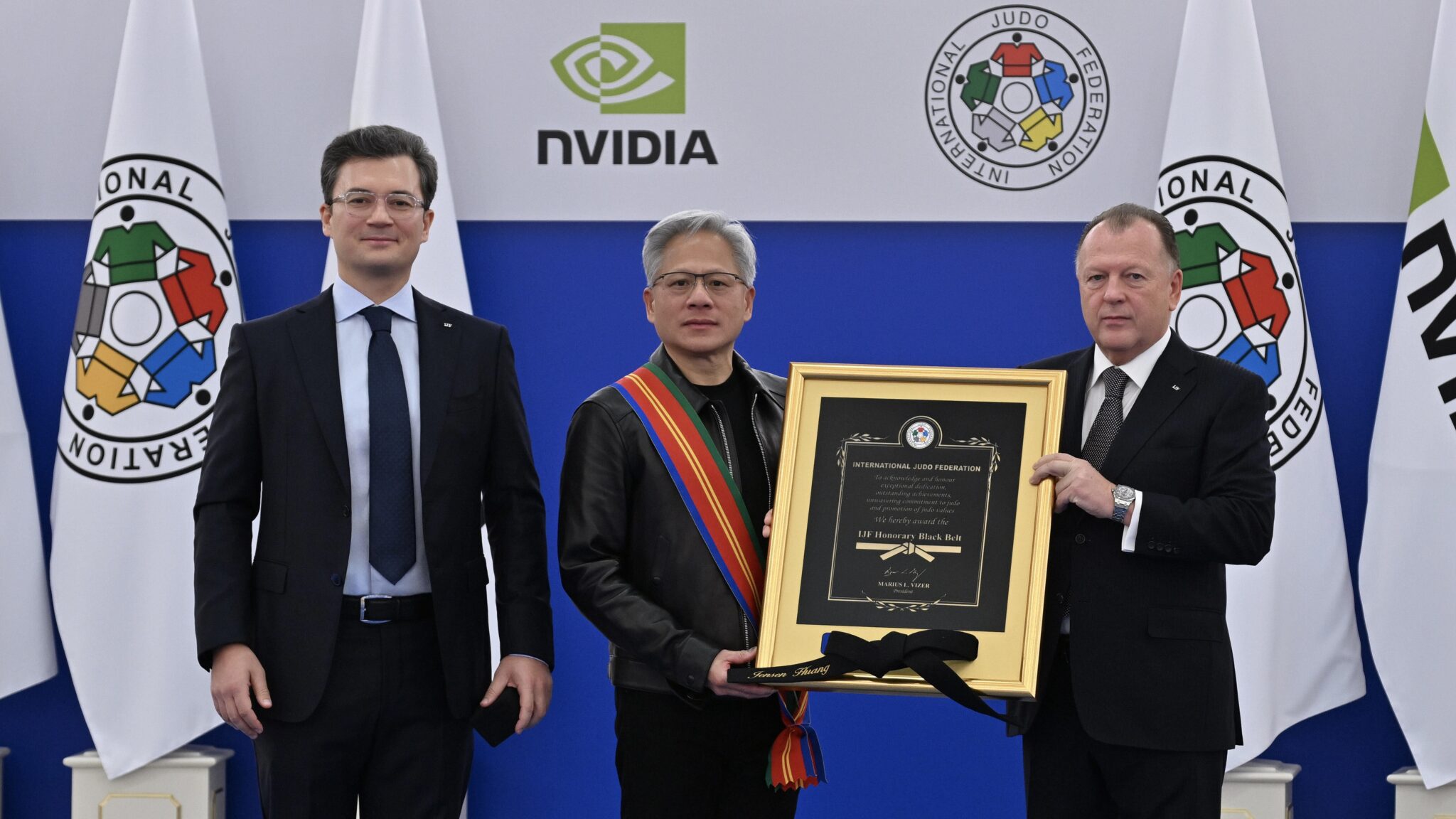
Further underscoring the spirit of discipline and rigor associated with the country’s leadership goals, Marius Vizer, President of the International Judo Federation (IJF), alongside IJF Executive Committee member and promotion director Timur Kemell, presented Huang with an honorary black belt in judo. The ceremonial belt, intricately embroidered with gold stitching, served as a symbolic tribute to Huang’s steadfast support for Kazakhstan’s technological trajectory and leadership qualities that mirror the dedication of the martial art.
Implications for the Future of Central Asian Technology
The convergence of massive hardware investments, government-backed policy frameworks, and active venture capital participation marks a defining chapter in Kazakhstan’s economic history. By methodically constructing every layer of the artificial intelligence stack—from sustainable energy conversion and accelerated computing hardware to culturally resonant language models and physical robotics—Kazakhstan is establishing a blueprint for emerging economies seeking to transition from resource dependence to digital sovereignty.
For the younger generation of Kazakh developers, engineers, and scientists, the technological transformation represents a generational opportunity. Offering guidance to aspiring technologists during his visit, Huang advised students to master the foundational principles of computer science rather than merely learning surface-level applications, encouraging them to embrace a rapidly evolving global landscape.

"I envy being 18 years old today… because the world is changing so rapidly, and there’s a complete reset because of technology," Huang reflected.
Ultimately, the events in Astana demonstrate that Kazakhstan’s digital trajectory is no longer defined by abstract infrastructure projections. With localized compute capacity scaling rapidly and domestic enterprises deploying advanced AI models into production, the nation is successfully translating high-level vision into tangible economic output, cementing its status as a rising technological hub in Central Asia.