D-Matrix Adopts NVIDIA NVLink Fusion to Integrate Next-Generation Raptor XPUs into AI Infrastructure Platforms

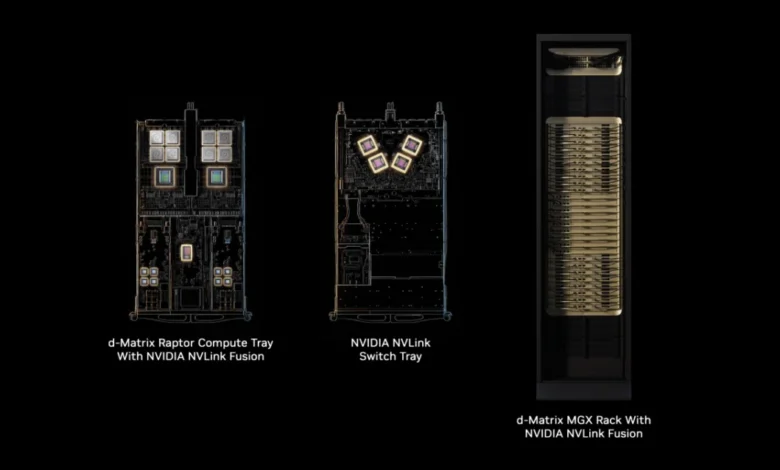
The landscape of artificial intelligence infrastructure is undergoing a fundamental architectural shift as specialized hardware developers seek streamlined pathways to large-scale data center deployment. In a significant industry development, AI inference chipmaker d-Matrix has formally announced its decision to integrate NVIDIA’s advanced NVLink Fusion technology into its product roadmap. By adopting this connectivity standard, d-Matrix will link its upcoming generation of Raptor XPUs—accelerated processing units designed explicitly for artificial intelligence inference workloads—directly into the broader NVIDIA AI platform. This strategic move aligns d-Matrix with a rapidly expanding ecosystem of hardware partners aiming to capitalize on mature, standardized infrastructure designs.
The collaboration bridges d-Matrix’s specialized silicon innovations with NVIDIA’s comprehensive hardware and networking stack, which includes NVLink scale-up domains, Spectrum-X scale-out networking, and the NVIDIA MGX rack architecture. For d-Matrix, this integration offers an accelerated and substantially de-risked methodology for transitioning from custom silicon design to enterprise-grade, rack-scale deployment. As the global demand for high-performance artificial intelligence inference continues to outpace traditional data center capabilities, hardware developers face mounting pressure to deliver solutions that balance computational efficiency with financial and energy constraints.
The Growing Pressures of AI Inference and the Need for Standardization
The exponential growth of generative artificial intelligence and large language models has fundamentally altered the economics of modern computing. While the initial wave of artificial intelligence development focused heavily on model training—a computationally intensive phase traditionally dominated by massive GPU clusters—the industry’s current trajectory is heavily weighted toward inference. Inference represents the operational phase where trained models process real-time queries, generate text, analyze images, and execute complex reasoning tasks for end users.
Because inference occurs continuously at scale, the volume of computational requests is staggering. Industry analysts project that inference workloads will consume a vastly larger share of global data center resources compared to training over the next decade. However, this surging demand collides directly with the physical and economic realities of modern infrastructure. Capital expenditure budgets for data center construction are finite, electrical grid capacities face severe bottlenecks, and the physical footprint of cooling systems imposes strict limitations on power density.
During a recent media briefing, d-Matrix co-founder and Chief Executive Officer Sid Sheth addressed these core industry challenges head-on. "Demand for inference is soaring, but capital, time, and energy remain finite," Sheth stated. He emphasized that by leveraging NVLink Fusion and the MGX framework, d-Matrix can seamlessly incorporate its Raptor XPUs into broadly deployed, liquid-cooled architectures. This integration provides enterprise customers with a much faster, lower-risk pathway to deploy and scale ultra-low-latency inference solutions without reinventing the underlying data center infrastructure.
Overcoming the Hurdles of Custom Silicon Deployment
Historically, the journey from designing a custom processor to successfully deploying it within a hyperscale data center has been fraught with engineering hurdles, exorbitant costs, and extended timelines. Developing an advanced chip is merely the initial phase of a complex value chain. To achieve true AI factory scale, silicon innovators must engineer a complete, cohesive ecosystem that spans high-speed chip-to-chip interconnects, scale-up and scale-out networking topologies, modular rack architectures, power delivery mechanisms, advanced liquid cooling systems, and robust software stacks.
Every individual step in this integration pipeline introduces distinct technical risks. Sourcing cutting-edge semiconductor components, validating high-speed communication interfaces, and designing proprietary rack architectures that comply with modern enterprise safety and thermal standards can delay product launches by months or even years. Furthermore, data center operators have historically resisted fragmenting their facilities with custom, single-purpose rack designs for every unique processor type entering the market.
To solve these systemic friction points, NVIDIA engineered NVLink Fusion as a high-bandwidth, low-latency interconnect technology designed to bridge custom XPUs and CPUs directly into the proven NVIDIA ecosystem. By utilizing NVLink Fusion, specialized silicon companies can bypass the monumental task of building proprietary infrastructure from the ground up. Instead, they can plug directly into validated rack designs, established global supply chains, and standardized power and cooling topologies. This standardization allows data facilities to construct universal racks capable of housing diverse compute engines—including GPUs, CPUs, and specialized XPUs—within a single, unified operational footprint.
Technical Architecture and Deep Integration with the NVIDIA Stack
Under the terms of the newly announced partnership, d-Matrix plans to utilize NVIDIA NVLink to interconnect its Raptor XPUs within a high-bandwidth, low-latency scale-up domain. This architectural design enables d-Matrix racks to operate collaboratively and harmoniously alongside existing NVIDIA GPU-based systems, such as the NVIDIA Vera Rubin NVL72 platform, facilitating advanced disaggregated inference configurations where different hardware components handle distinct stages of a complex AI workflow.
Beyond core compute connectivity, the integration plan encompasses a wide array of NVIDIA’s cutting-edge networking and processor technologies. d-Matrix intends to incorporate NVIDIA Vera CPUs, ConnectX-9 SuperNICs, BlueField-4 DPUs, and Spectrum-X Ethernet networking into its deployment frameworks. The convergence of these components with NVLink and the MGX rack architecture establishes a rock-solid foundation. It allows d-Matrix to deploy its specialized inference accelerators right alongside traditional NVIDIA infrastructure within flexible, highly efficient, and unified AI factories.
The NVIDIA AI platform itself is intentionally built to be vertically integrated yet horizontally open. While the proprietary software stack and hardware components ensure optimized performance, architectures like NVLink Fusion extend this openness to third-party XPUs and CPUs. This strategic openness empowers specialized silicon developers to concentrate entirely on their core processor innovations—such as optimizing matrix multiplication units, reducing memory footprint, or maximizing energy efficiency—while relying on NVIDIA’s robust infrastructure framework to deploy those innovations at enterprise scale.
Expanding the Horizon of NVIDIA AI Factories
The broader NVIDIA full-stack AI factory ecosystem represents the state of the art in modern computing architecture. Incorporating systems such as the NVIDIA Vera Rubin NVL72, Groq 3 LPX, Vera CPU racks, Vera BlueField-4 STX storage solutions, and Spectrum-6 SPX Ethernet networking, this infrastructure is engineered to be entirely fungible. A fungible AI factory is capable of dynamically executing virtually every conceivable artificial intelligence workload, deep learning model, and architectural variation with maximum performance-per-watt ratios and the lowest possible cost per token.
The introduction of NVLink Fusion grants enterprise customers unprecedented flexibility. Data center operators can precisely match the optimal compute architecture to each specific workload within a standardized, unified platform. Whether a task requires massive parallel processing via GPUs, general-purpose instruction handling via CPUs, or specialized low-latency matrix mathematics via XPUs like those developed by d-Matrix, the infrastructure can adapt fluidly.
For specialized silicon innovators, this level of platform integration transforms the commercialization landscape. By gaining authorized access to NVIDIA’s advanced networking fabric, system architectures, software libraries, and global supply chain networks, companies like d-Matrix can dramatically compress their time-to-market metrics. Furthermore, the reduction in engineering and validation risk makes semi-custom AI factory deployments economically viable for a broader segment of the semiconductor industry.
Broader Industry Implications and Future Outlook
The alignment between d-Matrix and NVIDIA highlights a broader, defining trend in the contemporary technology sector: the transition from proprietary silos toward collaborative ecosystems. As artificial intelligence models continue to scale in parameter size and complexity, no single hardware architecture can efficiently handle every facet of the computational pipeline. The future belongs to heterogeneous computing environments where diverse processors collaborate seamlessly over ultra-high-speed interconnects.
For the enterprise market, the standardization fostered by NVLink Fusion promises to lower the barriers to adopting specialized silicon. Historically, procurement departments hesitated to deploy niche processors due to the integration complexities and the risk of hardware lock-in or infrastructure obsolescence. By standardizing on universal rack architectures like MGX and utilizing common interconnect standards, enterprises can future-proof their data center investments. They can integrate cutting-edge innovations from emerging startups like d-Matrix without disrupting their foundational power, cooling, and networking investments.
As d-Matrix advances toward the commercial deployment of its Raptor XPUs utilizing NVLink Fusion, the industry will be closely monitoring the performance benchmarks and adoption rates within hyperscale environments. The success of this collaboration may well serve as a blueprint for future hardware integrations, demonstrating that even competing or specialized semiconductor developers can thrive by anchoring their innovations to a universally accepted, high-performance infrastructure standard. Ultimately, this cooperative framework accelerates the maturation of the global AI economy, ensuring that compute power can scale efficiently to meet the relentless demands of next-generation artificial intelligence applications.