Skild AI Unveils S1 Foundation Model and Expands NVIDIA Partnership to Revolutionize Industrial Robotics

Industrial automation has historically been constrained by rigidity. Manufacturing floors, complex distribution warehouses, and high-precision production lines are dynamic, ever-changing environments where tasks evolve, physical layouts shift, and new products arrive on short notice. Traditional industrial robots, despite their high precision and speed, have rarely been able to keep up with this fluidity without requiring extensive, time-consuming reprogramming, custom dataset creation, and tedious validation cycles. Every minor shift in a product line or factory floor layout traditionally demands a dedicated team of robotics engineers to rewrite code, recalibrate sensors, and fine-tune machine-learning weights.
Addressing this fundamental bottleneck in physical artificial intelligence, Skild AI officially launched its groundbreaking S1 robot foundation model last week. Built to learn previously unseen, long-horizon tasks from a single video demonstration, the S1 model introduces an unprecedented level of adaptability to automation. Leveraging a technique known as in-context learning, the model takes video inputs to comprehend and immediately execute complex physical tasks without requiring updates to its underlying neural network weights or undergoing task-specific post-training.
The launch of the S1 model coincides with a remarkable commercial milestone for Skild AI. Just 10 months after deploying its technology into the commercial market, the company has surpassed an impressive $100 million annual revenue run rate. Furthermore, Skild has rapidly established more than 60 commercial deployment partnerships, spanning critical industrial sectors such as advanced manufacturing, logistics, heavy inspection, institutional security, and specialized food preparation.
Background Context and the Evolution of Physical AI
For decades, industrial robotics operated on a deterministic paradigm. Robots were programmed to perform repetitive, highly specific motions within controlled environments. If a bolt was moved by a millimeter or a component design changed slightly, the robot would fail unless manually retrained. This limitation severely restricted the deployment of autonomous systems in small-batch manufacturing, custom assembly, and unpredictable warehouse environments.
The paradigm began to shift with the advent of deep learning and reinforcement learning, but scaling robotics intelligence remained an immense challenge. Unlike large language models that could ingest vast oceans of internet text, training general-purpose robots required physical data that was difficult, expensive, and dangerous to collect in the real world.
Skild AI’s breakthrough stems from years of foundational research aimed at creating a generalized "robot brain." By building S1 on top of robust NVIDIA AI infrastructure, the company has bridged the gap between virtual simulation and real-world execution. The collaboration encompasses synthetic data generation, advanced model training, sophisticated simulation environments, and seamless deployment of physical AI in demanding industrial spaces.
Learning New Work From a Single Video
The core innovation of the S1 model lies in its user-friendly and intuitive prompting mechanism. Instead of collecting thousands of teleoperation examples or writing custom control scripts, an operator can simply record a short video of a human performing the desired task. The S1 model ingests this video, interprets the human operator’s intent, identifies the relevant objects, tracks the correct sequence of actions, and maps them directly into physical movements for the robot standing before it.
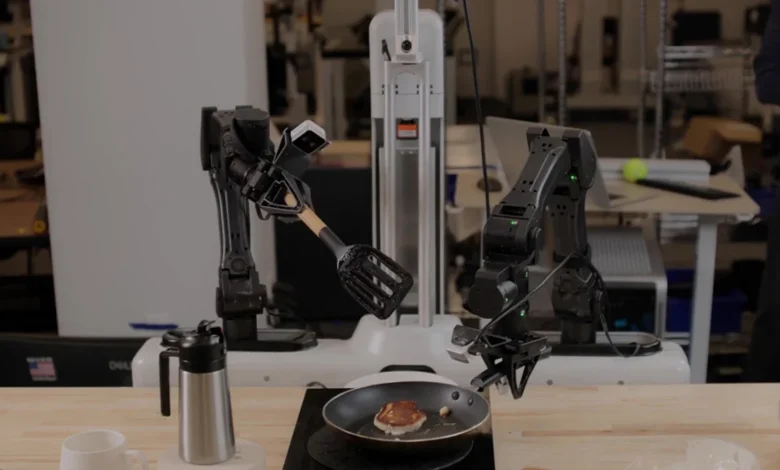
This capability eliminates the need for retraining. In rigorous testing, S1 has demonstrated the ability to perform unfamiliar, multi-step tasks lasting up to 10 minutes. These processes include intricate physical procedures such as plant potting, gourmet pancake making, pour-over coffee brewing, and complex kit assembly. These operations often span dozens of individual manipulation steps, forcing the robot to compose and execute sequences of skills it has never explicitly practiced before.
In a recent plant-potting evaluation conducted by the Skild AI engineering team, the transition from recording a human demonstration video to achieving fully autonomous execution on physical hardware took a mere 11 minutes. Moreover, the S1 model is not brittle; it actively adapts when objects within its field of view are displaced, recovers gracefully from unexpected physical errors, and dynamically links skills together in sequences completely absent from its pretraining dataset.
Comparative performance data highlights the magnitude of this technological leap. In standardized testing across novel, multi-step tasks, Skild’s S1 robot achieved an impressive success rate of approximately 66 percent at each individual step. By comparison, a baseline comparative AI system achieved a success rate of only 9 percent, representing a more than sevenfold improvement in task completion efficiency.
Efficiency gains are equally staggering when evaluated in terms of data collection. Skild estimates that providing the S1 robot with a single short video demonstration yields a training utility roughly equivalent to gathering 380 hands-on teleoperation examples. Manually collecting that volume of physical training data would typically require between 50 and 100 hours of intensive human labor.
From Laboratory Research to Real-World Factory Floors
While advanced robotics research frequently remains confined to academic laboratories, Skild AI has successfully translated its theoretical breakthroughs into immediate commercial deployments. The company is actively breaking the traditional cycle of constant robot retraining by empowering floor operators to demonstrate new tasks directly, bypassing the need to commission new datasets for every minor engineering change. Wherever customer privacy agreements permit, the experiential data gathered from Skild’s commercial deployments flows back into the broader model ecosystem, accelerating the capability curve for future implementations.
A prime example of this technology in action is a high-profile collaboration involving Skild, NVIDIA, and manufacturing giant Foxconn. The partners are currently deploying the Skild Brain on sophisticated dual-arm robotic manipulators dedicated to the high-precision assembly of advanced NVIDIA Blackwell data center systems.
In a showcased operational workflow, the dual-arm robot autonomously installs a critical power busbar and a limit block, precisely fastens 16 individual screws, and continuously adapts to physical disturbances across a demanding, multi-step assembly sequence. This application demands exceptional precision, contact-aware force control, rigorous sequence tracking, and real-time error recovery when the physical state of the workstation deviates from the initial plan.
NVIDIA Technology Across the Complete Development Cycle
The rapid iteration and high performance of Skild AI’s models are underpinned by an extensive suite of NVIDIA accelerated computing technologies. NVIDIA’s infrastructure provides the raw computational scale necessary to train a unified, shared robot brain using a hybrid diet of simulation data, human demonstration videos, teleoperation streams, and real-world deployment telemetry.
To diversify training data and convert raw video feeds into structured, machine-readable descriptions, Skild utilizes NVIDIA Cosmos open world foundation models. Concurrently, Cosmos Curator allows engineers to filter, annotate, and organize massive petabyte-scale datasets with high precision.
Before any model touches physical hardware, Skild relies heavily on NVIDIA’s open simulation frameworks to train and validate behaviors safely. NVIDIA Omniverse libraries and the Isaac Sim framework furnish physically accurate virtual environments. These platforms allow researchers to generate synthetic training data, test obscure edge cases, and validate safety protocols without risking expensive physical machinery.
Furthermore, Skild refines the fine motor skills of its robot brain through advanced reinforcement learning executed within Isaac Lab, an open and modular robot learning framework. Powered by the high-performance Newton physics engine, Isaac Lab enables Skild’s engineering teams to meticulously model complex physical parameters—such as dynamic forces, surface friction, physical contact, structural collisions, and fluid pressure—thereby substantially narrowing the persistent simulation-to-reality gap.
Deepening this technical alliance, Skild and NVIDIA are jointly developing novel, GPU-accelerated simulation solvers designed to accurately and rapidly model how robotic effectors physically touch, grip, and manipulate solid objects. These advanced solvers will soon be made universally available to the broader developer community as an integral component of the Newton physics platform.
As models mature from the research phase toward large-scale production deployment, optimization tools play a critical operational role. NVIDIA Nsight systems software allows engineers to diagnose and eliminate performance bottlenecks during grueling training cycles, while the NVIDIA TensorRT software development kit optimizes inference workloads. This ensures that physical robots can process sensory data and respond to environmental changes with microsecond-level latency in the physical world. Together, these tightly integrated technologies unify data ingestion, physics simulation, neural network training, and edge deployment into a cohesive, continuous lifecycle.
Broader Industry Implications and Future Outlook
The commercial momentum demonstrated by Skild AI—highlighted by its rapid ascent to a $100 million annual revenue run rate and dozens of active enterprise partnerships—signals a profound structural shift in the global automation landscape. As labor shortages persist across manufacturing, logistics, and supply chain sectors, the ability to rapidly onboard robotic workers via simple video demonstrations removes one of the most formidable economic and technical barriers to widespread automation.
By democratizing robot programming and replacing brittle, hard-coded logic with fluid, context-aware artificial intelligence, foundation models like S1 are poised to accelerate the ongoing reindustrialization trend. Factories can become truly flexible, capable of retooling overnight through simple video prompts rather than months of software engineering. As Skild AI and NVIDIA continue to scale their collaborative efforts, the vision of truly adaptable, general-purpose physical AI is rapidly transitioning from science fiction into the bedrock of modern global commerce.