NVIDIA DSX Platform Redefines AI Factory Energy Efficiency and Grid Integration

On a sweltering August evening in Silicon Valley, as the sun dipped below the horizon and regional air conditioning loads spiked dramatically, Silicon Valley Power issued a routine yet critical digital command. The utility transmitted an automated power adjustment signal directly to an artificial intelligence factory floor located within its municipal service territory. Inside a brightly lit San Francisco conference room, Varun Sivaram and approximately forty members of his engineering team at Emerald AI watched the live telemetry data stream across a Zoom window. Side-by-side with data center operators and municipal utility representatives, the team monitored the event in absolute silence. No human hands touched a physical breaker or manual switch.
Within seconds, Emerald AI’s Conductor platform—a sophisticated grid-orchestration tool and an early precursor to the capabilities engineered into the NVIDIA DSX Flex framework—seamlessly processed the incoming grid condition telemetry. The software immediately executed a pre-programmed workload hierarchy across thousands of active NVIDIA GPUs. Lower-priority computing tasks, such as background data processing and non-urgent model retraining, were intelligently throttled or temporarily rescheduled. Meanwhile, high-priority inference workloads and critical client services continued operating without a millisecond of interruption.
When the telemetry dashboard registered a clean, automated drop in facility power consumption from four megawatts down to three, the conference room erupted in cheers. Sivaram admitted to watching the deployment with bated breath, noting that it marked the startup’s inaugural operational test across a massive cluster of thousands of NVIDIA GPUs. Mansi Shah, head of product at Emerald AI, described the palpable tension and subsequent relief in the room, comparing the milestone to the high-stakes environment of a SpaceX rocket launch. Following that initial successful test, Silicon Valley Power has transmitted more than 200 subsequent demand response signals to the facility, yielding a flawless 100 percent success rate.
This milestone represents far more than a localized engineering success story in Santa Clara; it serves as a functional proof-of-concept for a much larger structural transformation. As the global artificial intelligence boom collides with physical limits in electricity generation and transmission infrastructure, the ability to dynamically flex power consumption offers a viable workaround. Rather than waiting a decade for utilities to permit, finance, and construct new high-voltage transmission lines, operators can leverage intelligent workload orchestration to align data center energy demand with available grid capacity in real time.
The broader implications of these energy constraints and technological countermeasures took center stage at the AI Infra Summit. During a keynote address dedicated entirely to infrastructure optimization, Ian Buck, NVIDIA’s vice president of hyperscale and high-performance computing, emphasized that the ultimate bottleneck for the modern AI economy is no longer just silicon availability, but reliable access to gigawatt-scale power. Complementing this perspective, cloud provider Lambda released the first independent validation metrics from a live production environment, providing hard numerical evidence that intelligent power management can substantially elevate computational output without increasing a facility’s fixed electricity budget.
Dave Ward, president of cloud services at Lambda, noted that their initial proof of concept effectively shatters the traditional paradigm of rigid power ceilings. By deploying advanced software management tools, Lambda successfully converted previously stranded electrical capacity into productive real-world computational throughput, achieving significantly higher compute density within an identical physical footprint.
The Economics of the Gigawatt: Power as the Ultimate Constraint
In the contemporary landscape of high-performance computing, power has unequivocally emerged as the primary limiting factor for scalability. While chip designers have achieved remarkable feats in semiconductor miniaturization and algorithmic efficiency, the physical realities of thermodynamics and electrical grid capacities impose hard ceilings on facility growth. As NVIDIA founder and CEO Jensen Huang has frequently observed, a one-gigawatt data center will fundamentally never become a two-gigawatt data center overnight, owing to the immense lead times required to expand electrical generation and transmission infrastructure.
Consequently, the core metric for evaluating modern infrastructure has decisively shifted from sheer processing speed to work produced per gigawatt consumed. Data center developers and cloud service providers are increasingly meticulous about energy efficiency, ensuring that every individual watt directed into a facility translates directly into productive compute cycles. Historically, this optimization has focused heavily on physical plant engineering—refining facility layout, improving cooling distribution, and upgrading rack-level power conversion units.
However, the introduction of integrated platforms like NVIDIA DSX extends this efficiency discipline directly into the software and architectural layers of the AI workload itself. By combining smarter rack provisioning, enhanced operational intelligence, rapid workload checkpointing, and aggressive scheduling optimization, modern infrastructure can maintain continuous GPU utilization even amidst fluctuating power supplies. When engineering teams confront physical infrastructure limits, the traditional approach of optimizing isolated components yields diminishing returns. Instead, the industry has recognized the necessity of designing the entire factory as a unified, cohesive system.
Introduced initially at GTC Taipei, the NVIDIA DSX platform represents a comprehensive blueprint for holistic AI factory design, spanning advanced networking, direct liquid cooling, water conservation, and integrated facility architecture. Early enterprise deployments are already validating the platform’s core theoretical benefits across multiple operational domains.
Maximizing Throughput Within Static Budgets: The DSX MaxLPS Validation
At the heart of the recent announcements at the AI Infra Summit was the debut performance validation of DSX MaxLPS operating on NVIDIA HGX B200 GPU servers within a commercial cloud environment. DSX MaxLPS functions by continuously monitoring real-time power consumption at both the individual GPU and rack levels. It dynamically reallocates electrical headroom across interconnected compute nodes based on the specific operational profile of running workloads.
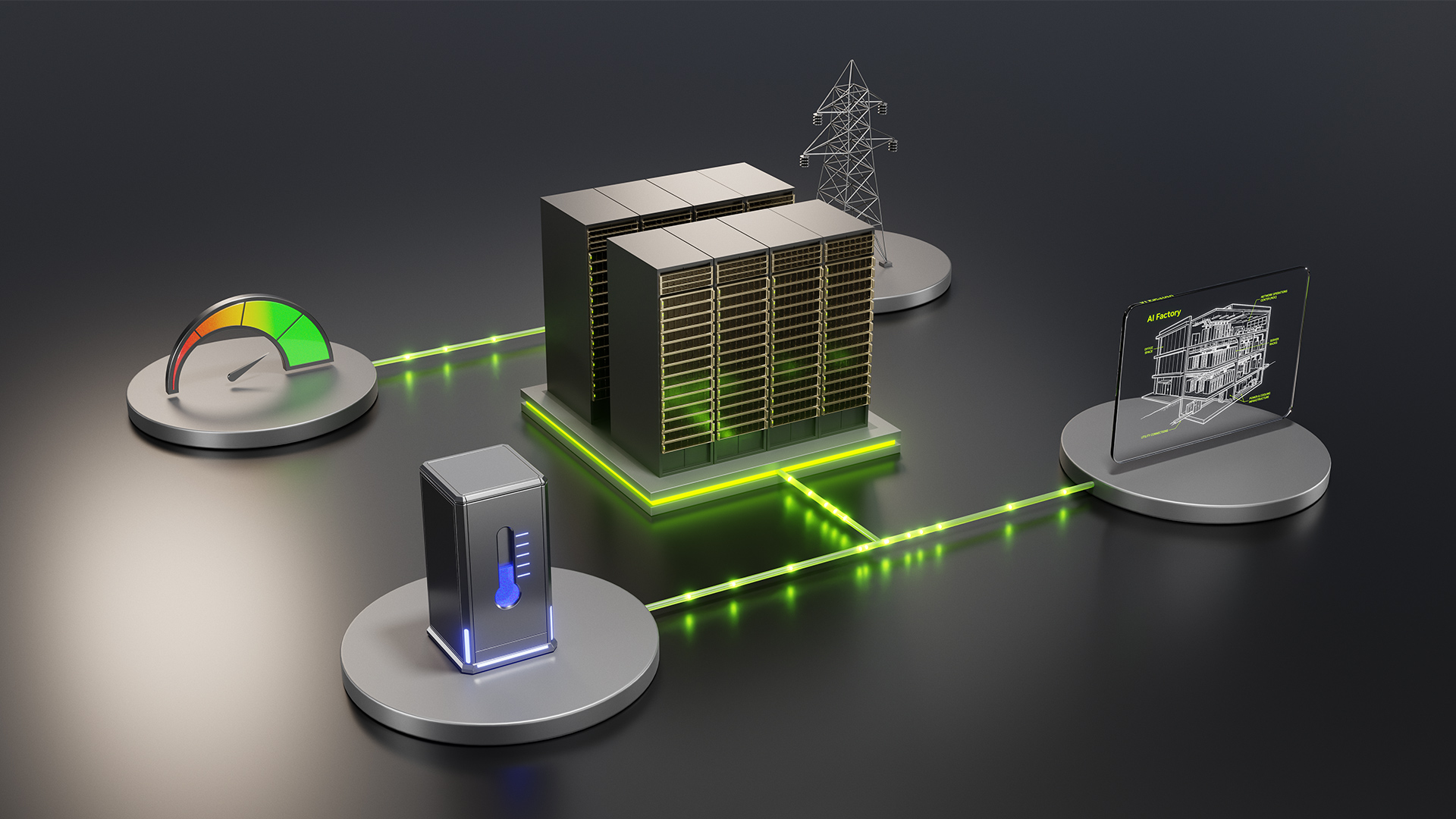
Because large language model training and real-time inference draw power in fundamentally different temporal patterns, static power provisioning often leaves substantial electrical headroom stranded. MaxLPS identifies and reclaims this residual capacity, optimizing power distribution across mixed-use AI infrastructure.
Lambda, a specialized GPU cloud provider catering to more than 10,000 enterprise clients ranging from venture-backed startups to major hyperscalers, tested this software on a five-rack, 19-node cluster configuration. The empirical findings demonstrated that by running 19 active nodes within the exact same aggregate power budget previously allocated to 16 nodes operating at full capacity, the facility achieved a remarkable 24 percent increase in cluster-wide token throughput. Output surged from approximately 4 million tokens per second to 5 million tokens per second, while overall performance per watt improved by 23 percent.
Independent projections from NVIDIA indicate that scaling this technology could unlock up to 40 percent more functional GPU capacity for upcoming Vera Rubin NVL72 AI factories, provided the deployment environment is properly configured. This capability fundamentally alters the financial and operational calculus of operating massive accelerated computing clusters, allowing providers to scale output without breaching local power supply agreements.
Commercial Scale Demand Response and Grid Participation
While automated power capping maximizes internal efficiency, grid-level flexibility addresses the external supply equation. The ongoing initiative in Santa Clara illustrates how commercial software can integrate data center operations directly with utility-scale demand response programs. NVIDIA’s Eos AI factory currently participates in Silicon Valley Power’s Flexible Load Interconnect Program. This pioneering municipal utility initiative is specifically designed to treat large-scale AI factories as dispatchable, flexible energy resources rather than rigid, inflexible baseload consumers.
When Silicon Valley Power detects localized grid stress, its automated dispatch system transmits a curtailment signal. Emerald AI’s Conductor software processes the request and adjusts facility consumption in under a minute. In exchange for providing this crucial grid stabilization service, the participating facility secures authorization to operate at a larger baseline capacity than would otherwise be permitted under constrained local grid conditions.
This successful commercial trial serves as the architectural foundation for the forthcoming DSX Flex framework. As the platform matures, capabilities demonstrated by Emerald AI are being integrated natively into the broader DSX ecosystem. The first dedicated commercial deployment of DSX Flex is scheduled for a 96-megawatt Vera Rubin AI facility located at NVIDIA’s AI Factory Research Center in Manassas, Virginia. This rollout builds directly upon a cumulative series of five successful operational demonstrations conducted across two distinct continents.
Next-Generation Electrical Delivery: The 800V DC Architecture
Beyond software orchestration and grid-level demand response, physical power delivery mechanisms inside the data center are also undergoing a radical architectural evolution. As accelerated computing clusters scale in density to support power-hungry hardware like the GB200 NVL72 platforms—which dissipate approximately 120 kilowatts of thermal energy per rack through direct liquid cooling—traditional lower-voltage power distribution paths introduce severe conversion inefficiencies and physical constraints.
To eliminate these bottlenecks, NVIDIA DSX reference designs are actively incorporating an advanced 800-volt direct current (800V DC) power architecture. By transitioning to higher-voltage direct current distribution within the facility, operators can significantly reduce conversion stages, minimize resistive electrical losses, and support unprecedented compute density without requiring oversized, cumbersome copper busbars and cabling infrastructure.
Holistic Engineering for the Gigawatt Era
The modern AI factory cannot be optimized through isolated hardware upgrades alone. A high-performance GPU cluster remains inherently constrained if underlying networking fabrics experience latency, or if poor rack provisioning strands electrical capacity. Furthermore, thermal management overhead requires sophisticated coordination to ensure that massive heat loads generated by dense direct liquid-cooling loops are efficiently rejected before they impede computational performance.
The definitive path toward maximizing valuable token output per megawatt consumed lies in comprehensive system-level design. The NVIDIA DSX suite addresses this requirement across the entire lifecycle of a facility: utilizing simulation software like DSX Sim prior to physical construction, deploying operational engines like DSX OS and DSX Exchange during runtime, and relying on standardized DSX Reference Designs to eliminate guesswork during initial engineering phases.
Ultimately, the metric that will define leadership in the infrastructure economy is straightforward: useful work produced per megawatt consumed. When regional electrical grids face unprecedented strain, modern AI facilities must prove capable of providing immediate relief without dropping active workloads or requesting unauthorized capacity expansions. Through holistic platforms like NVIDIA DSX, the industry is establishing a rigorous new baseline for what an enterprise artificial intelligence factory is expected to achieve.
Related posts: