The Definitive Guide to Answer Engine Optimization and Selecting the Right AEO Checker for Your Brand

The digital landscape is currently undergoing its most significant transformation since the inception of the search engine. As users increasingly pivot away from traditional link-based search results in favor of AI-generated summaries provided by platforms like ChatGPT, Perplexity, and Google’s AI Overviews, the fundamental mechanics of visibility are shifting. For businesses that have spent decades optimizing for the "ten blue links," this transition represents a paradigm shift: the emergence of Answer Engine Optimization (AEO).
An AEO checker is a specialized tool designed to measure whether a brand is being cited, mentioned, or ignored within the AI-generated responses that now dominate the user journey. As these engines synthesize information from multiple sources to provide a single, definitive answer, the opportunity for a brand to secure a click is often bypassed entirely. In this new era, visibility is no longer defined by a high-ranking URL, but by the ability to become a trusted source of truth within an AI’s output.
![AEO checker tools that measure answer engine visibility [2026]](https://53.fs1.hubspotusercontent-na1.net/hubfs/53/aeo-checker-1-20260903-3858273.webp)
The Rise of the Answer Engine: A New Search Reality
The shift began in earnest with the rapid adoption of large language models (LLMs) that prioritize conversational, synthesized answers. The release of ChatGPT in late 2022 marked the starting point, followed by the integration of Perplexity’s real-time web-indexed responses, and culminating in Google’s wide-scale deployment of AI Overviews (AIO) in May 2024.
This evolution represents a departure from the "link economy." In a traditional search model, Google acted as a traffic coordinator, sending users to third-party domains. In the current model, the engine acts as an information concierge. By reading across thousands of pages to formulate a specific response, these engines often resolve a user’s query before they ever interact with an external website. This "zero-click" phenomenon forces marketers to re-evaluate their digital footprint. If your brand is not mentioned or cited within the AI response, you are effectively invisible to that user, regardless of how well you rank in the underlying organic search results.
Defining AEO vs. Traditional SEO
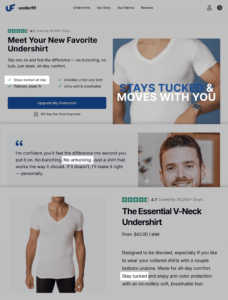
While SEO and AEO are often discussed as separate disciplines, they are functionally interdependent. SEO remains the bedrock of digital strategy; it ensures that a website is crawlable, structured, and authoritative. Answer engines rely on these exact same signals—such as site authority, clear schema markup, and verifiable primary data—to determine which sources are trustworthy enough to cite.
![AEO checker tools that measure answer engine visibility [2026]](https://no-cache.hubspot.com/cta/default/53/9dd5e54b-fbef-4dd0-bc44-1689feb1ea18.png)
However, where SEO focuses on keyword density and ranking position, AEO focuses on content utility and entity relevance. An AEO strategy aims to place a brand’s content directly inside the "knowledge block" of an AI response. This requires a granular approach to content creation, where information is structured to answer specific, high-intent questions in a concise, authoritative manner that an AI can easily parse and verify.
How to Monitor AI Visibility Manually
For organizations in the early stages of this transition, manual monitoring serves as a necessary diagnostic tool. This process involves a systematic audit of the queries that drive the most value for the business.
- Defining the Query Set: Identify high-value, information-rich keywords, including branded terms, product comparisons, and specific informational queries related to your industry’s pain points.
- Executing Controlled Searches: Perform these searches in "incognito" or private browser sessions to prevent past user behavior from skewing the results.
- Analyzing the Output: For every query, document three key data points: Did an AI-generated summary appear? Is your domain listed in the citations or the body of the response? Which competitors are being cited instead of your brand?
- Iterative Testing: Because AI responses are dynamic and can fluctuate based on the specific session or the underlying model’s training updates, a single snapshot is insufficient. Reliable data requires multiple tests over several days to identify patterns in how your brand is being represented.
The Necessity of Automated AEO Tools
Manual spot-checks are effective for small datasets, but they fail to scale as a business grows. Furthermore, the volatility of AI responses—which can change based on real-time web updates—makes manual tracking prone to human error and data latency. This has led to the rise of specialized AEO software that automates the collection and analysis of citation data.
![AEO checker tools that measure answer engine visibility [2026]](https://53.fs1.hubspotusercontent-na1.net/hubfs/53/aeo-checker-2-20260903-852936.webp)
When selecting an AEO checker, organizations should prioritize tools that offer:
- Multi-Engine Tracking: The ability to monitor ChatGPT, Perplexity, and Google AI Overviews simultaneously.
- Citation vs. Mention Analysis: Distinguishing between a link (a citation) and a brand reference (a mention), both of which have different values for brand awareness and authority.
- Competitive Benchmarking: Automated reports that flag when a competitor is cited for a query where your brand is notably absent.
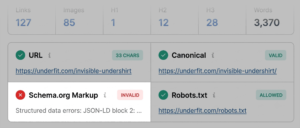
- Actionable Insights: Rather than just reporting data, the best tools categorize the findings into specific content tasks—such as correcting schema errors or updating outdated information—to improve the likelihood of future citations.
Market Landscape: Current Tools and Solutions
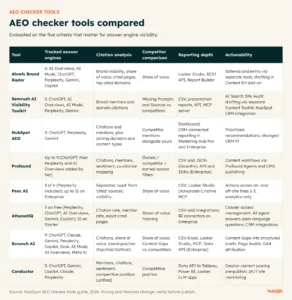
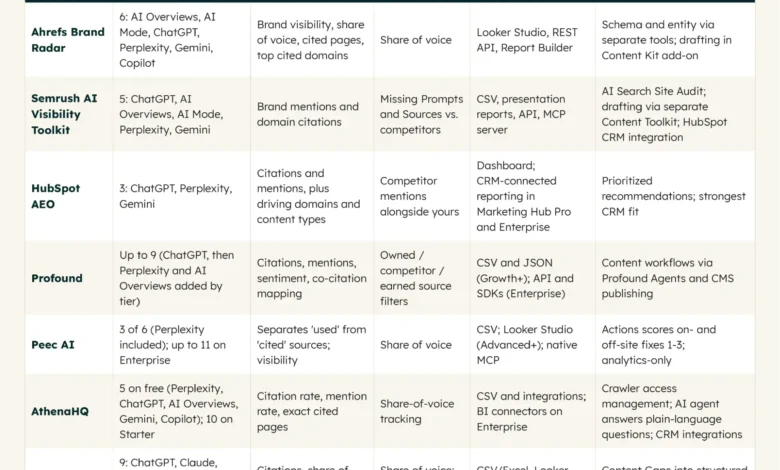
The market for AEO tools is currently bifurcated into general-purpose SEO suites that are adding AI features and specialized platforms built for the AI era.
- Broad-Spectrum SEO Suites: Tools like Ahrefs and Semrush have updated their platforms to include "Brand Radar" and "AI Visibility" toolkits. These are excellent for companies that already rely on these platforms for traditional SEO, as they provide a seamless view of how AI integration is impacting existing organic traffic.
- Specialized AI Analytics: Emerging platforms such as Profound, Peec AI, and AthenaHQ offer deeper, more technical insights into how specific LLMs handle citation logic. These tools are often better suited for enterprises that require granular data on sentiment and source attribution.
- CRM-Integrated Solutions: Platforms like HubSpot have integrated AEO directly into the CRM, allowing marketers to bridge the gap between AI visibility and actual revenue impact. By connecting AI-referred traffic to specific sales opportunities, these tools provide a clearer picture of the ROI associated with AEO efforts.
Metrics That Matter in the Age of AI
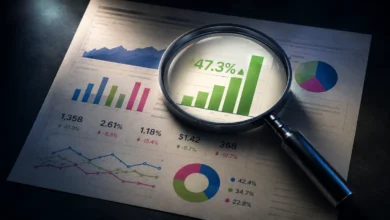
As the digital landscape evolves, so too must the metrics used to measure success. While traditional metrics like organic click-through rate (CTR) and keyword ranking remain relevant, they are no longer sufficient. Modern AEO reporting should include:
![AEO checker tools that measure answer engine visibility [2026]](https://53.fs1.hubspotusercontent-na1.net/hubfs/53/aeo-checker-3-20260903-8904553.webp)
- Citation Coverage Rate: The percentage of high-value queries where your brand is cited as a source.
- Brand Share of Voice in AI: How often your brand appears in comparison to primary competitors within AI-generated responses.
- AI-Referenced Traffic: A specific tracking category for users who reach your site after clicking through an AI-generated citation, rather than a traditional search result.
- Sentiment and Accuracy Scores: Monitoring whether the AI is accurately representing your brand, or if it is inadvertently providing outdated or incorrect information that could damage brand equity.
Strategic Implications and Future Outlook
The move toward answer engines represents a significant consolidation of the web’s information. For brands, the implications are clear: the cost of being "ignored" by an AI is growing, while the benefit of being "cited" is becoming a primary driver of digital authority.
As of late 2026, the industry is seeing a shift toward more sophisticated AI models that prioritize real-time, verified data. This puts a premium on high-quality, primary research and clearly defined factual content. Brands that adapt by structuring their data for machine readability and focusing on answering the direct questions of their customers will likely find themselves at an advantage.
However, organizations must also remain cautious. The "zero-click" nature of AI answers means that traffic volatility will likely increase. Establishing a robust AEO strategy is not merely about maintaining current levels of traffic; it is about ensuring that your brand remains part of the conversation in a digital world that is increasingly mediated by artificial intelligence. By investing in the right tools and shifting focus from traditional keyword ranking to comprehensive answer engine visibility, brands can future-proof their digital presence against the ongoing disruption of the search industry.