Deploying Enterprise-Grade Speech Transcription with the AWS WhisperX Deep Learning Container on Amazon SageMaker AI

Generic speech-to-text solutions have long struggled to bridge the gap between simple audio-to-text conversion and the high-fidelity, structured data required for modern enterprise workflows. Whether for contact-center quality assurance, legal discovery, or the automated indexing of broadcast media, organizations require more than just a raw string of text. Standard transcription engines often fail to provide the granular temporal accuracy needed for precise captioning, and they frequently struggle with speaker diarization—the critical process of identifying "who said what" in multi-party environments. These deficiencies create significant friction in compliance, analytics, and accessibility. The introduction of the AWS WhisperX Deep Learning Container (DLC) addresses these limitations by integrating OpenAI’s Whisper architecture with advanced forced-alignment and diarization capabilities, all within a production-ready environment on Amazon SageMaker AI.
The Evolution of Transcription Accuracy
The core challenge in automated speech recognition (ASR) has historically been the trade-off between speed and structural utility. Traditional models often output timestamps at the segment or utterance level, which can deviate from actual speech patterns by several seconds. For an organization attempting to redact sensitive information in a legal deposition or generate sub-second accurate captions for a live broadcast, a margin of error of even two seconds is unacceptable.
WhisperX fundamentally alters this paradigm by wrapping the Whisper model family with batched inference and integrating two specialized modules: wav2vec2 for forced alignment and sophisticated diarization algorithms. By calculating word-level timestamps, the system allows developers to map text to audio with millisecond precision. Furthermore, the speaker diarization component parses audio streams to assign unique labels to individual voices, turning chaotic meeting recordings into organized, searchable, and auditable transcripts.
Architectural Advantages of the DLC Approach
The deployment of these complex AI pipelines often presents a significant operational burden, requiring engineers to manage dependencies, optimize CUDA kernels, and navigate complex model-serving environments. The AWS WhisperX DLC simplifies this by packaging the entire stack—Whisper, alignment models, and diarization weights—into a pre-configured, GPU-ready image.
By utilizing a maintained DLC, enterprises eliminate the "dependency hell" associated with local model environments. The container follows the standard Amazon SageMaker AI serving contract, allowing developers to deploy the model with minimal configuration overhead. This shift reflects a broader industry trend toward "specialized containers," where the infrastructure layer is abstracted to allow for rapid iteration on the application logic. This release is part of a broader AWS initiative to provide purpose-built DLCs for multimodal AI, sitting alongside tools for text-to-speech, image processing, and LLM inference.
Choosing the Right Serving Pattern: Real-Time vs. Asynchronous
One of the most critical decisions for a machine learning engineer is selecting the appropriate serving endpoint. Amazon SageMaker AI offers two primary paths for WhisperX: real-time and asynchronous.
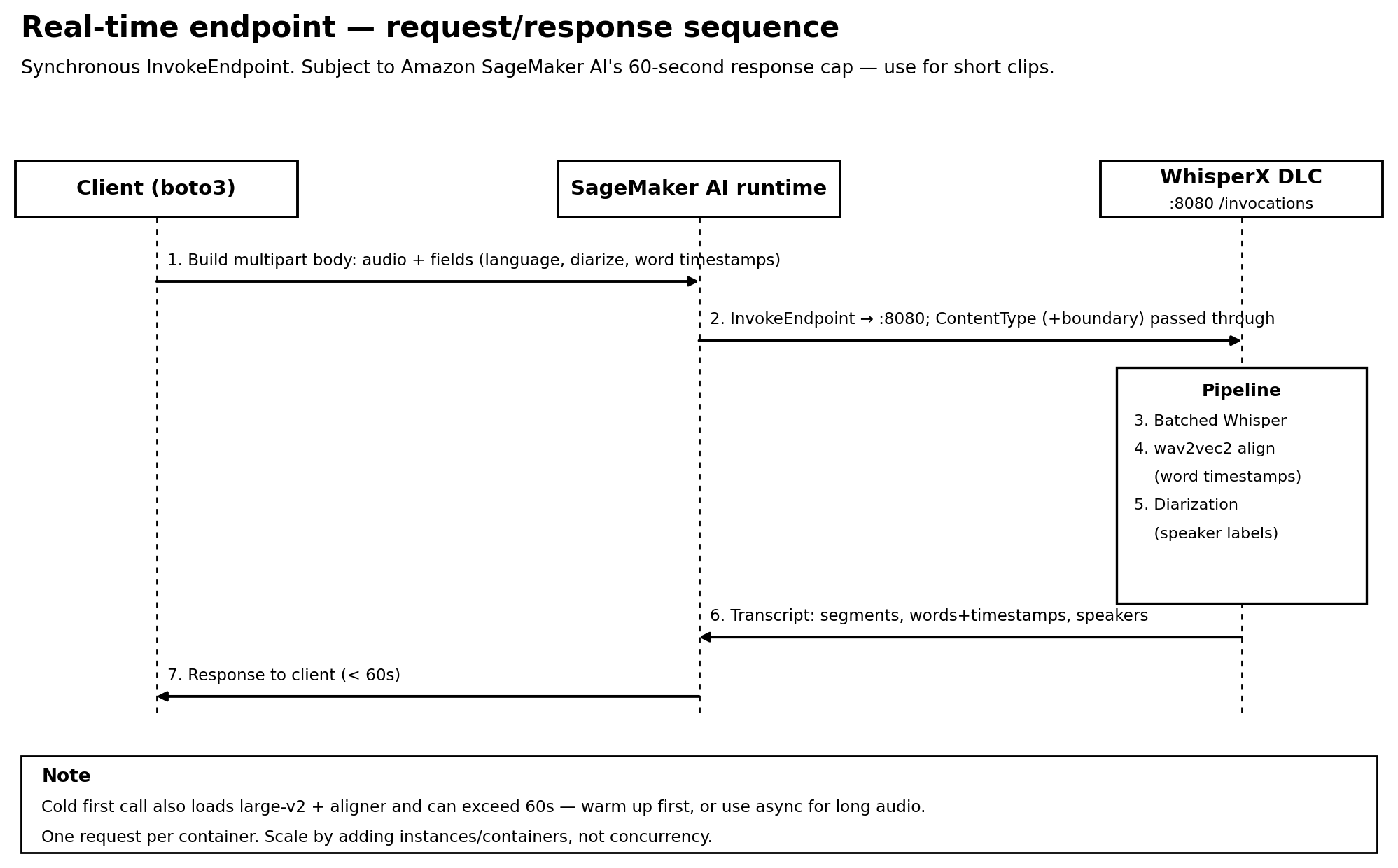
The real-time endpoint is designed for low-latency, interactive applications. When a user submits an audio file, the system processes it and returns the transcript within a single synchronous call. Given the 60-second response cap inherent in SageMaker’s real-time endpoints, this path is best suited for short, discrete audio clips. In a contact center environment, this might be used to provide agents with real-time script adherence prompts or live sentiment analysis as a call progresses.
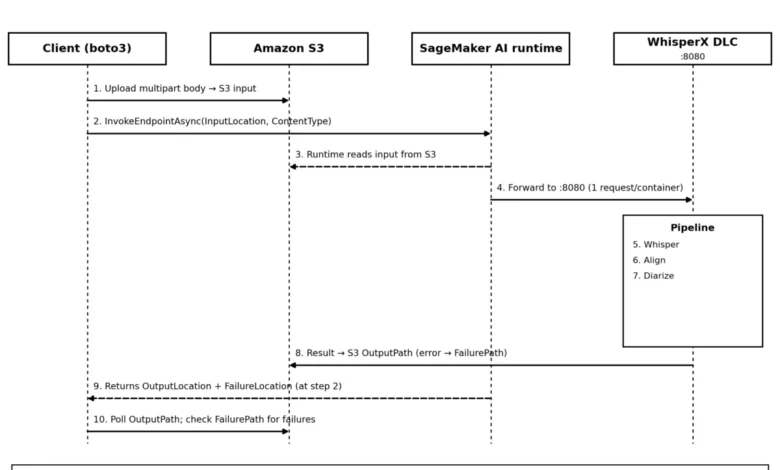
Conversely, the asynchronous endpoint is the engine of choice for high-volume or long-duration audio. By brokering input and output through Amazon S3, this pattern circumvents the 60-second response limitation. The client uploads the audio to a specified S3 bucket and receives a request ID. Once the transcription is complete, the results are written to an output path in S3. This architecture is ideal for processing hours of all-hands meetings, bulk podcast archives, or extensive legal discovery databases. Because the system can scale to zero when idle, the asynchronous pattern also offers superior cost-optimization profiles for intermittent workloads.
Empirical Performance: A Case Study in Crisis Communication
To demonstrate the efficacy of this technology, developers often turn to historical high-stakes audio: the air traffic control (ATC) communications from the 2009 emergency landing of US Airways Flight 1549, commonly known as the "Miracle on the Hudson."
This recording presents a "worst-case scenario" for standard ASR: significant background noise, heavy radio compression, rapid-fire technical jargon, and overlapping speakers. The WhisperX pipeline processes this audio by segmenting the radio exchange, detecting voice activity, and accurately attributing speech to the correct pilots and air traffic controllers.
When applied to a 40-second segment, the model provides word-level timestamps that allow a user to click any word in a transcript and jump directly to that specific moment in the audio. This level of synchronization is essential for regulated fields. In finance or healthcare, the ability to produce a verbatim, speaker-labeled transcript with verifiable temporal markers is not merely a convenience—it is a requirement for meeting audit and compliance standards.
Strategic Implications for Enterprise AI
The integration of WhisperX into the AWS ecosystem signals a shift in how businesses handle unstructured audio data. For years, audio has been treated as a "black box" that required manual transcription or costly third-party services. With the democratization of these tools, organizations can now treat audio as a structured dataset, similar to logs or telemetry.
1. Operational Efficiency: The transition from manual to automated, speaker-labeled transcription can reduce the cost of legal discovery and compliance reviews by orders of magnitude.
2. Searchability: By transforming audio into word-timed, diarized text, companies can index their entire media history. A bank can search for a specific compliance phrase across millions of recorded customer service calls in seconds.
3. Regulatory Compliance: In industries such as healthcare, where patient privacy is paramount, the ability to deploy these models within a private, VPC-secured AWS environment ensures that sensitive data never leaves the organization’s control.
Deployment Best Practices
Successfully deploying WhisperX at scale requires attention to several production-grade details. First, the GPU AMI pin is non-negotiable; failing to set InferenceAmiVersion to the required version for the specific CUDA driver will prevent the container from initializing. Second, because model weights are loaded lazily upon container startup, developers must ensure that the health-check timeout is set to a generous value (e.g., 900 seconds or more) to prevent the orchestrator from killing the container prematurely.
Furthermore, cost management is critical. For asynchronous workloads, implementing a "scale-to-zero" policy for the underlying GPU instances ensures that organizations are only paying for the compute power they consume. When choosing an instance type, the ml.g4dn.xlarge offers a cost-effective baseline, while the ml.g5.2xlarge provides the additional headroom required for high-concurrency or low-latency requirements.
Conclusion and Future Outlook
The AWS WhisperX Deep Learning Container represents a significant milestone in the maturation of speech technology. By moving beyond the limitations of generic ASR and providing a robust, scalable, and highly accurate solution, AWS is lowering the barrier to entry for advanced audio analysis. As organizations continue to digitize their operations, the ability to unlock the latent value hidden within millions of hours of recorded human interaction will become a key competitive advantage.
For engineers tasked with building these systems, the provided AWS Samples repository and JupyterLab notebooks serve as a comprehensive roadmap. Whether the goal is to improve accessibility through precise captioning or to enhance organizational transparency through searchable meeting logs, the combination of SageMaker AI and WhisperX provides a flexible, powerful foundation for the next generation of speech-to-text applications. As the multimodal series continues, we expect to see further integration of these specialized containers, ultimately creating a cohesive ecosystem where image, video, and audio are treated with the same analytical rigor as traditional structured data.