Designing Reliable Memory Systems for AI Agents: A Comprehensive Architectural Framework

The evolution of autonomous AI agents has shifted the industry’s focus from simple, stateless conversational models to complex, multi-step systems capable of executing long-running workflows. As these agents transition from single-turn request-response patterns to persistent, goal-oriented autonomy, the challenge of memory management has become the primary bottleneck in system reliability. When an agent lacks the ability to effectively retain, recall, and synthesize information across separate interactions, it effectively suffers from cognitive amnesia, forcing users to provide redundant instructions and preventing the agent from learning from past successes or failures. Conversely, poorly implemented memory systems—those that treat all information as equally important or fail to sanitize incoming data—often lead to persistent, "zombie" errors that are notoriously difficult to diagnose. This article examines the architectural standards required to build robust agentic memory, the systemic risks of naive implementations, and the industry-wide shift toward layered, provenance-tracked storage solutions.
The Evolution of Agentic Memory: From Stateless to Context-Aware
In the early stages of large language model (LLM) deployment, the "context window" was treated as the sole repository for information. Developers would simply prepend previous conversation turns to the current prompt. However, as agentic frameworks like LangChain, CrewAI, and AutoGPT gained traction, this approach proved insufficient for tasks lasting hours or days. The industry has since moved toward an "Externalized Memory" model, where an agent writes to and reads from dedicated storage layers.
This transition has not been without friction. Research from 2024 and early 2025 indicated that nearly 40% of production-level AI agent failures in enterprise environments were linked to "context pollution"—a phenomenon where irrelevant or contradictory information from previous sessions was retrieved during a critical reasoning step, causing the agent to hallucinate or deviate from its core objective.
Defining the Memory Taxonomy
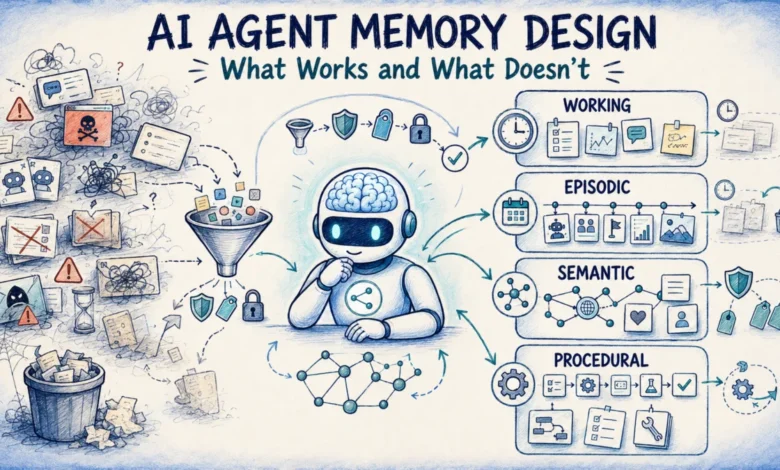
To build reliable systems, architects must stop viewing "memory" as a monolithic database. Industry experts now categorize agentic memory into four distinct functional pillars, each requiring a specific storage and retrieval strategy:
- Working Memory: High-velocity, short-lived storage for intermediate scratchpad values and active task states. This is typically managed via in-memory caches like Redis to ensure sub-millisecond retrieval.
- Episodic Memory: A repository of "what happened." It tracks past interactions, task runs, and decision logs. Vector databases are the standard here, utilizing semantic similarity search to help agents recall specific past experiences.
- Semantic Memory: The agent’s "knowledge base." This holds facts, user preferences, and domain-specific constraints. Unlike episodic memory, this requires high precision, often necessitating a hybrid of vector search and exact key-value lookups.
- Procedural Memory: The "how-to" layer. This stores successful action patterns and workflows. It acts as a library of pre-validated sequences that the agent can execute when faced with recurring tasks.
The Architecture of Reliability: Strategies That Work
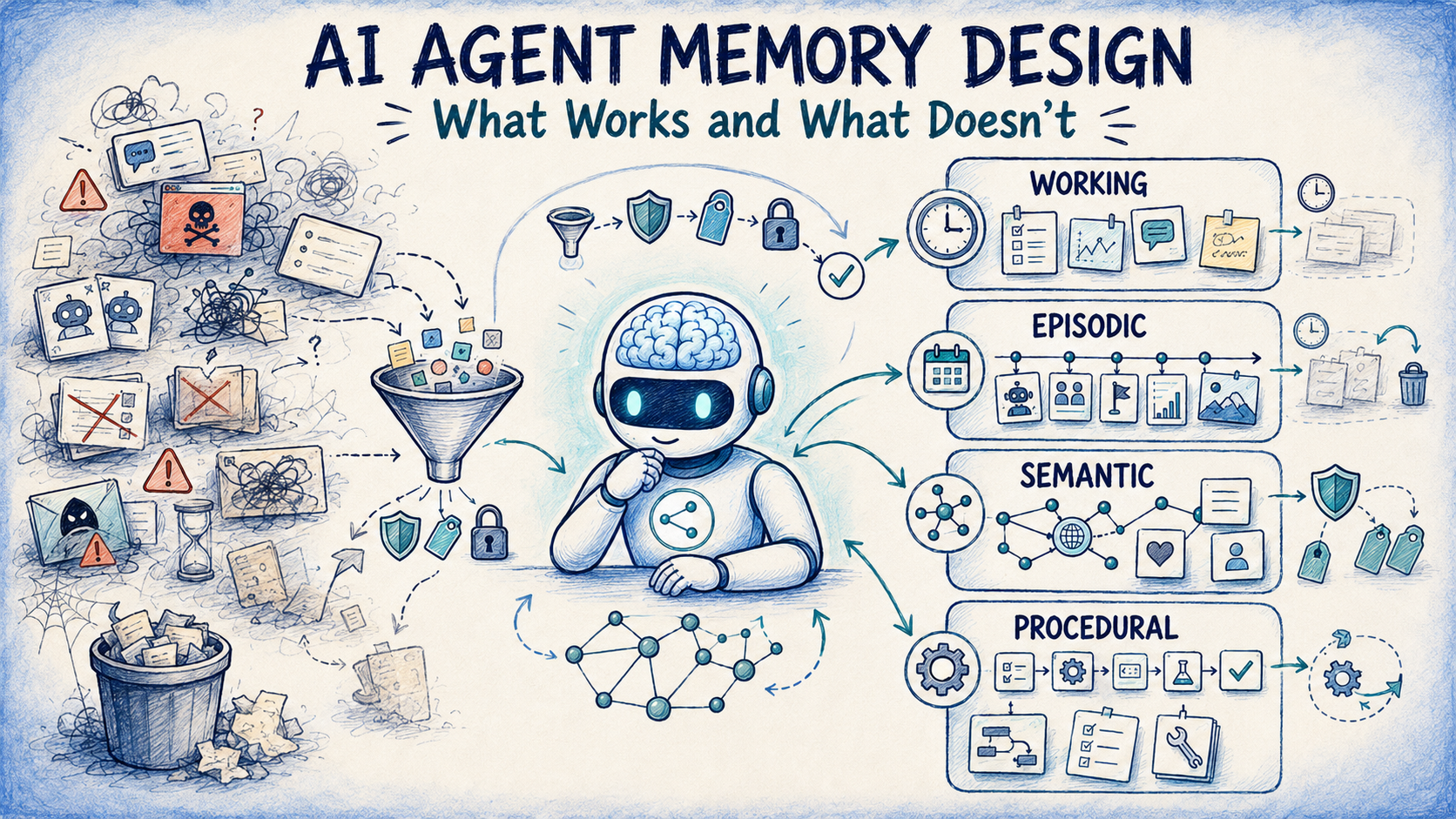
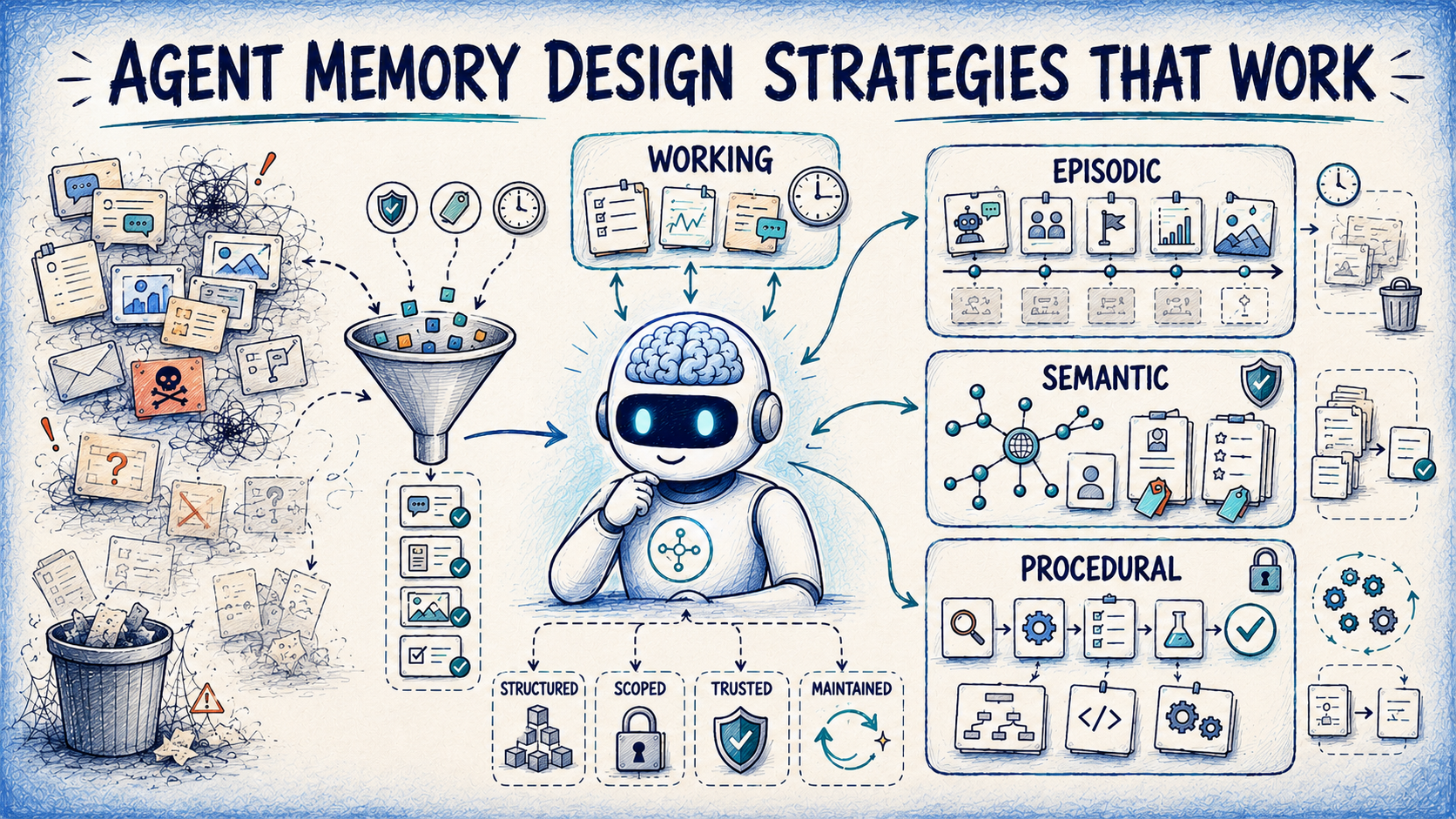
A critical advancement in agent design is the shift toward hierarchical memory with importance scoring. In legacy systems, agents were often configured to save every interaction to a vector store. This resulted in "retrieval noise," where semantic search returned thousands of irrelevant documents. Modern designs implement a "gatekeeper" function: before any data is written, the agent evaluates its importance using a Pydantic-based schema. Only information meeting specific thresholds—based on confidence scores and utility metrics—is promoted to long-term storage.
Furthermore, the implementation of "Memory Scoping" has emerged as a standard in multi-agent orchestration. In a system where a "Research Agent" and a "Code Execution Agent" operate simultaneously, a shared memory pool often leads to cross-contamination. By defining distinct namespaces, developers ensure that an agent only accesses data pertinent to its role, with a centralized "Orchestrator" managing global facts. This isolation prevents the "MemoryGraft" vulnerability, where a compromised agent could potentially pollute the knowledge base of the entire system.
The Perils of Naive Implementations: What Doesn’t Work
Despite the availability of sophisticated frameworks, many development teams continue to rely on "flat" architectures, which represent the most common point of failure. The "everything in a vector database" approach is particularly problematic. Vector databases excel at finding similar embeddings, but they lack the relational logic required to handle truth, hierarchy, or temporal decay. When an agent blindly retrieves "similar" data, it often surfaces an outdated or hallucinated fact simply because the embedding vector is close to the current query, regardless of the fact’s accuracy.
Equally dangerous is the reliance on "summary compression." In an effort to save tokens, developers often instruct an agent to summarize an entire conversation history and store the summary. This process is inherently lossy. Critical constraints, edge cases, and numerical data are frequently discarded in the summarization process. Furthermore, if the agent hallucinates during the summarization, that hallucination becomes "hardened" as ground truth in the long-term memory, creating a feedback loop of incorrect information that persists across weeks of operation.
The Provenance Requirement: Tracking the "Why"
A significant takeaway from recent security audits of autonomous systems is the necessity of provenance. A memory entry should never be stored as an isolated string. Modern, reliable systems attach a metadata envelope to every entry, recording:
- The Agent ID that created the entry.
- The specific Tool or function used to generate the data.
- The "Trust Level" of the source (e.g., system-generated vs. user-provided vs. external API).
- An input hash to ensure the data can be traced back to its origin.
By enforcing this level of auditability, developers can implement "sanitization-before-write" workflows. For instance, if an agent is pulling data from an external, low-trust web source, a secondary, specialized "Security Agent" can scan the content for prompt-injection attacks or hidden directives before the data is committed to the primary memory store.
Data-Driven Maintenance and TTL Policies
Memory without maintenance is a liability. As agents operate over extended periods, the "memory debt" accumulates. Professional-grade agentic systems now implement active maintenance routines, including:
- Time-To-Live (TTL) cycles for working memory to prevent the buildup of stale state.
- Periodic deduplication to merge conflicting facts.
- Confidence decay, where the "truth value" of a fact decreases over time if it is not reinforced or updated.
These maintenance routines treat memory like a living database rather than a static archive, ensuring that the agent’s "mental model" of the world remains synchronized with reality.
Broader Implications for AI Autonomy
The transition toward these structured, layered memory architectures signals a maturation of the AI industry. We are moving away from the "black box" era of LLM development into a more rigorous, systems-engineering-focused discipline. The implications are profound: as memory becomes more reliable, the ceiling for agentic performance rises. Agents will no longer be limited to single-session utility; they will be capable of accumulating expertise, maintaining complex user relationships, and operating with a level of consistency previously reserved for human staff.
However, this increased capability brings new responsibilities. The "MemoryGraft" attack and other forms of prompt-based memory poisoning highlight that memory is the next frontier of AI security. As we enable agents to "remember" and "learn," we must also build the mechanisms to ensure that these memories are accurate, authenticated, and secure.
In conclusion, the design of AI agent memory is no longer a peripheral task—it is the core of the agent’s intelligence. By abandoning the notion of a single, undifferentiated memory store and embracing a layered, provenance-heavy, and maintenance-oriented architecture, developers can build agents that are not only more capable but also significantly more predictable and secure. The future of autonomous AI lies in the ability to distinguish between what is fleeting, what is useful, and what is true.
Related posts: