The Enigma of Cosmic Silence: Exploring the Fermi Paradox, the Great Filter, and the Microscopic Future of Advanced Civilizations


With a staggering 13 billion-year head start on stellar and planetary evolution, the universe has possessed the necessary chemical precursors and temporal runway to foster complex life long before Earth formed. Yet, despite decades of radio astronomy, deep-space probes, and theoretical calculations suggesting the galaxy should be teeming with intelligent life, humanity continues to gaze into a seemingly deafening void. This contradiction—first famously articulated by physicist Enrico Fermi over lunch in 1950—remains one of the most profound and unsettling questions in modern science: Where is everybody?
The Fermi Paradox and the Absence of Interstellar Visitors
The Fermi Paradox highlights a fundamental friction between high mathematical probabilities of extraterrestrial existence and the absolute lack of empirical evidence supporting it. The Drake Equation, formulated by astronomer Frank Drake in 1961, attempts to estimate the number of active, communicative civilizations in the Milky Way by multiplying variables such as the rate of star formation, the fraction of stars with planets, the number of habitable planets, and the longevity of such civilizations. Even when using conservative estimates, the equation often yields numbers suggesting our galaxy should host numerous advanced societies.

However, no physical evidence, technological artifacts, or unambiguous electromagnetic transmissions have ever been intercepted. This absence of contact has drawn intellectual parallels to other theoretical gaps, such as the complete lack of verified time travelers from the future. Much like the absence of extraterrestrial visitors does not categorically disprove alien life, the absence of time tourists does not definitively render temporal mechanics impossible. Instead, it suggests that advanced technologies—whether time travel or interstellar colonization—either face insurmountable physical barriers or are utilized with extreme caution, remaining entirely hidden from our primitive instruments.
Historical Chronology of the Search for Extraterrestrial Intelligence
The methodical investigation into the existence of alien intelligence spans nearly a century, evolving from philosophical musings into rigorous empirical science:
- 1959: Physicists Giuseppe Cocconi and Philip Morrison publish a landmark paper in Nature suggesting that interstellar communication could be achieved via microwave radio frequencies, laying the groundwork for radio astronomy searches.
- 1960: Astronomer Frank Drake conducts Project Ozma at the National Radio Astronomy Observatory in Green Bank, West Virginia, using a telescope to scan the nearby stars Tau Ceti and Epsilon Eridani for artificial signals.
- 1974: The Arecibo Observatory transmits a coded binary message toward the globular star cluster M13, located roughly 25,000 light-years away, in an effort to announce human existence to any listening civilization.
- 1977: The Ohio State University "Big Ear" radio telescope detects the famous "Wow! Signal," a strong, narrowband narrowband radio spike that matches expected characteristics of an extraterrestrial transmission, though it was never repeated.
- 1984: The SETI Institute is founded as a non-profit scientific organization dedicated to searching for evidence of intelligent life in the universe through radio and optical telescope arrays.
- 1992–Present: NASA and various international bodies intermittently fund and defund targeted search programs, eventually shifting toward private philanthropy, such as the Breakthrough Listen initiative launched in 2015 with a 100-million-dollar commitment.
The Great Filter: Testing the Resilience of Civilizations
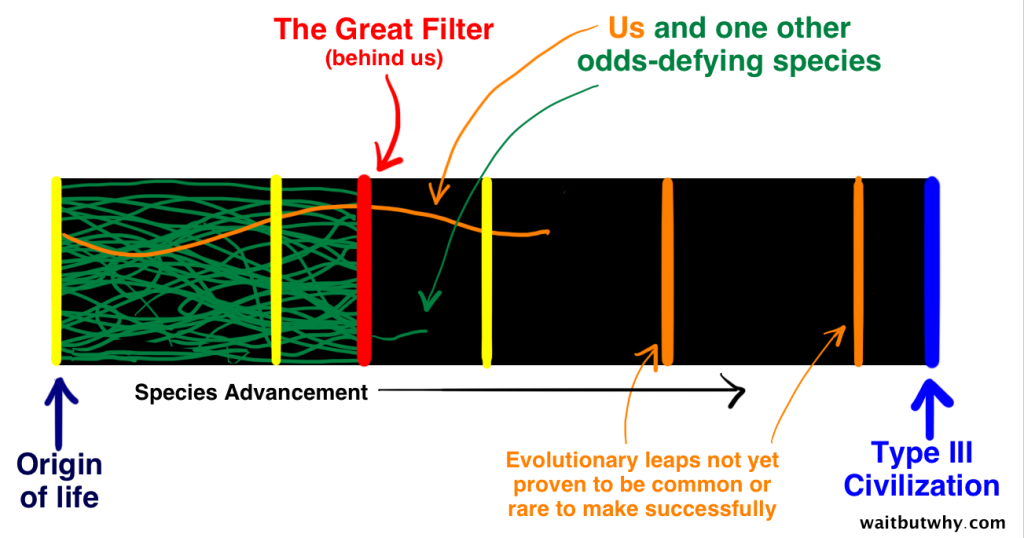
To reconcile the high probability of life with the stark reality of cosmic silence, economists, astrobiologists, and philosophers have proposed various theoretical frameworks. One of the most prominent is the Great Filter hypothesis, popularized by economist Robin Hanson. The theory posits that between the initial appearance of life and the attainment of a Type III civilization on the Kardashev scale—capable of harnessing the total energy output of an entire galaxy—there exists a monumental evolutionary barrier.

According to this hypothesis, all life forms must eventually navigate this evolutionary choke point. The central question of the Great Filter is whether humanity has already passed it, or if it lies ahead of us in our future.
The three primary interpretations of the Great Filter are categorized as follows:
- We Are Rare (The Filter is Behind Us): Under this scenario, the transition from non-living matter to single-celled organisms, or from prokaryotes to complex eukaryotes, is so statistically improbable that Earth is among the very few planets to achieve it.
- We Are Doomed (The Filter is Ahead of Us): This pessimistic view suggests that life evolves relatively easily across the cosmos, but technological civilizations invariably self-destruct shortly after discovering nuclear energy, artificial intelligence, or irreversible climate alteration.
- We Are Looking Wrong (The Observation Bias): This perspective argues that civilizations exist in abundance, but human methods of detection are too primitive, brief, or fundamentally misaligned with how advanced technology actually manifests.
The Macro-to-Micro Paradigm Shift
Challenging the conventional assumption that advanced civilizations must engage in massive, highly visible engineering projects—such as building Dyson spheres around stars or dispatching planet-sized colony ships—analysts suggest a radically different trajectory for intelligence. Technological evolution on Earth offers a compelling precedent: computational hardware has not grown larger over time; rather, it has become exponentially smaller, denser, and faster.

Extrapolating this trend to a cosmic timescale, highly advanced life forms may abandon cumbersome physical infrastructure in favor of hyper-optimized, microscopic engineering. Seth Shostak, a senior astronomer at the SETI Institute, has frequently argued that the laws of physics favor miniaturization. Smaller machines require less energy to function, suffer from fewer latency issues due to the finite speed of light, and can perform operations at vastly accelerated speeds.
Consequently, an advanced extraterrestrial society may have little incentive to rearrange planetary systems or broadcast powerful radio waves across interstellar space. Instead, they could operate via advanced nanobots, synthetic biology, or digitized consciousness operating within quantum substrates. If such a transition is the inevitable destination of technological evolution, humanity’s current radio telescope arrays would be entirely blind to their existence, searching for industrial smoke signals while the rest of the galaxy operates on the scale of the subatomic.
Broader Implications and Future Outlook
The implications of the Fermi Paradox and the miniaturization hypothesis profoundly reshape how humanity views its place in the cosmos. If advanced civilizations naturally transition into microscopic or digital realms, the traditional metrics of space exploration—such as physical colonization and overt radio communications—become obsolete.
This perspective shifts the focus of astrobiology from searching for massive megastructures to refining atmospheric biosignatures, detecting anomalous chemical imbalances on exoplanets, and exploring more nuanced indicators of synthetic activity. As observational capabilities expand through next-generation instruments like the James Webb Space Telescope and forthcoming ground-based observatories, science inches closer to resolving whether humanity is genuinely alone, or simply looking at the universe through the wrong lens.