Building Interactive AI Experiences with Model Context Protocol Apps and Amazon Bedrock AgentCore

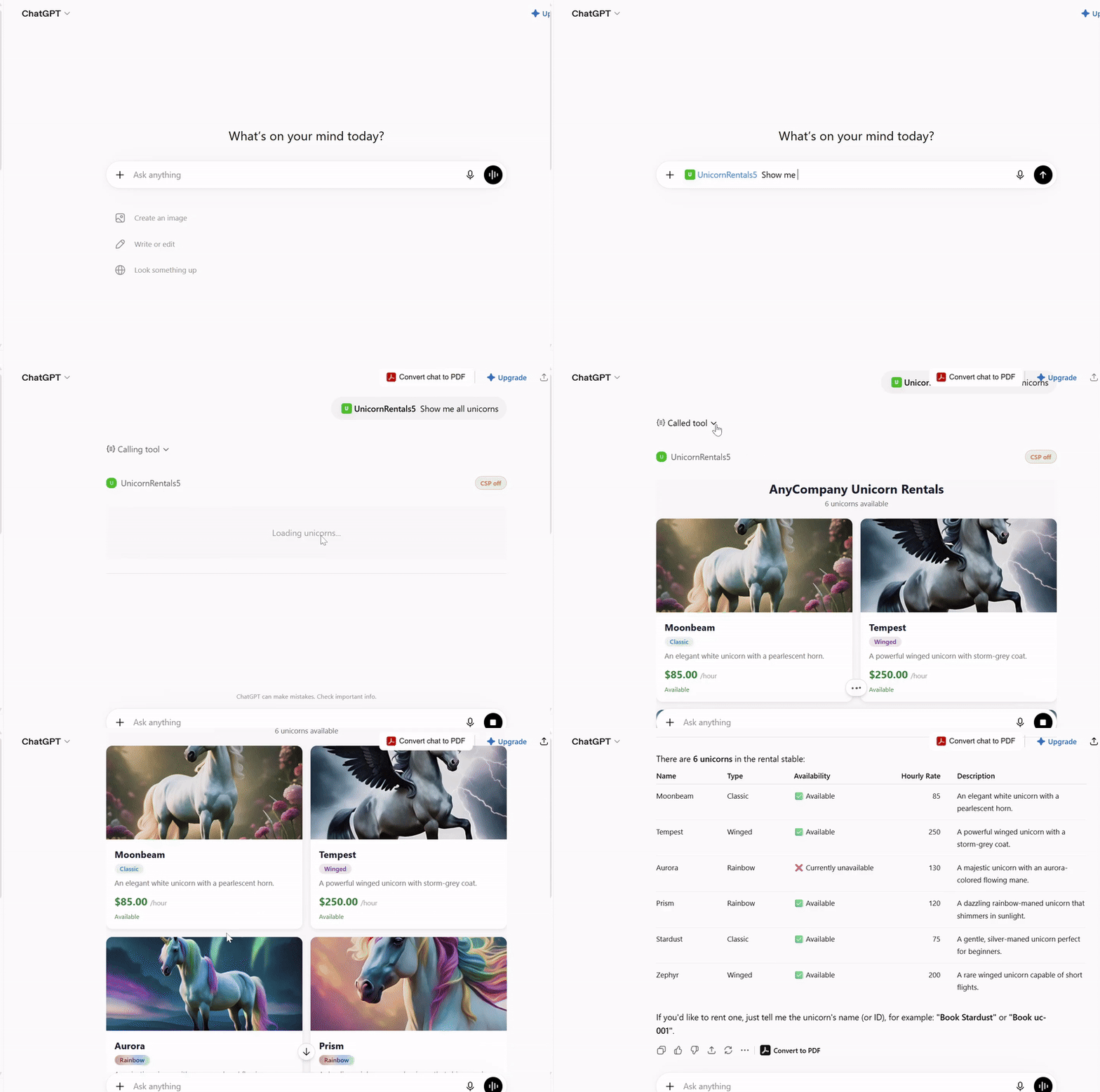
The evolution of generative artificial intelligence has moved beyond simple text-based conversational interfaces toward highly interactive, functional agents that perform real-world tasks. As businesses race to integrate AI into their customer experience strategies, they face a recurring challenge: how to provide rich, visual interfaces within third-party AI hosts like ChatGPT or Claude without becoming siloed into a single proprietary ecosystem. The emergence of the Model Context Protocol (MCP) Apps extension, combined with the robust infrastructure of Amazon Bedrock AgentCore, marks a significant shift in how organizations can bridge the gap between back-end business logic and front-end conversational AI.
This architectural integration allows developers to build "MCP Apps"—applications that can render interactive HTML widgets directly within the chat window of an AI host. By utilizing Amazon Bedrock AgentCore, companies can deploy these applications in a secure, serverless, and scalable environment, effectively offloading the "undifferentiated heavy lifting" of infrastructure management while maintaining full control over the user experience.
The Shift Toward Agentic Interactivity
Historically, integrating services into LLM-powered interfaces required custom-built plugins or rigid API integrations that were often host-specific. If an organization wanted to support both OpenAI’s ChatGPT and Anthropic’s Claude, they frequently had to maintain separate codebases or wrappers. The Model Context Protocol (MCP) aims to standardize this interaction. By defining a universal language for how AI models access external data and tools, MCP allows developers to build once and deploy across multiple host platforms.

The introduction of MCP Apps takes this a step further by enabling the rendering of structured, interactive UI components. Instead of forcing a user to parse a long text response to find booking details, an AI can now render a dedicated HTML card containing images, status indicators, and actionable buttons. This transition from "text-only" to "app-like" experiences represents a fundamental change in how users perceive and interact with AI-driven digital services.
Technical Architecture and Operational Framework
The solution hinges on two primary components: the AgentCore Runtime and the AgentCore Gateway. The AgentCore Runtime serves as a serverless, session-isolated environment specifically optimized for MCP-compliant servers. This runtime environment is designed to handle the complexities of protocol management, ensuring that requests from various AI hosts are handled securely and efficiently.
Behind the runtime, the AgentCore Gateway acts as a secure traffic manager. By exposing a single, unified endpoint, the gateway allows external AI hosts to connect to the internal service without requiring complex authentication handshakes on the client side. This gateway leverages AWS Identity and Access Management (IAM) and SigV4 authentication to ensure that only authorized traffic reaches the backend.
The business logic—the actual "brains" of the operation—remains decoupled from the protocol layer. In a standard implementation, this logic is housed in an AWS Lambda function, which queries an Amazon DynamoDB database. This separation is crucial for enterprise scalability; it ensures that the business logic can be updated, tested, and maintained independently of the AI-facing interface. If a company decides to swap its backend data provider or implement more complex logic, the MCP protocol adapter remains unchanged.
Chronology of a Transaction
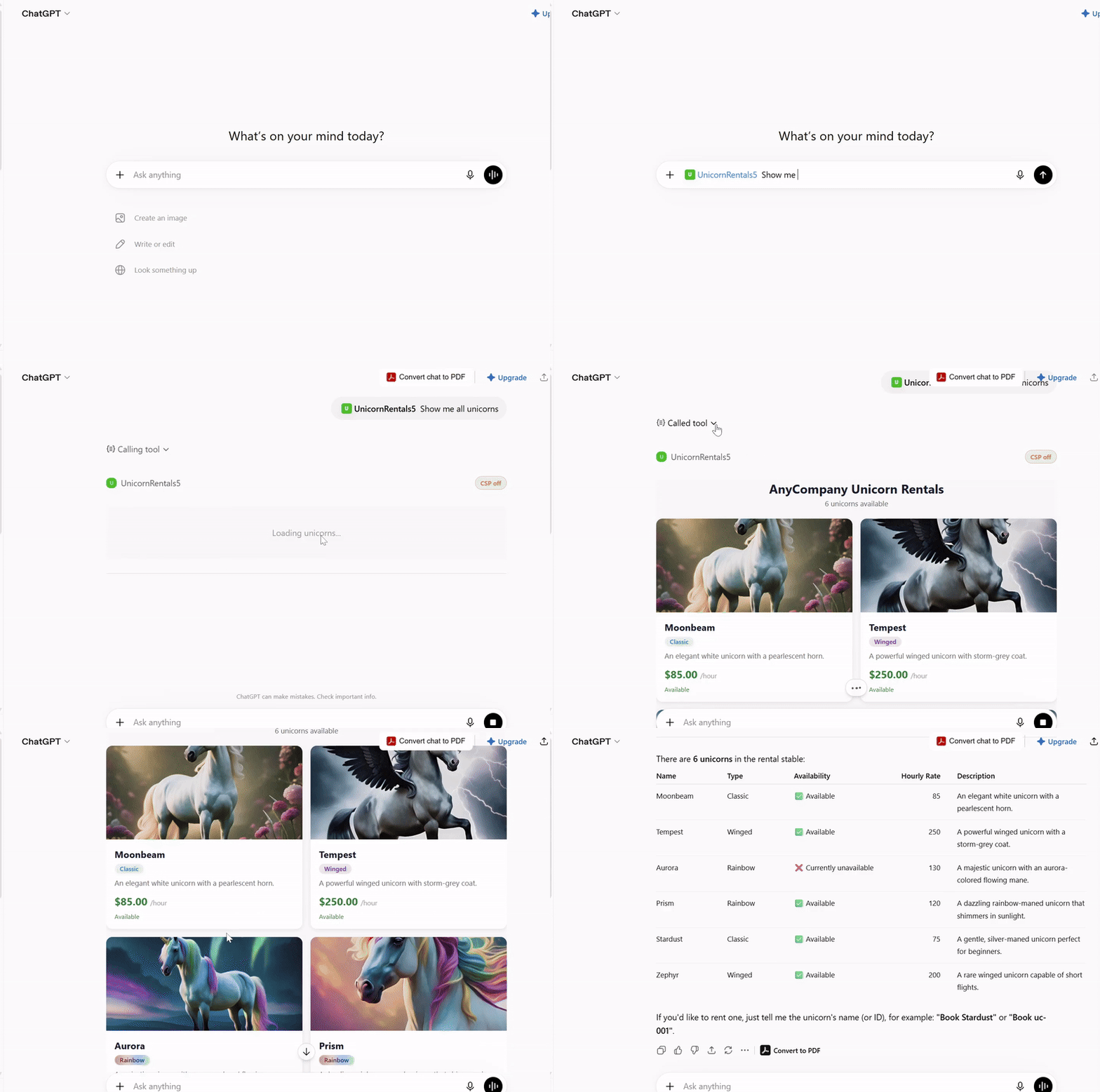
The power of this architecture is best observed in the lifecycle of a user request. When a user interacts with the "Unicorn Rentals" sample application, the process flows through a precise sequence:
- Tool Discovery: Upon connecting to the MCP server, the AI host queries the server to list available tools. The server returns a manifest of capabilities, such as
list_unicornsorbook_unicorn, along with their associated metadata. - Intent Mapping: The user submits a natural language request, such as "Can you show me the available unicorns?" The AI host processes this natural language and maps it to the appropriate tool call registered in the MCP manifest.
- Execution: The AgentCore Gateway receives the tool invocation, authenticates the request, and routes it to the AgentCore Runtime. The runtime executes the logic via the Lambda function, which fetches the current inventory from DynamoDB.
- Widget Rendering: Instead of returning a plain string, the server provides a
structuredContentpayload and a reference to an HTML widget resource. The AI host retrieves the widget HTML from the server and renders it as an interactive component within the chat thread.
This multi-phase approach ensures that the AI host never needs to know the intricacies of the database schema; it only needs to know how to render the provided UI components.
Market Implications and Security Considerations
The adoption of a standardized protocol for AI interaction has profound implications for software developers and enterprise architects. By reducing the friction associated with building AI-ready services, organizations can accelerate their time-to-market for conversational features. Furthermore, the protocol-agnostic nature of the solution mitigates "vendor lock-in," a primary concern for IT decision-makers in the current AI landscape.
Security remains a paramount concern in this environment. The architecture addresses this through multiple layers of defense. AWS WAF (Web Application Firewall) is employed at the gateway level to provide IP allowlisting, rate limiting, and protection against common web exploits. Within the runtime, resource-based policies restrict access to the underlying service, ensuring that the principle of least privilege is strictly enforced.

For production-grade applications, the integration of Amazon Bedrock Guardrails adds an essential layer of safety. By filtering harmful content and redacting sensitive PII (Personally Identifiable Information) before it reaches the end user, companies can ensure their AI agents remain compliant with industry regulations such as GDPR or HIPAA.
Analytical Perspectives on Scalability
From a financial and operational standpoint, the move to serverless, consumption-based pricing models—as provided by the AgentCore Runtime—allows for a high degree of cost predictability. Unlike traditional virtual machines that require constant maintenance and idle-time billing, the AgentCore model scales automatically with the volume of user interactions.
However, developers must carefully manage resource allocation. As the complexity of HTML widgets increases, the latency of rendering can impact the perceived performance of the AI assistant. Monitoring metrics such as "time to first token" and "widget load latency" via Amazon CloudWatch will be critical for teams looking to maintain a high-quality user experience.
Future-Proofing the AI Interface
The move toward the Model Context Protocol is viewed by industry experts as a natural maturation of the AI industry. Just as the web moved from static HTML pages to dynamic, interactive applications via AJAX and modern frameworks, the "AI-native" web is now evolving from static text generation to dynamic, tool-using agents.

By investing in an infrastructure that treats UI widgets as first-class citizens, companies are positioning themselves to capitalize on the next wave of AI development. As more AI hosts adopt the MCP Apps standard, the value of having a unified, standardized interface will only increase. Organizations that adopt this pattern now are effectively "future-proofing" their digital services, ensuring they can reach customers wherever they choose to interact—whether that is in a browser-based chatbot, a mobile application, or an enterprise-grade AI agent platform.
Conclusion
The integration of MCP Apps with Amazon Bedrock AgentCore represents a significant leap forward in the professionalization of generative AI applications. By providing a clean separation between the protocol-heavy lifting of AI communication and the core business logic of an enterprise application, this architecture offers a robust foundation for building the next generation of digital services.
For organizations looking to bridge the gap between their existing backend services and the rapidly expanding ecosystem of AI hosts, the path forward is clear: standardize the communication layer, decouple the business logic, and leverage serverless infrastructure to maintain agility. As the industry moves away from the novelty of simple text-based chat, the focus will increasingly shift to functionality, reliability, and the ability to deliver rich, interactive experiences. With the tools and patterns discussed, the infrastructure to support that shift is already here, providing a scalable and sustainable pathway for businesses to thrive in an AI-augmented world.
Related posts: