Beyond the Token: A Strategic Framework for Evaluating Generative AI Model Costs and Performance


Organizations building generative AI applications often rely on a single, deceptively simple metric when choosing a model: the price per million tokens. While this figure is prominently displayed on vendor pricing pages and occupies a central column in financial spreadsheets, it frequently fails to capture the true economic reality of production-grade artificial intelligence. In practice, production workloads do not consume tokens; they consume outcomes, such as resolved customer support tickets, synthesized research briefs, or accurate financial summaries. Between the sticker price of a model and the achievement of a desired outcome lie several critical multipliers that traditional cost analysis often overlooks: the model’s intrinsic accuracy, the volume of tokens required to reach a correct conclusion, and, in the context of agentic workloads, the number of iterative turns required to navigate complex tasks.
This shift in perspective is critical as enterprises transition from experimental pilots to high-scale production deployments. To address this, a comprehensive benchmarking harness, openai-on-aws/benchmarks-openai, has been developed to measure these performance multipliers across advanced models, including the GPT-5.6 series on Amazon Bedrock—specifically the luna, terra, and sol variants—against the industry-standard GPT-5.4 mini and nano baselines. This evaluation is not merely a technical exercise but a necessary financial audit for CTOs and engineering leads tasked with optimizing cloud infrastructure spend while maintaining strict quality assurance standards.
The Evolution of Model Benchmarking
Historically, the evaluation of large language models (LLMs) was confined to static academic benchmarks. While metrics such as MMLU (Massive Multitask Language Understanding) and AIME (American Invitational Mathematics Examination) provide a baseline for general intelligence, they do not simulate the unpredictable nature of real-world enterprise environments.
The current benchmarking framework represents a departure from these static tests by utilizing a standardized Responses API client to evaluate models across three distinct dimensions: single-call accuracy, multi-turn agentic trajectories, and rubric-graded professional deliverables. By holding the evaluation logic constant while toggling between model backends and configurations, researchers can isolate the performance variances inherent in different models and provider infrastructures. Crucially, the tests for Amazon Bedrock models were conducted with reasoning capabilities disabled, representing a practical, cost-optimized deployment configuration rather than an idealized theoretical limit.

Analyzing the Cost of Accuracy
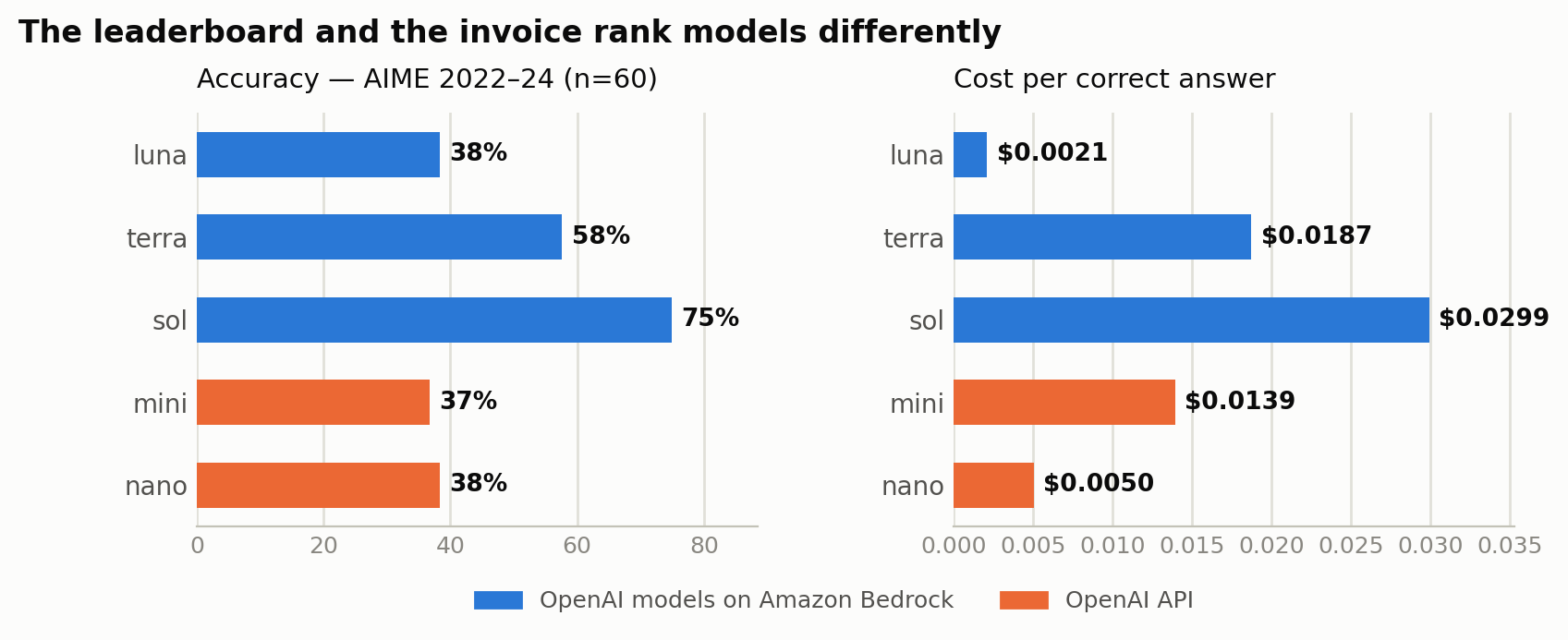
To derive a more accurate picture of capital efficiency, the benchmarking study calculates the "cost of a correct answer." By dividing a model’s total expenditure—encompassing both successful and unsuccessful attempts—by the number of correct responses, a clearer picture of the actual operational expense emerges.
Data gathered from AIME, GPQA Diamond, and MMLU-Pro indicate that the traditional focus on nominal token pricing is often misleading. In the AIME competition mathematics benchmark, the GPT-5.6-luna model demonstrated a superior balance of accuracy and cost-efficiency. While other models may boast higher peak performance in specific academic tasks, the cost-per-success metric reveals that the "cheapest" model on a per-token basis is not always the most economical choice when error rates and repeat attempts are factored into the equation. For example, a model with a lower price point that requires three attempts to solve a problem is significantly more expensive than a more capable model that achieves the correct answer on the first attempt.
The Hidden Cost of Agentic Trajectories
The most significant divergence between nominal pricing and actual operational cost occurs in agentic workloads, where models engage in multi-turn, iterative processes to achieve a goal. Because most agentic systems utilize client-managed history, every new turn requires the system to re-send the entire conversation context, including previous tool outputs and system instructions.
In a study of 50-question stratified samples from DeepSearchQA, which involves multi-step web research, the impact of turn count was profound. The data showed that input-token volume grows almost quadratically with the number of turns. If a model requires eight turns to solve a research prompt while another requires only five, the latter provides savings that extend far beyond the base cost of tokens. The analysis found that GPT-5.6-terra, despite having a higher nominal token price, consistently outperformed the baseline mini model in cost-per-success. The terra model required fewer turns to reach a satisfactory conclusion, thereby reducing the total context-window overhead and delivering a lower overall cost-per-passing-answer.
This observation provides a vital lesson for developers: turn efficiency is a hidden pricing variable. When designing agents that chain tool calls—such as those performing multi-hop lookups or iterative retrieval—the trajectory cost must be calculated alongside the per-token cost to avoid significant budget overruns.
Evaluating Professional Deliverables via GDPval
Beyond factual accuracy, many enterprise applications require the generation of complex documents such as compliance briefs, legal plans, and financial protocols. In these scenarios, "correctness" is determined not by a string match, but by a rigorous rubric. Utilizing the GDPval framework—which assesses professional-grade deliverables written by subject matter experts with an average of 14 years of experience—researchers evaluated the performance of these models in high-stakes environments.
The results from this 48-task evaluation highlight the strengths of the GPT-5.6 configuration. Models like luna displayed a marked improvement in producing output that adheres to specific structure, completeness, and nuanced caveats—requirements common in legal and medical documentation. In this specific category, the cost-efficiency of the newer models was stark; the luna configuration achieved a higher pass rate at a lower observed cost per deliverable compared to the mini and nano baselines. These findings suggest that for quality-gated production environments, the investment in a higher-capability model pays for itself by reducing the human-in-the-loop review time and minimizing the need for manual rework.
Performance and Latency Metrics
Latency remains a cornerstone of user experience, particularly for interactive applications. The comparative study examined median time-to-first-token (TTFT) and throughput across both Amazon Bedrock and the standard OpenAI API. The data collected in mid-2026 suggests that the Amazon Bedrock infrastructure offered distinct advantages in these areas, with luna showing approximately 21% lower TTFT and 43% higher throughput for longer outputs compared to the baseline benchmarks.
These latency metrics are particularly relevant for teams operating under strict Service Level Objectives (SLOs). While shared services are inherently subject to variable load, the stability of the Bedrock-hosted models provided a more consistent tail-latency profile. The observed worst-case TTFT ratios were notably more favorable on Bedrock, indicating greater predictability for high-traffic, latency-sensitive applications.
A Decision Framework for Model Migration
For organizations currently utilizing older or lighter-weight models like GPT-5.4-mini or nano, the migration path to newer models such as the GPT-5.6 series on Amazon Bedrock should be determined by the "workload shape."

- High-volume, low-complexity tasks: Where failures are inexpensive, luna on Amazon Bedrock serves as an ideal candidate due to its lowest cost-per-successful-outcome.
- Interactive applications: Where latency and accuracy are paramount, benchmarking luna is the recommended starting point to ensure both quality thresholds and SLOs are met.
- Complex agentic chains: For agents that perform iterative tool calls, both luna and terra offer superior F1 scores and reduced trajectory costs.
- Quality-gated document production: For professional output requiring adherence to complex rubrics, the higher pass rate of the 5.6 series drastically lowers the cost of manual oversight.
Broader Implications and Future Outlook
The transition toward outcome-based benchmarking signals a maturing generative AI market. As models continue to evolve and price points fluctuate, the ability to define, measure, and optimize for "success" rather than "consumption" will separate industry leaders from those struggling with inefficient AI spend.
The methodology outlined here, emphasizing reproducibility through open-source tooling, encourages a data-driven approach to infrastructure. By cloning the benchmarking repository and applying it to proprietary datasets, organizations can gain an empirical understanding of how different models perform on their specific, domain-relevant tasks. As the industry moves forward, the primary takeaway remains consistent: the per-token price is merely one input to a much larger strategic decision. By integrating accuracy, token efficiency, and trajectory costs into the procurement process, companies can ensure their generative AI investments provide tangible, measurable, and scalable value.