Powering the Next Generation of AI: Why Data Center Architecture, Not Grid Generation, Is the Real Crisis

The rapid expansion of artificial intelligence infrastructure has placed unprecedented demands on global electrical grids, sparking a fierce debate among policymakers, utility providers, and technology executives. For years, the conversation surrounding AI’s insatiable appetite for electricity has focused almost exclusively on generation capacity. Analysts and energy firms have argued that powering the future of artificial intelligence requires an aggressive buildout of new power plants, ranging from natural gas turbines and utility-scale solar arrays to the revival of nuclear energy facilities. Yet, recent catastrophic grid failures in regions heavily populated by data centers suggest that the core vulnerability is not a lack of available electrons, but rather a fundamental flaw in the architectural design of modern data center power systems.
The crisis of power reliability in the digital age was brought into sharp focus on July 22, 2026, when a major transmission line fault struck Ashburn, Virginia—widely recognized as "Data Center Alley" and the heart of the world’s largest data center cluster. In a matter of seconds, the transmission fault knocked more than 3 gigawatts of electrical load off the regional grid managed by PJM Interconnection. The sudden, synchronized disappearance of such a massive amount of electrical demand sent shockwaves through regional operators, threatening the stability of the entire mid-Atlantic grid.
This incident was far from an isolated anomaly. Just two years prior, a single failed surge arrester in the same region triggered a cascading protection response that caused roughly 60 Virginia facilities and 1,500 megawatts of load to drop off the grid simultaneously. In both instances, grid operators and engineers were caught off guard by the sheer uniformity of the response. The facilities behaved in an identical manner, dropping offline at the exact same moment in reaction to upstream grid disturbances. These events laid bare an uncomfortable truth for the technology sector: the electrical architecture connecting modern data centers to the broader grid is fundamentally unequipped to handle the erratic, high-velocity load profiles demanded by modern artificial intelligence hardware.
The Historical Mismatch Between Electrical Grids and Modern Computing
To understand why modern AI infrastructure routinely destabilizes power grids, one must examine the historical assumptions embedded in electrical grid design. Traditional electrical grids were engineered to supply power to predictable, steady industrial loads, such as steel mills, chemical refineries, municipal water systems, and residential neighborhoods. While these legacy loads varied in magnitude depending on the time of day or economic cycles, their power consumption patterns were relatively smooth. They drew power continuously, experienced minor operational hiccups infrequently, and recovered from minor voltage fluctuations gradually.
Artificial intelligence data centers, however, operate under an entirely different paradigm. An advanced AI training campus, packed with tens of thousands of specialized graphics processing units (GPUs) and accelerators, does not draw a steady, predictable stream of electricity. Instead, these facilities can experience dramatic load swings of up to 70% in mere milliseconds as training algorithms cycle through intensive computational phases. Conversely, at the first sign of an electrical anomaly upstream, these facilities are programmed to trip offline almost instantaneously to protect billions of dollars worth of sensitive computing equipment from voltage spikes or surges.
While executing an emergency shutdown is a rational economic decision for an individual data center operator seeking to safeguard expensive hardware, the collective impact of multiple gigawatt-scale facilities dropping offline simultaneously creates a catastrophic supply-demand imbalance for the grid. As the technology industry plans the next generation of mega-campuses designed to operate at even higher capacities, this structural incompatibility threatens to trigger widespread rolling blackouts and destabilize regional grids across North America and Europe.
Anatomy of an Architectural Failure: Where the Traditional Power Stack Breaks
The standard power distribution architecture utilized inside commercial data centers has remained largely unchanged for decades. When electrical power arrives at a facility from the utility, it typically enters at medium voltage, passes through large transformers that step the voltage down, flows through low-voltage uninterruptible power supply (UPS) units to condition the power, and finally reaches the server racks.
When applied to the massive scale of modern artificial intelligence workloads, this legacy power stack experiences critical failures in three distinct areas.
First, the low-voltage UPS systems are typically positioned deep inside the main building, located in close physical proximity to the server halls. The batteries housed within these units function essentially as an undersized spare tire—engineered to sustain facility operations for a brief window of a few minutes during a total blackout, rather than continuously absorbing the massive, rapid, and volatile load swings generated by AI clusters around the clock.
Second, to maintain high operational efficiencies and minimize wasted energy, legacy power converters are frequently run in "eco-mode" or bypass configurations. Under this operational mode, a static switch feeds electrical power directly from the utility grid to the server racks with minimal active filtering. Consequently, the severe sub-millisecond load swings produced by AI compute clusters flow directly back out into the grid unchecked. At the same time, transient disturbances originating from the external grid enter the facility too rapidly for mechanical switches to catch, exposing delicate computing hardware to potential damage.
Third, the protective relay logic governing these facilities was established during an era when a "large industrial load" was considered to be roughly 50 megawatts. This legacy protection logic is blind to the vast scale of the modern grid it now influences. When an upstream voltage disturbance occurs, the protective system executes its programming precisely as designed, but with disastrous consequences: it counts a series of minor voltage dips and systematically disconnects the facility from the grid on the third dip. As confirmed by subsequent reviews of major load-loss incidents by entities like the North American Electric Reliability Corporation (NERC), these poorly coordinated protection schemes are responsible for the vast majority of sudden data center drop-offs during grid faults.
Industry experts emphasize that this vulnerability is not the result of sloppy engineering; rather, it is the consequence of traditional engineering principles being utterly outgrown by the scale and velocity of modern computational loads.
Redesigning the Power Path: Moving Up, Out, and In-Line
To resolve the systemic risks posed by AI data centers, energy and infrastructure engineers are advocating for a comprehensive overhaul of the power protection architecture. This proposed transformation relies on three coordinated structural shifts: moving the power protection equipment up in voltage, moving it out of the primary data building, and placing it directly in the continuous path of every electron.
The first strategic move involves elevating the voltage level of the power protection systems from traditional low-voltage applications (such as 480 volts) up to medium voltage, typically ranging from 13.8 kilovolt levels and higher. This aligns the protection equipment directly with the medium voltage tier that large facilities draw from utility transmission and distribution networks.
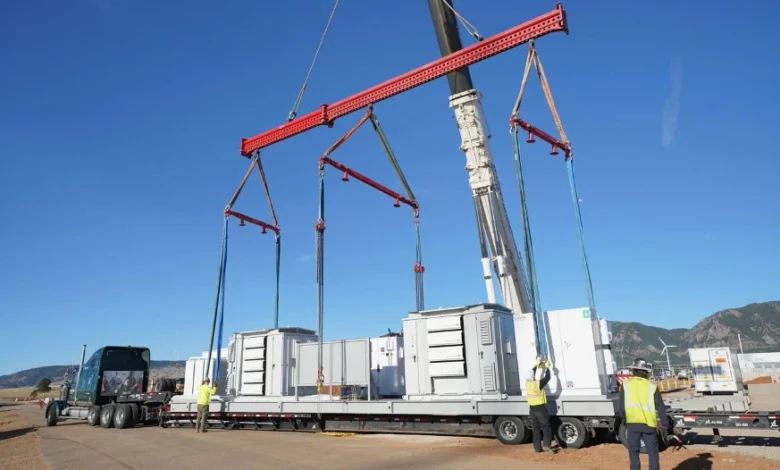
The second move involves physical relocation: shifting the power conditioning and energy storage infrastructure out of the main data hall and into modular, exterior enclosures situated near the electrical substation. By clearing this heavy equipment out of the interior, the primary data facility is left exclusively dedicated to housing computational servers and the complex cooling systems required to prevent thermal overload.
The third and most critical move places the protection system directly into the active power path. Instead of relying on a reactive battery backup system that sits on standby, an in-line medium-voltage system ensures that every electron flowing into the facility runs through the conditioning architecture continuously. Because the system is permanently engaged, there is no need for complex detection mechanisms or mechanical switching to activate backup power during a fault; nothing was ever routed around the system in the first place.
Transforming Grid Liabilities into Grid Assets
The implementation of an in-line, medium-voltage power architecture fundamentally alters the operational dynamics between data centers and utility providers. When thousands of AI accelerators suddenly spin up to execute intensive computational tasks, the medium-voltage storage system instantly absorbs the massive power swing, presenting the external grid with a smooth, flat, and predictable load profile. Conversely, when a severe fault or voltage sag occurs on the utility side, the equipment stationed outside the facility absorbs the shock, allowing the compute infrastructure inside to operate without interruption.
This architectural evolution also streamlines the notoriously complex and lengthy interconnection process required to bring new data centers online. Under traditional frameworks, utility regulators must evaluate and certify an intricate maze of individual transformers, low-voltage UPS arrays, chillers, pump systems, and switchgear lineups. By standardizing the interface through a single, certified medium-voltage box, utilities can significantly accelerate the regulatory review process. Furthermore, data center operators can upgrade or swap out server chip generations without triggering mandatory, time-consuming re-studies of their grid interconnection agreements, shaving months off facility permitting timelines.
Inside the facility fence, the removal of bulky low-voltage UPS rooms frees up valuable physical square footage, which can be repurposed for additional compute hardware or enhanced liquid cooling infrastructure. This drives a noticeable increase in power density per construction dollar invested.
From an economic standpoint, this structural shift inverts traditional operational expenditures. Because the medium-voltage equipment is located externally, runs at higher voltages, and incorporates dedicated energy storage, it frequently qualifies for federal and state clean energy tax credits. Additionally, the system can actively participate in lucrative grid stabilization programs, such as peak shaving and demand response. Backup power transitions from being a purely defensive insurance policy against blackouts into an active revenue-generating asset for the facility operator.
Empirical Validation and Industry Implications
Rigorous testing of full-scale medium-voltage, in-line architectures has already begun under laboratory conditions. In early 2026, engineers conducted comprehensive trials at the National Laboratory of the Rockies, a premier U.S. Department of Energy research facility equipped to simultaneously replicate real-world electrical grid faults and AI-scale load swings within a closed-loop system.
During the evaluation, testing teams subjected the system to severe stressors from both directions. Real-world AI computational load profiles were slammed into the compute side at full medium-voltage levels, while simultaneous utility-side grid faults—including complete zero-voltage blackout events—were introduced to the system. The results demonstrated that the compute infrastructure experienced zero disruption, while the grid-facing side remained perfectly stable. Furthermore, the system successfully cleared the stringent large-load voltage ride-through requirements mandated by the Electric Reliability Council of Texas (ERCOT) with substantial performance margins to spare.
As grid operators face mounting pressure to maintain regional reliability, regulatory compliance standards are tightening across the United States and international markets. While traditional data center operators frequently view these strict reliability rules as burdensome regulatory hurdles, an integrated medium-voltage, in-line architecture meets and exceeds these compliance standards inherently.
Industry analysts suggest that the ongoing challenges associated with the AI buildout are largely symptoms of an outdated infrastructure model designed for an obsolete era of electrical consumption. By elevating power protection to medium voltage, relocating storage systems outside the building envelope, and integrating protection directly into the continuous power path, the technology sector can convert data centers from severe threats to grid stability into robust assets for electrical reliability. As engineering firms and major technology developers adopt these advanced architectural standards for the next wave of AI factories, the broader energy market moves closer to resolving the delicate balance between surging computational demand and grid security.
Related posts: