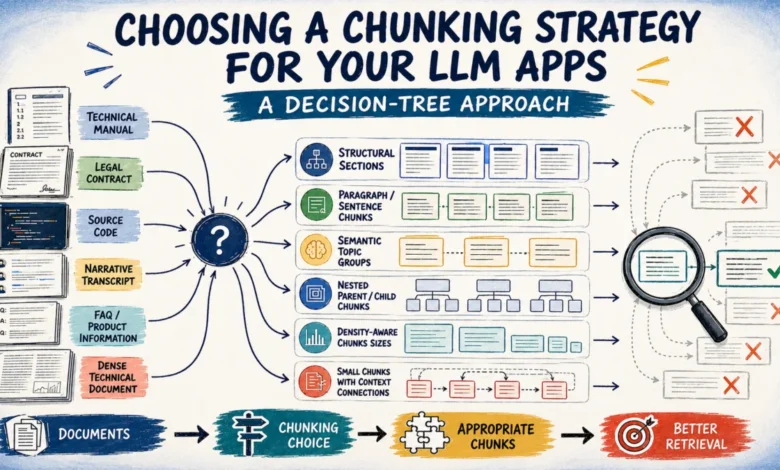
The Evolution of RAG and the Chunking Problem
Retrieval-augmented generation functions by retrieving relevant document snippets from a vector database and injecting them into a prompt for an LLM to synthesize an answer. Early iterations of RAG often relied on naive, fixed-size windowing. However, developers quickly discovered that arbitrarily slicing a document frequently severed logical connections, resulting in fragmented context and hallucinations.
The history of chunking has moved from simple character counts to sophisticated, context-aware semantic partitioning. In 2023, the industry-wide focus shifted toward "semantic awareness," where the goal became to ensure that each chunk represents a discrete unit of information. Without a coherent strategy, the vector embeddings—the mathematical representations of text—become diluted, leading to "noise" in the retrieval phase. A recent study by industry analysts noted that RAG systems with poorly optimized chunking strategies experience a 30% to 40% higher rate of retrieval failure compared to those utilizing structural or semantic-based segmentation.
Understanding the Decision-Tree Framework
Selecting an appropriate strategy requires a methodical evaluation of document architecture and query intent. By utilizing a structured decision-tree approach, engineers can systematically eliminate sub-optimal methods and align their processing pipeline with the specific nature of their data.
Phase 1: Context and Structural Assessment
The first step in the decision process is determining if segmentation is necessary. For concise content—such as FAQ databases, individual configuration files, or brief product specifications—chunking often introduces unnecessary complexity. If the entire document fits within the embedding model’s context window and maintains a single topic, it should remain intact. Splitting such content creates fragmented search results, which can confuse the retrieval mechanism.
When documents are substantial, the secondary question involves internal structure. Many modern documents, particularly those in Markdown, HTML, or structured JSON, already contain natural breaks. Document-based chunking leverages these markers (e.g., headers, function declarations, or paragraph tags) to preserve logical integrity. By respecting these natural boundaries, developers ensure that related data points—such as a header and its corresponding body text—remain tethered together during the vectorization process.
Phase 2: Addressing Dependencies and Density
For more complex datasets, such as legal agreements or dense technical documentation, simple structural parsing is insufficient. Legal documents often rely on definitions established in earlier sections, requiring a deeper level of context preservation. In such cases, "late chunking" has emerged as a preferred technique. This approach involves embedding the entire document using a long-context model before deriving granular chunks from the resulting representations. This ensures that even when a snippet is isolated, it retains the semantic "memory" of the document’s broader context.
Information density is another critical factor. If a document contains a mix of sparse, high-level summaries and dense, technical data, a single chunk size will inevitably fail. Adaptive chunking allows systems to adjust segmentation logic based on the information density of the text, preventing the "over-segmentation" of simple sentences or the "under-segmentation" of complex, data-heavy paragraphs.
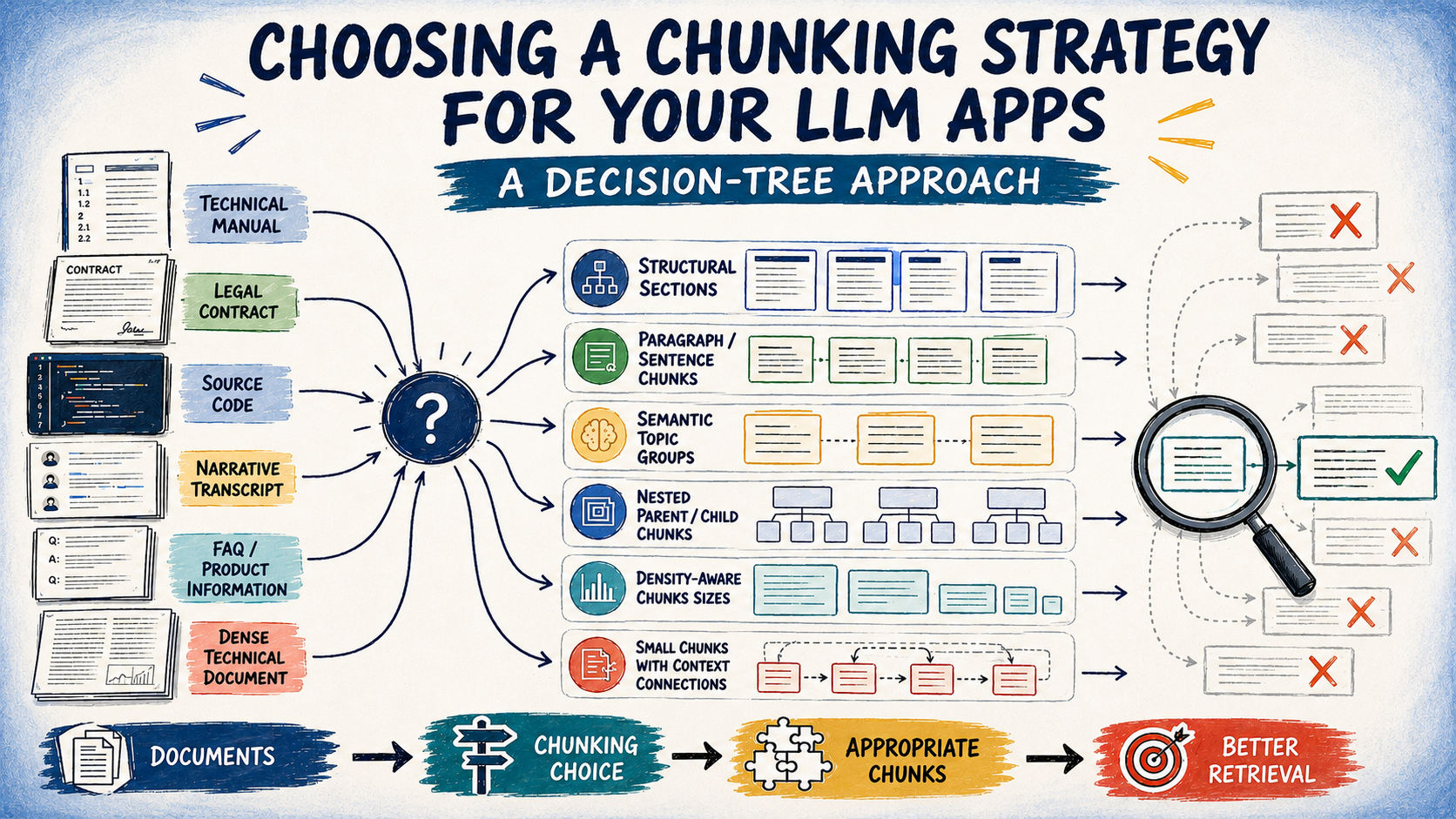
Analytical Overview of Strategies
The following table outlines the current standard strategies deployed in professional RAG environments, categorizing them by their primary utility and inherent trade-offs:
| Strategy | Primary Application | Primary Trade-off |
|---|---|---|
| No Chunking | Small, single-topic documents | Inapplicable to long-form content |
| Document-based | Structured docs (HTML/MD/Code) | Sensitive to inconsistent formatting |
| Late Chunking | Documents with global dependencies | Higher compute/Long-context model required |
| Adaptive | Varied information density | Increased algorithmic complexity |
| Hierarchical | Broad and specific query needs | Maintenance of multi-layer indices |
| LLM-based | High-stakes, precision-required docs | Significant latency and cost |
| Semantic | Unpredictable topic shifts | Threshold calibration challenges |
| Agentic | Heterogeneous document sets | High overhead for per-document analysis |
| Recursive | General-purpose, uniform corpora | Moderate semantic precision |
| Fixed-size | Fast, low-cost prototyping | Risk of context breakage |
Implementation Pitfalls and Mitigation
Data scientists and engineers frequently encounter performance degradation that stems from "semantic drift." A common symptom is the retrieval of technically relevant chunks that nonetheless fail to answer the user’s question because the crucial context was lost during the split.
To mitigate these risks, industry best practices suggest implementing a "monitoring and feedback" loop. If a system is consistently returning chunks that end in the middle of a sentence, the immediate fix is to transition from a structure-blind approach to a recursive approach that honors sentence-ending punctuation. Furthermore, for those deploying agentic chunking, performance bottlenecks often arise from redundant analysis. The most effective mitigation is to cache the segmentation logic at the collection level, preventing the system from re-calculating the strategy for every individual document upon re-indexing.
Broader Implications for AI Infrastructure
The shift toward more sophisticated chunking methods reflects a broader trend in the AI field: the transition from "model-centric" to "data-centric" development. As the capability of LLMs themselves begins to plateau, the competitive advantage is moving toward the quality of the data pipeline.
The economic implications are equally significant. Businesses spending thousands of dollars on API calls for LLM inference are finding that a well-architected chunking strategy can reduce the number of irrelevant tokens processed, thereby lowering costs while simultaneously improving the precision of responses. By treating the chunking strategy not as a static configuration but as a dynamic component of the RAG architecture, organizations can achieve a more scalable and reliable deployment.
Conclusion: A Strategic Path Forward
The selection of a chunking strategy should be an iterative process. Engineering teams are advised to begin with the simplest possible method—usually recursive chunking—and only introduce complexity when the retrieval metrics dictate a need for higher granularity or context preservation.
As the RAG ecosystem continues to mature, we expect to see an increase in "hybrid" approaches, where systems dynamically select the chunking method based on the incoming file type and query intent. For now, the most robust RAG systems are those that prioritize the logical structure of the data over the convenience of a "one-size-fits-all" approach. By aligning your segmentation strategy with the inherent properties of your documentation, you ensure that the retrieval engine acts as a precise scalpel rather than a blunt instrument, ultimately leading to more accurate, useful, and reliable AI-powered applications.