Monday.com Unveils Groundbreaking AI Engineering Architecture for Production-Scale Agentic AI


monday.com is pushing the boundaries of artificial intelligence in the software development lifecycle, revealing the intricate architecture and operational strategies that have enabled them to deploy agentic AI teammates at an unprecedented scale. This pioneering approach, built upon Amazon Bedrock, has resulted in significant gains in engineering productivity, with per-engineer PR throughput increasing by over 50%. The company’s internal data indicates that nine out of ten "Builders" (a term encompassing engineers, product managers, analysts, and product designers) are now utilizing AI coding tools monthly, a dramatic surge from approximately half a year ago.
This deep dive into monday.com’s AI engineering practices highlights not just the technological framework but also the crucial retrofits and human-centric design principles that have been instrumental in integrating these advanced agents into a mature, decade-old codebase serving millions of users. The company emphasizes that their implementation moves beyond theoretical greenfield demonstrations, tackling the complex realities of enterprise SaaS development, including on-call responsibilities, customer impact, and stringent compliance requirements.
The Evolution of AI Engineering at monday.com: Three Levels of Integration
monday.com frames the integration of AI agents into their engineering workflow through three distinct levels:
- Initial Integration and Tooling: This foundational stage focuses on equipping engineers with AI coding assistants and basic automation tools. The primary goal is to enhance individual productivity and familiarize the workforce with AI’s capabilities in areas like code generation and suggestion.
- Agentic Team Members: The subsequent level involves introducing more sophisticated, autonomous agents that operate as integral members of existing teams. These agents are assigned tasks, participate in workflows, and are managed with the same rigor as human colleagues, fostering a collaborative environment where AI augments human capabilities.
- Fully Autonomous Operations: The ultimate stage, currently being pioneered with initiatives like Morphex, aims for fully autonomous engineering agents capable of independently managing entire development cycles, from ticket assignment to production deployment, with minimal human oversight.
Agents as Teammates, Not Just Tools: The Sphera System
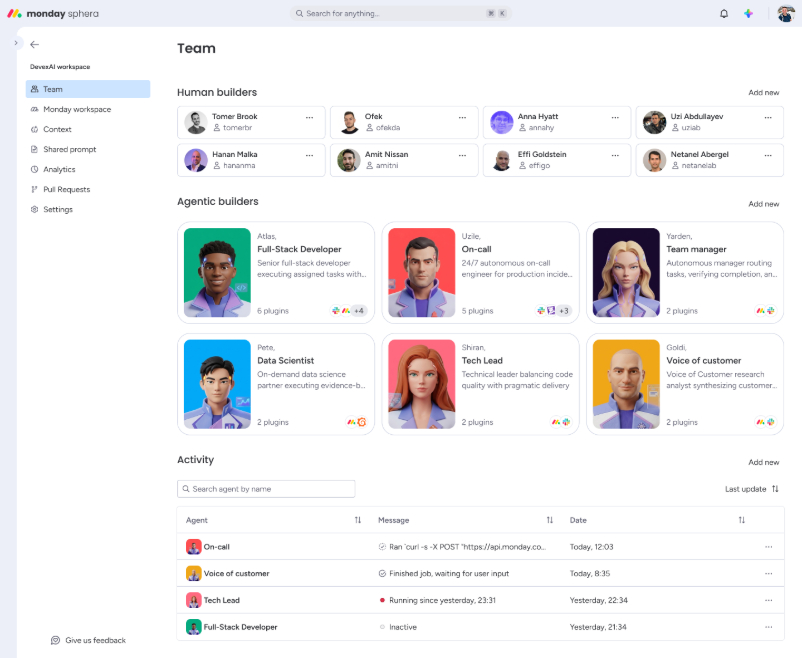
Central to monday.com’s success is its internal agent system, named Sphera. Unlike traditional task management systems that might present a job queue, Sphera offers a "Teams" page, a unified view of both human and AI team members. Each agent, like "Atlas," is assigned a specific role (e.g., Software Engineer) and a clear job function, such as picking up tickets, writing code, and shipping features. Crucially, these agents are integrated into the same backlog as human engineers, operating within the familiar development environment.
This integration is not merely cosmetic. Every agent possesses a stable identity that flows seamlessly across communication platforms like Slack, code repositories like GitHub, and monday.com’s own work management system. This allows human team members to tag, assign, code-review, or deactivate agents as they would any other colleague. This "teammate" paradigm ensures that agents are accountable for tangible results and are deeply embedded within the fabric of real teams, driving meaningful progress.
A Robust Architecture for Scalable AI Operations
The architecture powering monday.com’s agentic AI is a testament to its focus on reliability, scalability, and seamless integration with existing cloud infrastructure, primarily leveraging Amazon Web Services (AWS).
Unified Inbox and Event Handling
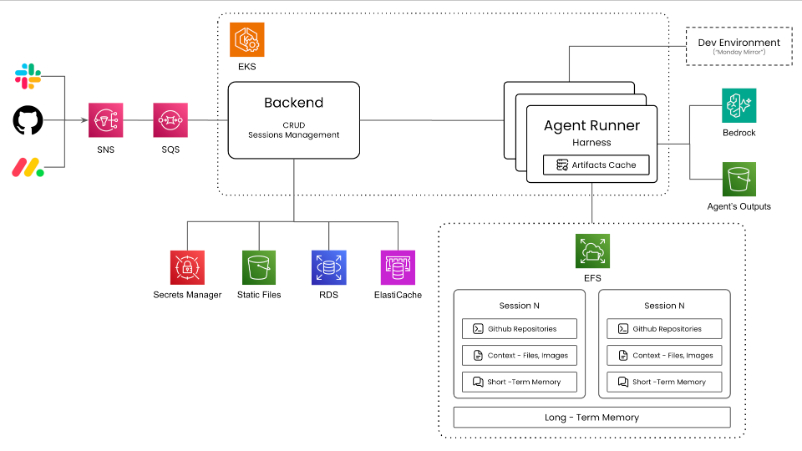
A key design principle is the unification of agent interaction points. A monday-built agent receives tasks through three primary channels: a Slack @mention, an assignment on a monday.com item, or a GitHub PR review request. All these inputs converge into a single agent session, sharing the same memory and workspace. This ensures a consistent experience and prevents the need for multiple, disparate agent systems.
The AWS Ecosystem in Action
The operational backbone of this system comprises seven core AWS services:
- Amazon Simple Notification Service (Amazon SNS): Acts as the initial ingestion point for all external triggers, enabling a fan-out to various downstream services.
- Amazon Simple Queue Service (Amazon SQS): Provides reliable, per-team queues, ensuring that messages are processed efficiently and resiliently.
- Amazon Elastic Kubernetes Service (Amazon EKS): Hosts the "monday Builders CoWORK" consumers, which manage the SQS queues and dispatch tasks to individual agent runner pods.
- Amazon Relational Database Service (Amazon RDS): Supports backend data storage and management.
- Amazon ElastiCache: Offers sub-millisecond latency for critical live state data, such as current tasks, run cursors, and distributed locks.
- Amazon Elastic File System (Amazon EFS): Provides persistent storage for agent sessions and memory, allowing for seamless state resumption across different compute instances.
- Amazon Simple Storage Service (Amazon S3): Serves as the long-term audit trail, storing durable records like final transcripts, snapshots, and evaluation artifacts.
Additionally, AWS Secrets Manager handles secure per-session secret management, and Amazon Bedrock serves as the central hub for all Large Language Model (LLM) interactions, abstracting away the complexities of individual model providers. The monday-agent-sdk runs within each agent runner pod, acting as a thin but crucial wrapper around the core LLM capabilities.
Event Path: From Trigger to Agent Execution
The journey of an event begins when it lands in Amazon SNS. From there, it’s fanned out to team-specific SQS queues based on topic and routing keys. The "monday Builders CoWORK" consumers, operating on EKS, poll these queues, identify the responsible agent, and forward the message to the appropriate agent runner pod. This pub/sub model combined with queuing offers critical benefits: built-in retries and dead-letter queues, robust back-pressure handling against LLM provider throttling, durable replay capabilities for testing patched builds, and concurrent fan-out for high-throughput scenarios.
monday-agent-sdk: A Strategic Wrapper
The monday-agent-sdk is intentionally designed as a lightweight wrapper around LLM frameworks like the Claude Agent SDK. Its purpose is threefold:
- Abstraction of Model Interactions: It standardizes how agents interact with LLM APIs, allowing for easier model switching and updates without disrupting the agent’s core logic.
- Context Management: It facilitates the management of conversation history, tool calls, and other contextual data necessary for agent decision-making.
- Integration with Internal Systems: It bridges the gap between the LLM’s capabilities and monday.com’s internal tools, services, and workflows, enabling agents to perform real-world actions.
State Management: ElastiCache, EFS, and S3
Effective state management is critical for agent persistence and performance.
- Live State: Stored in Amazon ElastiCache, this includes rapidly changing data like current tasks, run cursors, distributed locks, and heartbeats. ElastiCache’s self-expiring keys and sub-millisecond read times make it ideal for this high-frequency, low-latency access pattern, proving more cost-effective and performant than alternatives like Amazon DynamoDB for this specific use case.
- Sessions and Memory: Persistent state, including the agent’s workspace and conversational memory, resides on Amazon EFS. Each active session is represented by a directory on this shared filesystem, allowing compute pods to mount the same EFS path and resume operations seamlessly. This includes checked-out code repositories, encrypted secrets, chronological message logs, and a cross-session memory file (
MEMORY.md) alongside daily journals (diary/YYYY-MM-DD.md). The use of EFS ensures compatibility with standard POSIX filesystem operations required by many development tools (e.g., Git, npm) and facilitates smooth agent recovery on different EKS pods. - Durable Records: Final transcripts, snapshots, artifacts, and evaluation results are stored in Amazon S3, serving as an immutable audit trail and historical archive, keyed by session ID.
Amazon Bedrock: The Foundation for Scalable LLM Deployment
Amazon Bedrock is positioned not merely as a token provider but as a comprehensive "model fabric" that enables monday.com to deploy and manage hundreds of agents efficiently. Key operational advantages offered by Bedrock include:
- Centralized Model Management: Simplifies the process of selecting, configuring, and deploying various LLM models.
- Cost Optimization: Provides tools and visibility for monitoring and controlling LLM expenditure.
- Safety and Compliance: Integrates with AWS security and compliance frameworks, ensuring responsible AI deployment.
- Capacity Planning: Offers insights into model usage and helps manage capacity to avoid throttling.
- Performance Monitoring: Enables tracking of model latency, throughput, and error rates.
EKS as the Compute Foundation
The compute fleet is built on Amazon EKS, with each active agent session typically occupying a dedicated pod. These pods mount the agent’s EFS workspace, ensuring crash isolation at the session level. Auto-scaling is managed by KEDA, responding to average active sessions across pods, with metrics collected via Datadog. The system employs a single worker image, leveraging EFS for cached repositories to accelerate session startup. This streamlined approach eschews complex service meshes or orchestrators-of-orchestrators, relying on the robust capabilities of EKS, SQS, and the caching layer.
Five Retrofits Crucial for Production Readiness
Achieving effective AI agent integration within a mature codebase required significant architectural adjustments and strategic retrofits. monday.com identifies five key innovations that were instrumental:
Evals First: Rigorous Assessment Before Model Upgrades
Initially, the bar for agent-generated Pull Requests (PRs) was simply "looks fine." This proved insufficient as agent volume increased. The introduction of two evaluation layers became critical:
- Deterministic Metrics: Tracking key performance indicators per agent, such as PR merge rates, revert rates, and zero-touch merge rates.
- LLM-Scored Evals: A comprehensive evaluation of each PR across five dimensions: Intent & Decision, Execution & Artifact, Completeness & Usefulness, Instruction & Boundary, and Efficiency.
These evaluation layers feed directly back into the agent harness, driving continuous improvement. monday.com reports that by solely adjusting these evaluations, rather than changing models, prompts, or human interventions, they saw significant score improvements across all dimensions.
Memory as a File, Not a Vector Store
Early attempts to imbue agents with memory involved context-window stuffing and vector retrieval over past transcripts, which proved largely ineffective. The breakthrough came with the implementation of simple markdown files: a per-agent MEMORY.md for cross-session context and a diary/YYYY-MM-DD.md file written at session end and read at session start. This plain-text approach, devoid of complex embedding or recall scoring mechanisms, enabled agents to effectively retain and recall information across sessions, significantly improving their continuity and efficacy.
Remote Sandbox for Pre-Human Review Testing
Atlas’s early PRs, while passing local tests, often failed in Continuous Integration (CI) due to dependencies specific to monday.com’s complex environment, including feature flags and third-party services. To address this, a remote sandbox environment was established for each agent session. Every PR is automatically deployed to this sandbox, where comprehensive tests, checks, and replayed production traffic are executed before the PR is submitted for human review. This significantly reduces the likelihood of human reviewers encountering broken builds and streamlines the feedback loop.
PR Guardrails: Automated Enforcement of Engineering Standards
As agent PR volume surged, human review became a bottleneck. To alleviate this, every monday.com engineering standard was translated into an automated reviewer within the "PR Guardrails" system. These automated checks cover critical areas such as metrics tagging, feature flag hygiene, Datadog usage, security boundaries, database and microservice conventions, test quality, and documentation. This system leverages internal knowledge via monday.com’s MCP servers, ensuring that automated reviews are contextually relevant. Every PR, whether agent- or human-authored, undergoes this evaluation. Roughly one in five PRs fails at least one standard, leading to automatic rejection without human intervention. Human overrides are minimal, with the system shouldering the primary enforcement burden.
Builders CoWORK: monday Boards as the Shared State Layer
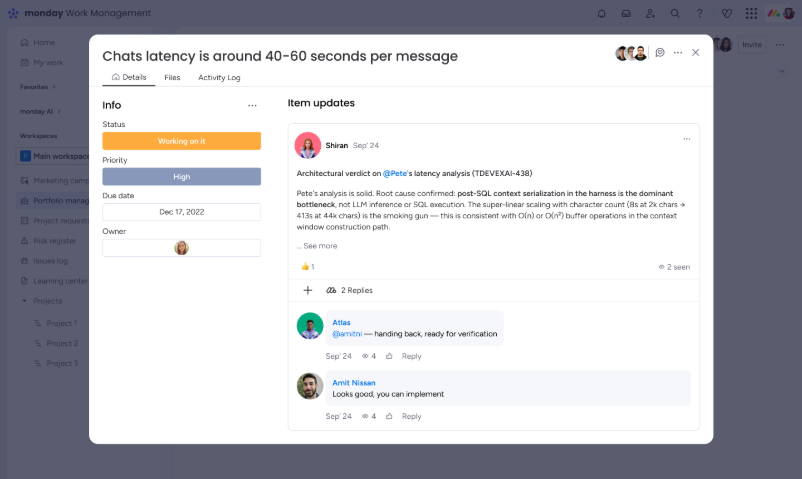
A significant failure mode was identified when agents operated in silos, submitting PRs that lacked clear ownership. To rectify this, the "CoWORK workspace" was introduced. This user-facing surface of the "monday Builders CoWORK" system, which also routes events, integrates agent tasks, status, blockers, and handoffs directly onto the same monday boards used by human teams. This effectively transferred accountability from a systemic problem to monday.com’s already robust human workflow management, ensuring that AI-driven tasks are as transparent and manageable as human ones.
The Path to Autonomous Merging: Morphex and Confidence Scoring
By late Q1 2026, the primary bottleneck shifted from code generation to human review. With PR Guardrails effectively handling standard enforcement, the next frontier was achieving autonomous merging for agent-authored PRs. This led to the development of Morphex, monday.com’s first fully autonomous engineering agent.
Morphex operates within the same repository, CI pipeline, and Guardrails framework as human engineers. Nineteen out of every twenty Morphex PRs merge automatically, not by bypassing review, but by successfully passing all established gates. This means that approved PRs are deployed to production with no human in the loop. Morphex’s output rivals that of prolific human engineers, and rejected PRs fail for reasons identical to those encountered by humans: flaky tests, ambiguous specifications, or unhandled edge cases.
The key to this autonomous merging lies in a "confidence-scored automatic merging" system. This score is derived from four crucial signals available at the time a PR is opened:
- Guardrails Pass Rate: A high score indicates the PR has successfully navigated all automated engineering standards.
- Test Stability: Consistent green test results across multiple runs suggest code reliability.
- Agent History: A history of successful, low-revert PRs from the agent builds confidence.
- Human Edit Rate: A low rate of human edits on previous agent-authored PRs signifies the agent’s accuracy.
When this confidence score surpasses a predefined threshold, the PR merges automatically. Below the threshold, it routes to a human reviewer with the specific failing signal highlighted. This represents a transition from Level 2 to Level 3 AI engineering, not by eliminating humans, but by empowering them to focus on cases where the system’s confidence is insufficient for fully autonomous action. monday.com is now focused on increasing the fraction of merged agent PRs that ship without human review while maintaining or improving the revert rate.
The monday.com Way: Trust Through Integration
monday.com’s philosophy is that AI engineering is not about creating perfect agents, but about building robust feedback loops that allow imperfect agents to be safely trusted, thereby freeing up human time. Their approach to building this system is deeply rooted in their company’s core principles:
- Integrated Identity: Agents share identity with humans, facilitating seamless collaboration and management.
- Shared Infrastructure: Agents leverage the same AWS infrastructure as the rest of the company, ensuring consistency and scalability.
- monday Boards for State: The use of monday boards for state management integrates agent workflows into the existing human operational framework.
- Existing Governance: Agents operate under the same governance and compliance policies as human teams, making the system auditable, reversible, and trustworthy by default.
This integration avoids the creation of a separate, siloed AI governance layer, ensuring that the existing, well-tested systems are leveraged.
Lessons Learned and Future Outlook
Reflecting on their journey, monday.com identifies three key areas where they would approach development differently:
- Evals on Day One: Implementing rigorous evaluations from the outset, rather than months into development, would have accelerated learning and impact.
- EFS for Memory: Prioritizing the EFS-based markdown file approach for memory over initial investments in vector stores would have streamlined development.
- Integrated CoWORK: Launching the CoWORK workspace directly on monday boards from the beginning, rather than as a separate workspace, would have improved initial human context-switching.
While monday.com is not open-sourcing their monday-agent-sdk, they are committed to sharing their architecture and operational playbook. The value, they contend, lies not in the SDK itself but in the surrounding harness and integrations, which are highly specific to their environment. By being transparent about their successes and challenges, monday.com aims to contribute to the broader industry’s progress in running production agents at scale.
The company invites collaboration and discussion with teams building agents into their engineering processes, offering their insights to help others navigate similar challenges. The ongoing development promises further advancements in AI-driven engineering, with a clear focus on augmenting human capabilities and driving unprecedented levels of productivity and innovation.