Unlock the Power of Local AI: Running Advanced Language Models on Your Machine in Under 15 Minutes with Ollama

In an era increasingly defined by the accessibility of powerful artificial intelligence, a significant shift is occurring: the decentralization of AI workloads. Gone are the days when cutting-edge language models were solely the domain of massive cloud infrastructure and prohibitively expensive APIs. A new generation of efficient, smaller language models (SLMs) is democratizing AI, making it possible for individuals and organizations to run sophisticated AI tools directly on their own hardware. This article details a streamlined process for achieving this feat, enabling users to set up and run a fully functional small language model locally in under 15 minutes, leveraging the innovative platform known as Ollama.
The Local AI Revolution: Bringing Intelligence to Your Fingertips
The landscape of artificial intelligence is rapidly evolving, with a notable trend towards the development and deployment of smaller, more efficient language models. These models, often referred to as Small Language Models (SLMs), are challenging the dominance of their larger, cloud-based counterparts by offering compelling performance with significantly reduced computational and resource requirements. As highlighted in previous discussions on the introduction to SLMs and the top SLMs capable of running on a laptop, models such as Meta’s Llama 3.2 3B and Google’s Gemma 2 9B represent the vanguard of this movement. They offer a tangible pathway for users to experience advanced AI capabilities without relying on external services.
The true power of these advancements is realized when these models can be operated directly on personal computing devices. This local deployment offers unparalleled advantages: complete offline functionality, robust data privacy, and cost-effectiveness, as there are no per-token charges associated with inference. Historically, establishing such a local AI environment was a complex undertaking, often involving intricate configurations of graphics processing unit (GPU) drivers, meticulous management of Python virtual environments, and the often frustrating resolution of dependency conflicts. However, the advent of Ollama has dramatically simplified this process, ushering in an era of accessible local AI.
Ollama: The Catalyst for Seamless Local AI Deployment
Ollama has emerged as a pivotal tool in the democratization of local AI, fundamentally altering the setup experience. It abstracts away the complexities inherent in deploying and managing AI models by packaging sophisticated model architectures into a streamlined, lightweight background service. This service expertly handles model downloads, manages native hardware acceleration, and exposes a straightforward local Application Programming Interface (API). In essence, Ollama functions as a specialized version of containerization technology, akin to Docker, but meticulously engineered for the unique demands of language models. Instead of wrestling with raw model weights and intricate configurations, users interact with Ollama through a concise set of intuitive commands, facilitating an unparalleled ease of use.
This guide is designed to navigate the most direct and user-friendly path – the "happy path" – to get your first SLM operational on your local machine in under 15 minutes. The objective is to provide a distraction-free, platform-agnostic experience, focusing solely on enabling local inference without the fragmentation often associated with different operating systems or hardware configurations.
The "Happy Path": A Three-Step Journey to Local AI Chat
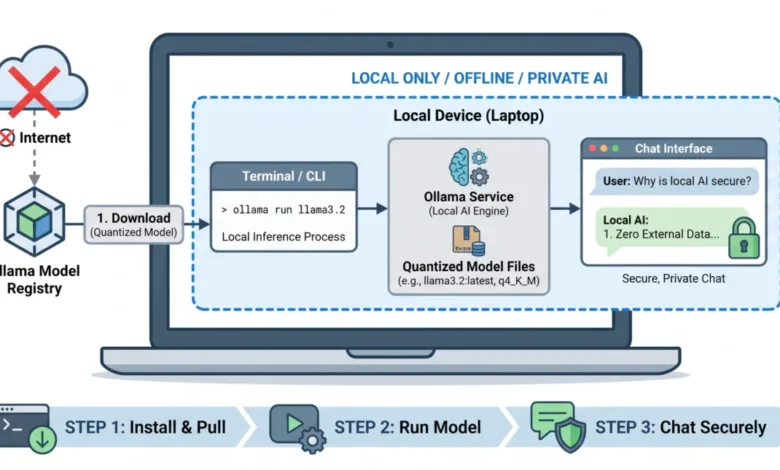
The following steps outline a unified, cross-platform installation and operational flow. Regardless of whether your system runs on macOS, Windows, or Linux, the underlying setup process remains consistent, comprising three fundamental stages to achieve a fully functional AI chat session.
Step 1: Installing Ollama
The initial step involves acquiring and installing the Ollama application for your specific operating system. The official Ollama website provides straightforward installers for each major platform, ensuring a quick and efficient setup. Once downloaded, the installation process is typically a matter of a few clicks, after which Ollama will quietly establish itself as a background service, ready to manage your local AI models.
Step 2: Downloading Your First Model
With Ollama successfully installed and operating in the background, the next crucial step is to download an actual language model. This is accomplished through your system’s terminal interface. For users on Windows, this would be Command Prompt or PowerShell. The command to initiate the download and execution of a model is elegantly simple. For this guide, we will be deploying Llama 3.2 3B, a model recognized for its balanced performance characteristics, making it particularly well-suited for everyday laptop usage.
The following commands are executed in your terminal:
# Verify Ollama is running by checking the version
ollama --version

# Pull and immediately run the Llama 3.2 3B model
ollama run llama3.2
Upon executing the ollama run llama3.2 command, Ollama will commence the download of the model’s constituent layers. Llama 3.2 3B is a testament to efficient model design, with its download size typically around 2.0 gigabytes. On a standard broadband internet connection, this download should complete in under three minutes, a remarkably swift process given the complexity of the model being acquired.
Step 3: Your First Chat Session
As soon as the model download reaches 100%, your terminal transforms into an interactive chat interface. This signifies that you are now engaging with an artificial intelligence model running entirely on your local hardware. This means no internet connection is required, and no data is transmitted beyond your machine, ensuring complete privacy and security. To initiate a conversation, you can use the following prompt:
>>> Write a three-bullet-point summary explaining why local AI is secure.
The expected output from the Llama 3.2 3B model would be a concise summary highlighting the inherent security benefits of local AI:
- Zero External Data Transmission: Your prompts and data remain exclusively on your local machine, eliminating the risk of cloud-based data leaks or third-party logging.
- Complete Offline Functionality: As the model operates entirely on your local hardware, it necessitates no internet connection, thereby preventing network-based interception or surveillance.
- Total Infrastructure Control: You retain absolute ownership and control over the hardware and operational environment, enabling the enforcement of stringent access controls and compliance policies.
To conclude your chat session and exit the interactive mode, simply type /bye and press Enter.
Understanding the Downloaded Artifact: Model Weights and Quantization
The simplicity of the three-step process belies the sophisticated technology at play. When you execute ollama run llama3.2, several critical processes occur behind the scenes. Understanding these processes is crucial for making informed decisions regarding model selection, memory management, and performance optimization in future local AI endeavors.
Model Tags and Default Behavior: When a specific version or "tag" of a model is not explicitly provided during the ollama run command, Ollama defaults to the :latest tag. For Llama 3.2, this tag points to the 3-billion parameter variant, which strikes an excellent balance between computational speed and functional capability for typical consumer-grade hardware.
The Significance of Quantization: A fundamental aspect enabling SLMs to run on consumer hardware is the technique of quantization. A 3-billion parameter model, if run at its native 16-bit floating-point precision (fp16), would typically require approximately 6 gigabytes of Video RAM (VRAM) solely for its weights. The fact that the download size is around 2.0 GB indicates that a compression technique has been applied. Ollama, by default, utilizes 4-bit quantization, specifically a variant like q4_K_M. This process significantly compresses the model’s weights from full-precision floating-point numbers down to 4-bit integers. This reduction in precision dramatically decreases the memory footprint by over 60% and concurrently accelerates inference speeds. While there might be a marginal impact on accuracy, the trade-off is well worth the substantial gains in efficiency, making it feasible to run these powerful models on laptops.
Assessing Output Quality: A Sanity Check: Given the compact nature of 3-billion parameter models, their performance can be sensitive to available system resources. It is important to recognize potential indicators of resource strain. If the generated text appears fragmented, repetitive, or nonsensical, it may suggest that the model is struggling due to insufficient VRAM or system RAM. In such scenarios, closing resource-intensive applications or opting for an even lighter model (e.g., ollama run smollm2:1.7b) is recommended. Conversely, coherent, contextually relevant, and well-structured output signifies that the model is operating optimally within the available hardware constraints.
Troubleshooting Common First-Run Issues: A Diagnostic Guide
While Ollama’s installation process is generally robust, variations in hardware configurations can occasionally lead to unexpected issues. Rather than sifting through extensive log files, the following table provides a quick reference for diagnosing and resolving the three most common first-run failures.
| Symptom / Error | Root Cause | The Immediate Fix |
|---|---|---|
| Chat response takes minutes to start, or text prints one word at a time. | Insufficient VRAM/RAM. The model is too demanding for your GPU, forcing Ollama to rely on slower CPU/system memory for processing. | Close resource-intensive applications like web browsers or integrated development environments. Alternatively, consider using a smaller model such as ollama run smollm2:1.7b. |
| Error: "Failed to contact GPU driver" or Ollama defaults to CPU on a high-end gaming laptop. | GPU driver mismatch. Ollama is unable to establish a connection with your dedicated GPU. This is frequently caused by outdated Nvidia CUDA or AMD ROCm drivers. | Update your GPU drivers to the latest available version. On Windows and Linux systems, verify that the CUDA_VISIBLE_DEVICES environment variable is not inadvertently configured to block access to the GPU. |
| Error: "address already in use" or "Error: listen tcp 127.0.0.1:11434: bind: address already in use" | Port conflict. Another instance of Ollama is already running as a background service, preventing the terminal from establishing a new connection on the default port 11434. | Do not attempt to relaunch the application. Instead, execute your Ollama command directly from the terminal (e.g., ollama run llama3.2). The existing background daemon is already active and listening on port 11434. |
The Implications of Local AI Deployment: A Foundation for Future Innovation
Establishing a functional local inference setup provides a powerful, private AI engine entirely under your control. This means no reliance on external API keys, no restrictive rate limits, no subscription fees, and, critically, no data leaving your machine. This level of autonomy represents a significant technological capability and serves as an ideal launching pad for more advanced AI exploration.
The path forward with local AI is remarkably accessible. Exploring other models from the "Top 7 Small Language Models You Can Run on a Laptop" list is as straightforward as modifying the model name in your terminal command. For instance, you can easily switch to Gemma 2 9B by running ollama run gemma2:9b, or experiment with Phi-3.5 using ollama run phi3.5. Each model possesses unique strengths, with some excelling in logical reasoning, others in code generation, and still others in handling extended context windows. Experimenting with a variety of these models will swiftly reveal which best aligns with your specific workflow and requirements.
As you gain confidence and familiarity with local AI operations, consider leveraging Ollama’s local API. This API, accessible at localhost:11434, is designed to be compatible with OpenAI’s API standards. This compatibility opens a vast array of possibilities for integrating local models into your custom scripts, bespoke tools, and innovative applications. This foundational understanding of local inference, coupled with your newfound knowledge of quantization techniques and hardware requirements, will equip you effectively for more sophisticated local AI projects and developments in the future. The era of accessible, private, and powerful AI is no longer a distant prospect; it is a tangible reality achievable on your own hardware today.