The Fermi Paradox: Why Advanced Civilizations Remain Invisible in an Aging Universe


With a thirteen-billion-year head start on cosmic evolution, the universe has provided ample time for biological and technological development across billions of galaxies. Yet, humanity remains entirely without empirical evidence of extraterrestrial contact. This contradiction—between high statistical probabilities of alien life and the complete absence of observed civilizations—forms the core of the Fermi Paradox. Named after Italian-American physicist Enrico Fermi, who famously asked "Where is everybody?" during a 1950 luncheon conversation at Los Alamos National Laboratory, the paradox continues to challenge astronomers, astrobiologists, and philosophers.
As scientific instruments grow more sophisticated, searching deep space for technosignatures and biosignatures has become a major focus of modern astrophysics. However, decades of radio astronomy, targeted searches through projects like Breakthrough Listen, and deep-space imaging have yielded zero definitive signals from intelligent civilizations. This persistent silence forces researchers to reevaluate fundamental assumptions about the nature of technology, the limits of observation, and the evolutionary path of sentient life.

Historical Context and the Origins of the Fermi Paradox
The intellectual foundation of the Fermi Paradox rests on two competing estimates: the immense scale of the cosmos and the high probability that life will emerge under favorable conditions. The observable universe contains an estimated two trillion galaxies, housing roughly $10^22$ stars—more than all the grains of sand on Earth’s beaches. A significant fraction of these stars host rocky planets within their habitable zones, where liquid water can exist.
In 1961, astronomer Frank Drake formulated the Drake Equation to estimate the number of active, communicative extraterrestrial civilizations in the Milky Way. By multiplying factors such as the rate of star formation, the fraction of stars with planets, the number of habitable planets per system, the fraction where life actually appears, and the lifespan of such civilizations, the equation routinely yields optimistic numbers. Even conservative inputs suggest our galaxy should harbor numerous technological societies.
Despite these probabilities, Enrico Fermi’s observation cuts through the mathematics with physical reality. If intelligent life is common, and if even a fraction of civilizations develop interstellar travel or broadcasting capabilities, the galaxy should have been colonized or explored millions of times over. The total absence of artifacts, probes, or radio transmissions creates the profound tension known today as the Fermi Paradox.

The Great Filter and Evolutionary Hurdles
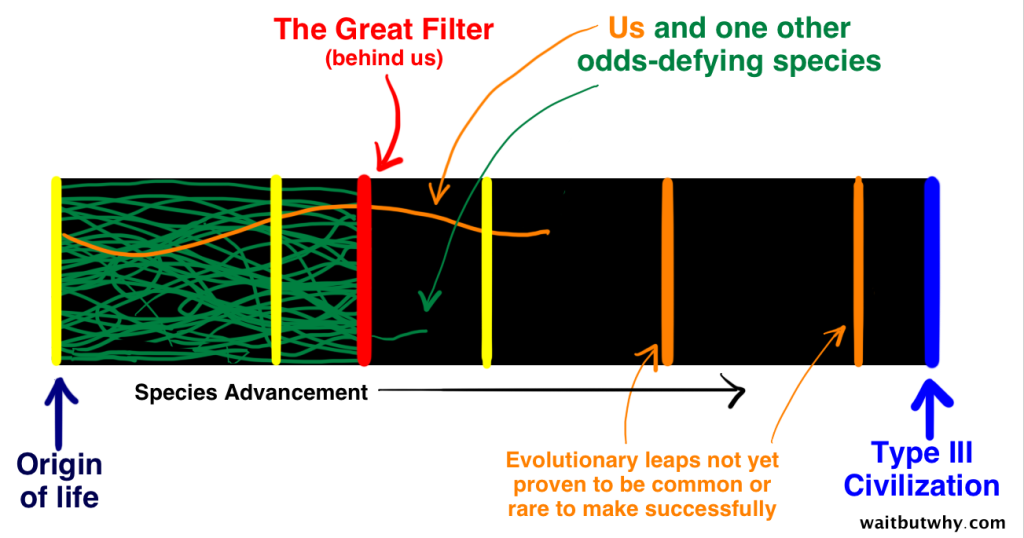
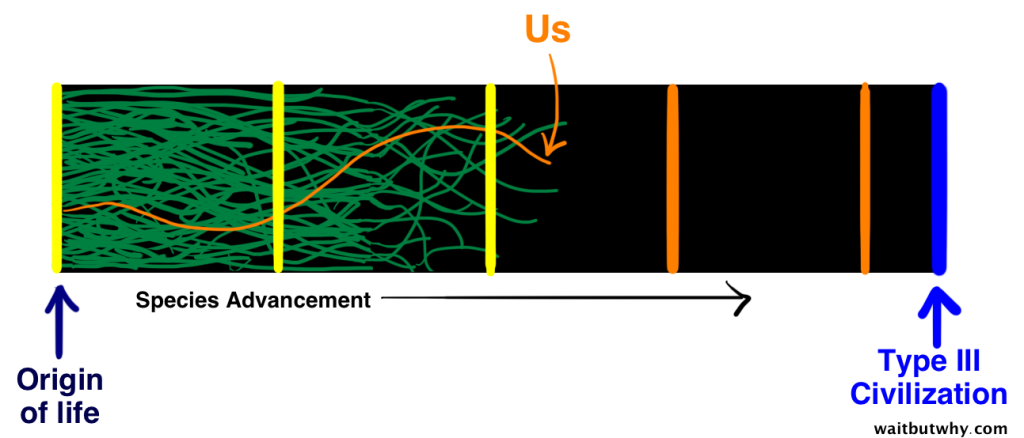
To resolve the contradiction between statistical probability and observational silence, economists and scientists have proposed several theoretical models, most notably "The Great Filter." Popularized by economist Robin Hanson, the Great Filter hypothesis suggests that at some point between the appearance of prebiotic chemistry and the development of Type III civilization status on the Kardashev scale, life encounters an insurmountable barrier.
This framework posits that every developmental stage acts as a filter through which life must pass. These stages typically include:
- The emergence of self-replicating molecules (abiogenesis).
- The evolution of simple single-celled organisms (prokaryotes) to complex cells (eukaryotes).
- The jump from single-celled to multicellular life.
- The development of tool-making intelligence and linguistic communication.
- The mastery of advanced space-faring technology.
A critical question in astrobiology is whether humanity has already passed the Great Filter or if it still lies ahead. If the filter is behind us—meaning abiogenesis or the rise of eukaryotic life is exceptionally rare—humanity may be one of the few intelligent species in the galaxy. Conversely, if the filter lies ahead, most civilizations likely self-destruct through nuclear warfare, artificial intelligence divergence, ecological collapse, or engineered pandemics shortly after discovering advanced technologies.

Technological Scaling: The Nanotechnology Hypothesis
While traditional searches for extraterrestrial intelligence (SETI) focus on massive interstellar probes, Dyson spheres, or high-power radio beacons, alternative theories suggest our search parameters may be fundamentally flawed. Human intuition historically associates power and advancement with scale—larger monuments, bigger machines, and wider communication networks. However, the trajectory of human technological development points in the exact opposite direction.
Modern computing offers a clear parallel. Over the past several decades, computational power has scaled down exponentially while efficiency has increased. Vacuum tubes gave way to transistors, which shrank to microscopic silicon gates and quantum components. Smaller machinery requires less energy to operate, suffers from fewer mechanical constraints, and achieves faster internal communication speeds governed by the physical limit of the speed of light.
Applying this principle to astrobiology, theoretical physicists and astronomers—such as SETI Institute senior astronomer Seth Shostak—have proposed that mature technological civilizations abandon large-scale physical engineering. Instead of constructing planet-sized megastructures or broadcasting omnidirectional radio signals that consume immense power, advanced species may transition to nanotechnology, molecular manufacturing, and compressed digital spaces.
Under this hypothesis, an ancient civilization would have little incentive to rearrange star systems or launch lumbering, macroscopic colony ships. The true frontier of advanced engineering is microscopic, operating within spatial and temporal dimensions that are invisible to contemporary human instrumentation. If intelligent life universally converges toward miniaturization, the cosmic silence becomes easily explained: humanity is listening for brass bands while the rest of the universe communicates in whispers.
Implications for the Future of Human Exploration
The debate surrounding the Fermi Paradox is not merely an academic exercise; it carries profound implications for humanity’s long-term survival and space exploration strategies. Recognizing the potential existence of Great Filters informs global policies regarding existential risks, nuclear non-proliferation, biotechnology regulation, and artificial intelligence safety.
Furthermore, the shift in perspective regarding technological scale refines how space agencies and private enterprises design future search initiatives. Rather than relying solely on traditional radio telescope arrays, modern astrobiology increasingly incorporates the search for atmospheric pollutants, industrial heat signatures, and anomalous optical patterns that might indicate advanced technological activity on distant exoplanets.
As observational capabilities expand with the deployment of next-generation instruments like the James Webb Space Telescope and upcoming ground-based extremely large telescopes, the boundaries of the observable universe will become clearer. Whether humanity eventually detects faint technosignatures or continues to gaze into a seemingly empty cosmos, the pursuit remains one of the defining intellectual endeavors of modern science, addressing the fundamental question of whether life is a cosmic anomaly or an inevitable feature of an evolving universe.