The Great Consolidation: Why Anthropic is Shifting the AI Industry from Multi-Agent Architectures to Single-Agent Loops

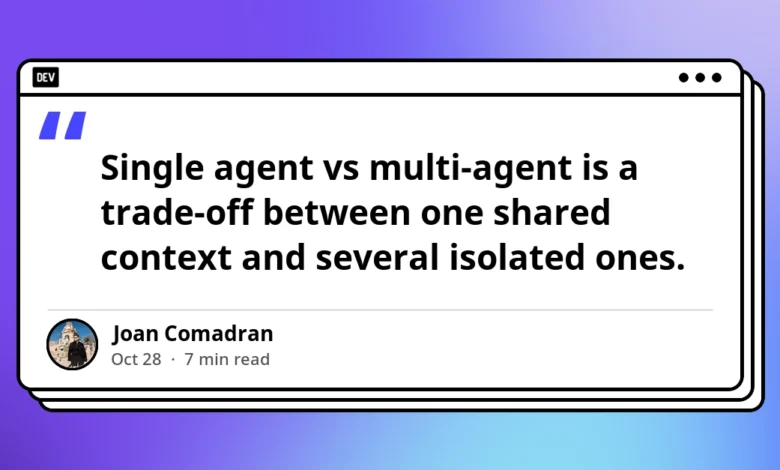
The landscape of enterprise artificial intelligence is undergoing a significant architectural pivot as of late 2026. For the past two years, the prevailing wisdom in agentic AI design favored complex, multi-agent hierarchies—systems where specialized subagents, directed by orchestrators or routers, handled distinct tasks. However, a major shift in technical guidance from Anthropic, bolstered by recent model performance gains, suggests that this "org-chart" approach to AI design is increasingly becoming a liability. The current recommendation for most production environments is to default to a single, robust agent loop that utilizes "skills" and "tools" loaded on demand, rather than fragmenting intelligence across several isolated subagents.
The Evolution of Agentic Design
The emergence of this trend can be traced back to the release of Anthropic’s technical documentation on October 22, 2026, titled Building agents: When to fold subagents into your main agent loop. The publication served as a formal critique of the "Frankenprompt" phenomenon, where developers attempted to manage complexity by spawning new agents for every minor sub-task.
Historically, multi-agent designs were a rational response to the limitations of earlier Large Language Models (LLMs). Developers relied on specialized agents because models struggled to maintain focus over long, multi-step sequences. By isolating a subagent within a narrow domain—such as billing, shipping, or technical support—developers could minimize errors and keep context windows manageable. However, this architectural choice introduced significant overhead. Each handoff between an orchestrator and a subagent required a lossy summary, increasing latency and creating "instruction drift," where the overall voice and logic of the system became disjointed.
Chronology of the Shift
The industry’s move toward consolidation accelerated rapidly in late October 2026.
- October 22, 2026: Anthropic publishes its guidance advocating for single-agent loops.
- October 24, 2026: Anthropic releases the
single-agent-loop-kiton GitHub, providing a reference implementation for developers to migrate existing multi-agent architectures into unified loops. - October 25, 2026: THE DECODER and other industry analysts highlight internal testing results, noting that some enterprise customers achieved a 2x increase in runtime performance by collapsing their multi-agent harnesses into a single, cohesive loop.
The shift is largely enabled by the increased reasoning capabilities of newer models, such as Opus 4.5, Opus 5.5, and Fable 5.1. These models possess the cognitive bandwidth to manage complex planning internally, rendering the intricate "harness code" once used to manage agent handoffs largely redundant.
Supporting Data and Performance Metrics
The move to a single-agent loop is not merely a stylistic preference; it is driven by measurable performance metrics. Internal data from early adopters suggests that the primary bottleneck in multi-agent systems is the "coordination tax." When a primary agent must delegate to a subagent, the system incurs latency costs associated with initializing a new context window, passing system prompts, and waiting for the secondary agent to "warm up."
Furthermore, Anthropic’s own internal testing on their "Claude Code" product revealed that moving procedures into "skills"—modular, procedurally defined instructions—and actions into "tools"—API-integrated functions—allowed them to reduce their core system prompt size by more than 80%. This reduction in token bloat directly translates to lower operational costs and faster inference times.
While the benefits are significant, engineers are cautioned that this is not a universal solution. Anthropic explicitly warns that tool-use performance begins to degrade when a model is forced to manage more than 30 to 50 tool definitions simultaneously. To mitigate this, developers are advised to employ "tool search" or "tool grouping" strategies, where the model only gains access to relevant tools based on the specific user intent detected in the current turn.
The Role of Skills vs. MCP Tools
A critical component of this new paradigm is the distinction between "skills" and "tools." In the proposed framework, skills represent the procedural knowledge of the agent—the rules, judgment calls, and step-by-step logic that previously resided in an agent’s system prompt. By converting these instructions into modular skills that load only when necessary, the agent remains nimble.
Conversely, Model Context Protocol (MCP) tools function as the agent’s bridge to the outside world. MCP serves as a standardized layer for tool discovery and execution. It does not replace the need for function calling but rather standardizes how integrations operate across different hosts, such as Claude, Cursor, or proprietary enterprise applications. The consensus among AI architects is that while skills manage how an agent thinks, tools dictate what an agent can do.
When Multi-Agent Systems Still Hold Value
Despite the push for consolidation, Anthropic maintains that subagents are not obsolete. They continue to be the appropriate choice in specific, high-complexity scenarios:
- Permission Isolation: When different tasks require different levels of security access, keeping those functions in separate agents with unique credentials is a security best practice.
- Parallel Research Paths: When a system must explore multiple, divergent possibilities simultaneously, multi-agent systems allow for independent processing that a single linear loop cannot easily replicate.
- Context Exhaustion: In scenarios where the volume of data exceeds even the most advanced context windows, delegating specific portions of the task to specialized subagents ensures that the primary agent is not overwhelmed by irrelevant information.
Even in these cases, the recommended design pattern has evolved. Instead of a full-handoff—where the user is redirected to a new agent—the preferred approach is to call the subagent as a "tool." This keeps the primary agent in control of the user experience, ensuring a consistent conversational thread.
Broader Implications for Enterprise AI
The shift away from multi-agent architectures represents a maturing of the AI industry. In the early stages of the "agent gold rush," companies often adopted overly complex architectures in a search for reliability. The current trend toward simplicity reflects a growing understanding that "less is more" when the underlying models are sufficiently capable.
For engineering teams currently managing a sprawling fleet of agents, the advice from industry leaders is to avoid a total rewrite. Instead, they recommend a staged migration: build a robust end-to-end evaluation suite, then systematically fold one subagent into the main loop at a time. By measuring performance before and after each migration, teams can identify which subagents are truly providing value and which are merely adding latency and cost.
This transition marks a departure from the "Conway’s Law" approach to AI, where agent architecture simply mirrored the organizational structure of the company. Instead, developers are moving toward a more logical, performance-first design. As models continue to improve in reasoning and context management, the "single-agent-loop" will likely become the standard for the majority of production-grade AI applications, forcing a long-overdue cleanup of bloated, multi-agent codebases across the enterprise sector.
For those in the field of AI engineering, this change underscores the importance of focusing on high-quality evals and efficient prompt engineering over architectural complexity. The era of the "Franken-agent" is effectively coming to a close, replaced by a more streamlined,, and cost-effective approach to artificial intelligence deployment.