Fine-Tuning vs. Frozen Embeddings: When to Adapt the LLM vs. the Sklearn Head

The rapid evolution of Large Language Models (LLMs) has fundamentally altered how organizations approach domain-specific machine learning tasks. As practitioners seek to move beyond generic pre-trained models to systems capable of specialized reasoning or classification, a critical architectural debate has emerged: should developers invest in the computational intensity of full-parameter or parameter-efficient fine-tuning, or is it more efficient to utilize frozen model embeddings as features for traditional, lightweight machine learning algorithms? This decision is no longer merely a matter of technical preference; it is a strategic calculation involving infrastructure costs, latency, and the marginal gains in predictive accuracy.
The Evolution of Model Adaptation
Historically, the machine learning community relied on fine-tuning, a process where the entire architecture of a neural network is adjusted to accommodate a new dataset. This method, while effective, often requires significant GPU resources, making it prohibitive for smaller firms or projects operating under strict compute constraints. The introduction of techniques such as Low-Rank Adaptation (LoRA) and its quantized variant, QLoRA, has democratized this process by allowing practitioners to update only a fraction of the model’s weights.
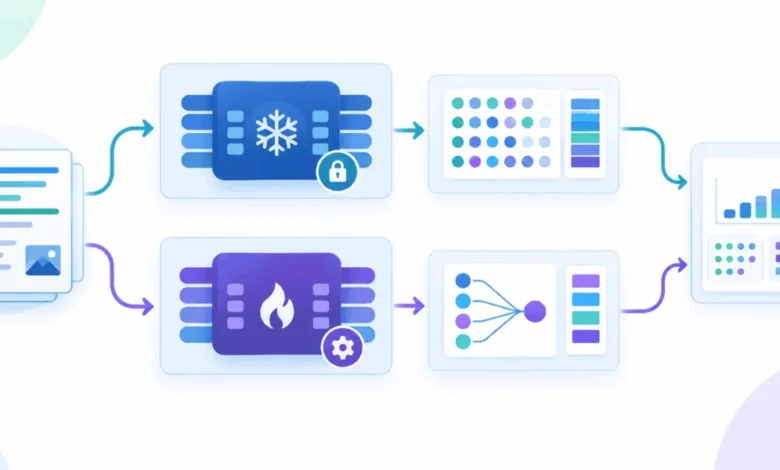
Conversely, the use of frozen embeddings—treating the LLM strictly as a feature extractor—represents a return to more classical statistical approaches. By freezing the LLM’s backbone, developers can transform text into high-dimensional numerical vectors and pass them into classifiers such as Random Forest or Support Vector Machines (SVM). This shift highlights a tension between the deep, nuanced understanding offered by fine-tuning and the sheer operational agility provided by frozen embedding workflows.
Comparative Methodology: A Technical Analysis
To determine the efficacy of these two paradigms, a comparative analysis was performed using the AG News dataset, a standard benchmark for text classification tasks consisting of categorized news articles. The experiment involved two distinct workflows.
In the first workflow, the LLM—specifically the Qwen2.5-1.5B model—acted as a static processor. The text was passed through the model, and the hidden states from the final layer were pooled to create a fixed-length representation. These embeddings were then fed into a Scikit-Learn Random Forest classifier. This approach minimizes the training time of the backbone model, as no weights are updated; the computational burden shifts entirely to the downstream classifier, which is inherently efficient.
In the second workflow, the same base model was subjected to QLoRA fine-tuning. By injecting trainable adapter matrices into the transformer layers, the model was forced to adjust its internal representations specifically for the AG News classification labels. This process, while more resource-intensive, aims to bake domain knowledge directly into the model’s architecture.
Chronology of Performance Metrics
The results of this controlled trial reveal a distinct trade-off between speed and precision. In the frozen embedding configuration, the feature extraction process consumed approximately 96.5 seconds, while the subsequent training of the Random Forest model was nearly instantaneous at 2.8 seconds. The resulting classification accuracy reached 82.0%.
In contrast, the QLoRA fine-tuning process was significantly more time-consuming, requiring 300.3 seconds to reach completion. While the fine-tuned model achieved an accuracy of 87.0%, the three-fold increase in training time suggests that for many real-world applications, the marginal gain of 5% in accuracy must be weighed against the operational cost and time-to-market constraints.
The Role of Parameter-Efficient Fine-Tuning (PEFT)
The adoption of LoRA has been a cornerstone in this transition. By freezing the pre-trained weights and training only small, rank-decomposition matrices, developers can achieve performance levels that mirror full fine-tuning without the associated memory footprint. Research indicates that these adapters typically account for less than 2% of the model’s total size.
The implication for industry is clear: when the goal is to extract features from a stable, well-understood model, frozen embeddings are often sufficient. However, when the model must adapt to a highly specialized lexicon—such as proprietary medical records, legal documentation, or niche technical manuals—the ability of LoRA to adjust the model’s internal weights becomes an essential feature rather than an optional enhancement.
Strategic Implications for AI Deployment
Industry experts suggest that the choice between these two strategies depends heavily on the lifecycle of the model deployment. In environments where data distributions are subject to rapid drift, the ability to retrain a lightweight Scikit-Learn head on frozen embeddings allows for rapid iteration. If a new class of data emerges, an organization can retrain a classifier in seconds rather than triggering an expensive and time-consuming fine-tuning cycle.
However, for enterprises aiming to build long-term, high-fidelity applications, fine-tuning is increasingly seen as the gold standard. The performance delta, while seemingly small in a 5% margin, can be the difference between success and failure in high-stakes fields such as fraud detection or sentiment analysis for financial trading.
Broader Impact on Infrastructure and Sustainability
The environmental and financial costs of training AI models have come under increased scrutiny. Fine-tuning models, even with efficient methods like QLoRA, consumes significant energy and GPU cycles. The frozen embedding strategy offers a more sustainable path for non-generative tasks. By offloading the learning component to CPU-friendly algorithms like Random Forest or Gradient Boosting, organizations can significantly reduce their carbon footprint and cloud infrastructure expenses.
Furthermore, the "frozen" approach simplifies the deployment pipeline. A frozen model can serve as a static API endpoint, while the classification logic can be updated independently. This decoupling of the LLM’s backbone from the classification head reduces the complexity of version control and model monitoring in production environments.
Future Outlook
As we look toward the next generation of LLMs, the divide between these two methodologies is likely to widen. Models are becoming larger, and the cost of fine-tuning, even with quantization, remains non-trivial. Simultaneously, the quality of embeddings generated by these models is improving, making frozen features increasingly powerful.
The industry is currently gravitating toward a hybrid architecture: using massive models as "feature factories" for the majority of routine tasks, while reserving dedicated, fine-tuned "specialist models" for complex, high-value decision-making processes. For the developer, the lesson is clear: one should not automatically reach for fine-tuning as the default. Instead, one should evaluate the specific accuracy requirements, the stability of the input domain, and the constraints of the production environment.
In conclusion, while fine-tuning offers the ceiling for potential performance, the use of frozen embeddings with classical classifiers provides a robust, cost-effective floor. By carefully selecting the strategy based on the specific demands of the use case, organizations can build AI systems that are not only accurate but also scalable, sustainable, and economically viable. The era of "blind" fine-tuning is ending, replaced by a more nuanced, architecture-conscious approach to machine learning deployment.