Optimizing AI Agent Efficiency Through Strategic Data Formatting: The Shift from JSON to Markdown

The rapid proliferation of autonomous AI agents has fundamentally altered how organizations interact with search engines and large-scale data repositories. While these agents possess the capability to synthesize vast amounts of information, a hidden technical bottleneck has emerged: token inflation. Every time an agent initiates a search query or performs a file retrieval, it consumes "tokens"—the fundamental units of text processing for Large Language Models (LLMs). When agents process raw search results, they frequently ingest excessive metadata, tracking parameters, and repetitive object structures that provide no functional utility to the model’s reasoning process. This inefficiency manifests as a significant financial burden for enterprises and a performance drain on system latency.
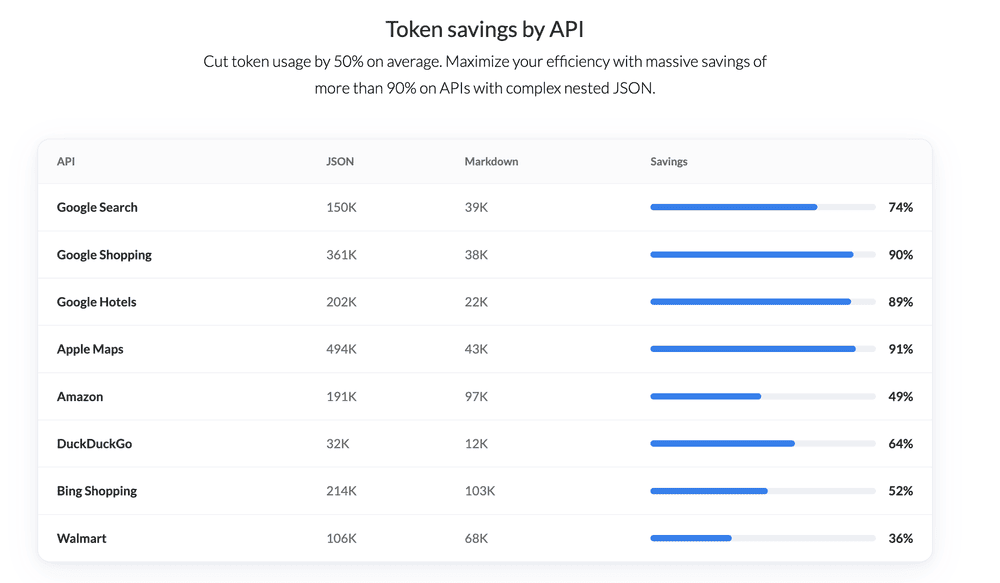
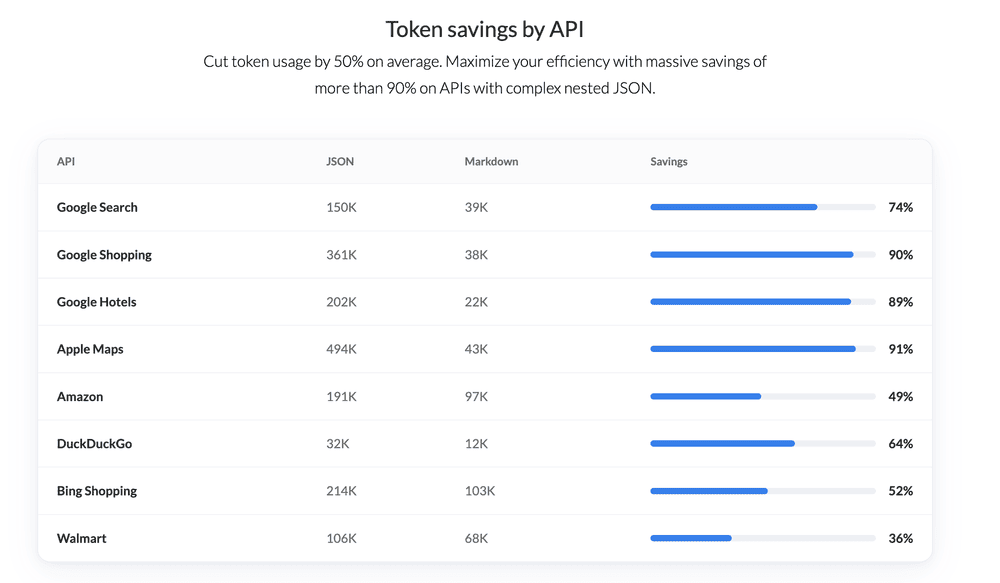
Recent empirical data from search API providers, specifically SerpApi, has highlighted a massive disparity between traditional data delivery methods and newer, streamlined formats. By transitioning from the industry-standard JavaScript Object Notation (JSON) to Markdown, developers have reported token usage reductions of up to 74 percent. This architectural shift represents a critical juncture in the development of agentic systems, where the "shape" of the data is now as important as the data itself.
The Anatomy of Token Bloat in Agentic Systems
To understand the scope of the problem, one must first analyze the nature of the data retrieved by modern search APIs. A standard API response designed for a traditional web application includes complex nested objects, schema markup, and tracking identifiers. When an LLM parses this JSON, it treats every character—including curly braces, quotes, and metadata keys—as tokens.
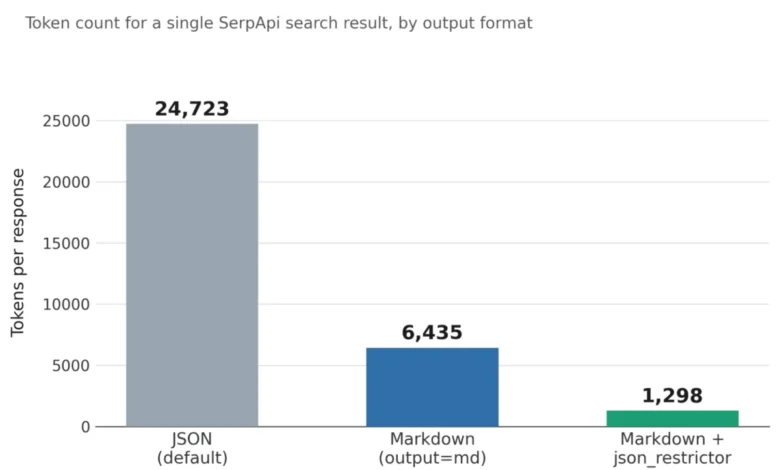
For an AI agent, the goal is often extraction, summarization, or synthesis. It does not require the structural overhead that a front-end application needs to render a dynamic user interface. When an agent processes a query for "coffee shops," a raw JSON response might contain dozens of lines of telemetry data, redundant store identifiers, and internal database keys. In testing environments, a standard JSON query for a common search term resulted in a payload of 24,723 tokens. By simply converting that identical data into a human-readable, model-optimized Markdown format, the token count plummeted to 6,435. Further restrictive filtering—limiting the data strictly to the essential fields required by the agent—pushed that number down to 1,298 tokens.
Chronology of Data Delivery: From Web Rendering to AI Integration
The evolution of data delivery has moved through three distinct phases. In the early 2000s, XML was the standard for structured data exchange, focusing on human readability and rigid hierarchy. By the mid-2000s, JSON emerged as the lingua franca of the web, prioritized for its lightweight nature and its seamless integration with JavaScript-heavy frontend frameworks.
However, the rise of LLMs—which gained mainstream momentum following the release of Transformer-based models in 2017—created a new paradigm. These models do not "parse" data in the traditional sense; they predict sequences of text. Consequently, they perform optimally when the data is presented in a format that mirrors natural language or structured documentation. Markdown, a lightweight markup language, provides exactly this environment. It strips away the programmatic noise of JSON, leaving behind a text-based structure that is highly efficient for LLMs to interpret while retaining the necessary hierarchy via headings, tables, and lists.
Supporting Data and Efficiency Benchmarks
The financial and operational implications of this transition are significant. LLM providers, such as OpenAI, Anthropic, and Google, bill users based on token consumption. In enterprise-scale applications where agents may run thousands of queries per hour, a 74 percent reduction in token usage is not merely a technical optimization—it is a material reduction in operational expenditures (OpEx).
Furthermore, the "context window" remains a finite resource for even the most advanced models. By reducing the number of tokens consumed by search results, developers can fit more information into a single prompt. This allows for:
- Increased Recall: The agent can process more search results in a single pass without hitting the context limit.
- Improved Accuracy: By removing "noisy" data, the signal-to-noise ratio improves, theoretically reducing the likelihood of hallucinations or irrelevant summarizations.
- Lower Latency: Fewer tokens to process means faster generation times for the final output, improving the end-user experience.
Technical Implementation and Industry Responses
Industry providers are beginning to recognize the necessity of model-first data delivery. SerpApi has implemented a server-side switch that allows developers to request Markdown output directly. This implementation is notable because it handles the transformation on the server side, ensuring the client receives a pre-optimized payload.
The mechanism relies on several key transformations:
- Removal of Redundant Metadata: Internal tracking links and UI-specific identifiers that do not contribute to semantic understanding are stripped.
- Table Simplification: Complex JSON arrays are flattened into Markdown tables, which LLMs are natively adept at reading.
- YAML Frontmatter: Essential context is placed in a concise header block, allowing the model to understand the scope of the data before processing the body.
While Markdown is highly efficient, industry experts warn that it is not a "one-size-fits-all" solution. If an application requires strict data typing—such as a financial engine requiring precise floating-point arithmetic for stock prices or currency conversion—JSON remains the superior choice. The challenge for developers is to build hybrid pipelines: using JSON for data-heavy, analytical tasks and Markdown for summarization, retrieval, and conversational AI agents.
Implications for Future AI Infrastructure
The shift toward Markdown-optimized data delivery signals a broader trend in software engineering: the "AI-first" design philosophy. As more developers move away from treating AI as a "bolt-on" feature and begin building systems that are natively agentic, the protocols for data exchange will continue to evolve.
The current reliance on JSON for all data transfer is increasingly viewed as a legacy practice when the end-consumer is an LLM. We are likely to see the emergence of standardized formats specifically designed for machine-to-model communication. These formats will prioritize token efficiency and semantic clarity, potentially incorporating features like compact serialization that retains structure without the verbosity of current standards.
Conclusion
The optimization of token usage is no longer an optional component of AI development; it is a fundamental requirement for building scalable and cost-effective agentic systems. The transition from JSON to Markdown, while seemingly a minor architectural tweak, highlights the critical importance of data shaping in the age of large-scale LLM deployments. By reducing the cognitive load on models and the financial cost on developers, this approach creates a more sustainable ecosystem for AI integration. As organizations continue to scale their agentic workloads, the ability to measure, audit, and refine the data payloads sent to these models will distinguish the most efficient systems from those burdened by the hidden costs of legacy data formats. Developers are encouraged to conduct their own benchmarking, as the delta between optimized and non-optimized payloads often reveals significant opportunities for performance gains that have been overlooked in the rush to implement AI functionality.