Optimizing AI Infrastructure Costs and Performance with Amazon Bedrock Prompt Caching

In the rapidly evolving landscape of generative artificial intelligence, the operational costs associated with large language models (LLMs) have emerged as a primary concern for enterprise developers. As organizations move from experimental pilots to production-grade applications, the volume of data processed by foundation models has grown exponentially. Amazon Web Services (AWS) has introduced a significant advancement in this domain with the implementation of prompt caching within Amazon Bedrock. This technology is designed to fundamentally alter the cost structure and latency profile of applications that rely on repeated context, such as Retrieval-Augmented Generation (RAG) systems, automated coding assistants, and complex agentic workflows.
The Mechanics of Computational Efficiency
At its core, prompt caching addresses a redundant computational bottleneck inherent in LLM architecture. When a foundation model receives a request, it must process the entire sequence of input tokens to generate an output. In many practical scenarios, a substantial portion of this input—such as long system instructions, massive knowledge bases, or complex tool definitions—remains static across multiple user interactions.
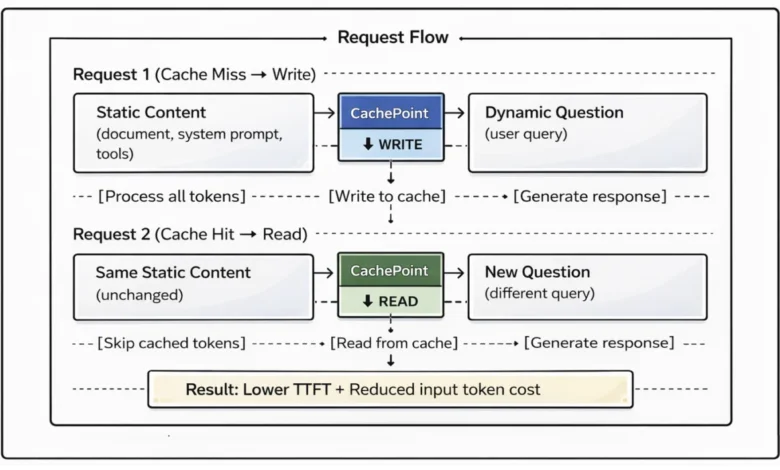
Without caching, an application sending a 10,000-token document alongside 50 distinct user questions forces the model to re-encode the document 50 times. This results in the billing of 500,000 input tokens, despite the model having previously "learned" or processed the document’s content. Prompt caching mitigates this by allowing developers to insert a cachePoint marker into their request. Amazon Bedrock then creates a snapshot of the tokens preceding this marker. On subsequent requests, the model retrieves the processed state from high-speed memory rather than re-computing the entire input, resulting in a reduction of input token costs by up to 90 percent on cache hits.
Financial and Operational Implications
The introduction of this feature is not merely a technical update; it represents a strategic shift in the economics of AI deployment. By moving the burden of context management from the application layer to the infrastructure layer, AWS enables developers to maintain large context windows without the prohibitive costs previously associated with them.
The pricing structure for this feature introduces three distinct tiers to incentivize efficient usage. Standard input tokens remain the baseline. Tokens written to the cache for the first time incur a 25 percent premium over standard rates, reflecting the initial computational effort. However, subsequent reads of these tokens are charged at a 90 percent discount compared to standard input. For scenarios requiring high-frequency, short-lived context, AWS also offers a one-hour Time-to-Live (TTL) cache option, priced at a 100 percent premium over standard input, providing flexibility for workloads with varying data volatility requirements.
Practical Implementation Scenarios
To maximize the utility of prompt caching, developers must consider the specific architecture of their applications. The following scenarios illustrate the versatility of the implementation:
1. Static Document and Context Caching
In RAG-heavy applications, users often query a singular, lengthy source document repeatedly. By placing a cachePoint immediately after the source text and before the dynamic user query, the system ensures that the model only re-processes the query itself. This is particularly effective for legal, medical, or technical documentation repositories where the source material is updated infrequently but accessed by thousands of users.
2. System Prompt and Persona Persistence
Sophisticated AI agents often utilize detailed system prompts that define persona, constraints, and operational guidelines. These prompts can easily exceed 2,000 tokens. By caching these instructions, organizations ensure that the model consistently adheres to its defined behavior while significantly lowering the overhead cost per request.
3. Agentic Tool Schema Caching
Modern AI agents are increasingly defined by their ability to interact with external APIs through tool calling. These tools are described by complex JSON schemas. In an agentic loop, where the model may iterate multiple times to resolve a request, caching these definitions prevents the model from having to re-parse the tool environment on every iteration.
Broader Industry Impact and Strategic Analysis
The move by AWS aligns with a broader industry trend toward "caching-first" architectures. As foundation models become larger and more capable, the "token tax" of running them has threatened the viability of smaller, cost-sensitive use cases. By lowering the entry barrier for high-context tasks, Amazon Bedrock is likely to accelerate the adoption of complex AI agents that require long-term memory and expansive knowledge bases.
From a performance standpoint, the reduction in Time-To-First-Token (TTFT) is perhaps as valuable as the cost savings. TTFT is a critical metric for user experience in conversational interfaces. By skipping the re-processing of thousands of cached tokens, the model can initiate the generation of the response almost immediately, providing a snappier, more human-like experience.
Challenges and Best Practices
While prompt caching offers substantial benefits, it requires a disciplined approach to development. Industry experts suggest the following best practices:
- Granularity: Do not cache everything. Only cache content that is guaranteed to remain static across multiple requests.
- TTL Management: Align the TTL with the update frequency of the content. Using a 1-hour TTL for a document that changes every 10 minutes will result in stale data and inaccurate model outputs.
- Tenant Isolation: For multi-tenant SaaS platforms, ensure that cached content is properly namespaced. A common technique involves prepending a SHA-256 hash of the tenant ID to the cached content, ensuring that Tenant A never triggers a cache hit for Tenant B’s data.
- Monitoring: Use the
cacheDetailsandusagemetrics provided by the Converse API to audit the effectiveness of your caching strategy. A high "cache miss" rate indicates that the caching strategy is not aligned with the actual request patterns.
Future Outlook
As of the latest updates to the Amazon Bedrock ecosystem, the integration of the Converse API provides a unified syntax that is model-agnostic. This is a critical development, as it allows enterprises to swap between different model families—such as Anthropic’s Claude series or Amazon’s own Nova models—without re-architecting their entire caching infrastructure.
The ability to maintain high-context performance at a fraction of the cost is a major milestone for AI maturity. As organizations continue to scale, the focus will likely shift toward more intelligent, automated caching policies where the system identifies frequently accessed context patterns and optimizes the cache automatically. For now, the tools provided by Amazon Bedrock offer a robust foundation for building the next generation of cost-effective, high-performance AI applications.
Conclusion
Prompt caching in Amazon Bedrock marks a shift from treating AI as a "stateless" query engine to a "stateful" collaborator. By reducing input costs by up to 90 percent and significantly improving response latency, AWS has provided a vital tool for enterprise-scale AI. Developers who embrace these caching patterns—whether through simple document caching, sophisticated multi-tiered TTL strategies, or secure tenant isolation—will be best positioned to build sustainable, scalable generative AI solutions in an increasingly competitive digital marketplace. As the technology matures, the integration of these caching layers will likely become a standard component of the AI development lifecycle, much like database caching is for traditional web applications today.
Related posts: