Anthropic’s Claude Opus 5, the Pinnacle of Generative AI, Now Available on Amazon Bedrock and Claude Platform on AWS

The landscape of artificial intelligence has witnessed a significant advancement with the official launch of Claude Opus 5 on Amazon Bedrock and its availability through the Claude Platform on AWS. This latest iteration from Anthropic, a leader in AI safety and research, represents a substantial leap forward in generative AI capabilities, promising enhanced performance across a wide spectrum of enterprise workloads. Claude Opus 5 is positioned as Anthropic’s most sophisticated model to date, marking the debut of its fifth-generation architecture. The model is designed to deliver top-tier intelligence at Opus-tier pricing, a strategic move that aims to democratize access to cutting-edge AI for a broader range of businesses.
This new model is set to redefine how organizations approach complex tasks such as agentic coding, knowledge work, visual understanding, and long-running operational processes. Early indications suggest that Claude Opus 5 not only matches the high intelligence benchmarks set by its predecessor, Claude Fable 5, but in many domains, it surpasses them, all while maintaining a competitive cost structure. The integration of Claude Opus 5 onto Amazon Bedrock ensures that enterprises can leverage its advanced AI capabilities while adhering to stringent data governance policies. A key feature of this integration is the default Zero Data Retention (ZDR) policy, which guarantees that customer data is not stored or used for model training, thereby safeguarding sensitive enterprise information.
Furthermore, Claude Opus 5 benefits from Bedrock’s advanced inference engine. This allows developers to seamlessly integrate the model within their existing AWS infrastructure, ensuring robust enterprise-grade security, adherence to regional data residency requirements, and scalable inference capabilities without the need for direct operator access to underlying systems. This managed service approach simplifies deployment and operational overhead for businesses.
Beyond Amazon Bedrock, Claude Opus 5 is also accessible via the Claude Platform on AWS. This offering provides businesses with a more direct pathway to Anthropic’s native platform experience, accessible through the familiar AWS Console. It allows for unified development, testing, and deployment workflows, leveraging the same APIs, features, and console interface that Anthropic offers directly. Crucially, this integration also brings the convenience of unified AWS billing and authentication, streamlining financial management and access control for organizations already invested in the AWS ecosystem.
This release signifies a pivotal moment for AI engineers and developers looking to embed advanced AI into production systems. The article aims to provide a comprehensive overview of Claude Opus 5’s enhancements and offer practical guidance for its integration into agentic systems and production inference workloads on Amazon Bedrock. For detailed technical specifications and implementation guides, users are encouraged to consult the dedicated documentation for the Claude Platform on AWS.
What Sets Claude Opus 5 Apart: A New Paradigm in AI Performance
Anthropic reports that Claude Opus 5 represents a transformative advancement, particularly in the realm of coding. The model demonstrates an unprecedented ability to comprehend and navigate complex codebases, mirroring the expertise of seasoned software engineers. It can generate production-quality code, dynamically adapting its strategy as it progresses through a task. This sophisticated understanding extends to powering highly dependable, long-running agents. These agents are capable of operating for extended periods, even overnight, exhibiting remarkable resilience by identifying and circumventing obstacles, recovering from errors, and systematically achieving their defined objectives.
For professional and knowledge-based work, Claude Opus 5 brings a new level of depth to reasoning, especially when analyzing lengthy documents. This translates to significantly higher accuracy in complex analytical tasks, with the most pronounced improvements observed in document-intensive enterprise applications. The culmination of these enhancements results in a frontier-level AI capability that is also economically viable, offering "Opus-tier economics" for businesses. This means organizations can access unparalleled AI power without an exorbitant cost increase, making advanced AI more accessible for critical business functions.
The development of Claude Opus 5 can be traced back to Anthropic’s ongoing commitment to building reliable and steerable AI systems. Following the successful introduction of Claude 3, which established new benchmarks for AI performance and safety, Anthropic has continued to push the boundaries of what is possible. The Claude 3 family, comprising Haiku, Sonnet, and Opus, showcased a significant improvement in reasoning, accuracy, and contextual understanding. Claude Opus 5 builds upon this foundation, specifically targeting areas where even the most advanced models previously struggled. The emphasis on agentic capabilities and long-running tasks suggests a strategic focus on automating complex business processes that require sustained, intelligent operation.
Diverse Use Cases: Driving Innovation Across Industries
Claude Opus 5’s capabilities make it an ideal solution for industries where precision, unwavering reliability, and profound reasoning are paramount. In the financial services sector, for instance, it can power sophisticated financial workflows, offering deeper insights and a holistic understanding of complex contexts. Its enhanced clarity and focus are particularly beneficial for compliance-sensitive operations, helping to mitigate risks and ensure adherence to regulatory frameworks.
For agent and workflow automation, Claude Opus 5 demonstrates an enhanced ability to identify and challenge flawed instructions, a critical feature for robust automation. It can intelligently decompose intricate jobs into smaller, more manageable sub-agents, thereby reducing the need for constant human oversight. This is a significant step towards more autonomous and efficient operational systems.
In the realm of productivity and knowledge management, the model excels at tasks such as report generation, comprehensive auditing, intricate document drafting, and structured data analysis, all performed with exceptional consistency. Its ability to manage multi-day projects and deliver professional-grade outputs opens new avenues for efficiency and quality in business operations. This capability is particularly valuable in sectors like legal, research, and content creation, where long-form content and detailed analysis are routine.
Claude Opus 5 also represents a substantial upgrade over its predecessor, Claude Opus 4.8, particularly in cybersecurity applications. Its enhanced coding and security analysis capabilities are designed to bolster defenses against sophisticated threats. In scenarios deemed higher risk, Claude Opus 5 may, as a safety precaution, revert to the performance characteristics of Claude Opus 4.8. Users will be explicitly notified when such a fallback occurs, and API configurations can be adjusted to manage these instances according to specific security protocols and risk tolerance levels. This hybrid approach ensures both advanced performance and a safety net for critical operations.
The timeline for the development and release of such advanced models is typically characterized by extensive research, rigorous testing, and iterative refinement. Anthropic’s public statements and research papers often highlight their methodical approach to AI development, emphasizing safety and ethical considerations alongside performance. The transition from Claude 3 to Opus 5 likely involved advancements in transformer architectures, training methodologies, and vast datasets, enabling the model to achieve its current state-of-the-art performance.
Getting Started with Claude Opus 5 on Amazon Bedrock: A Seamless Integration
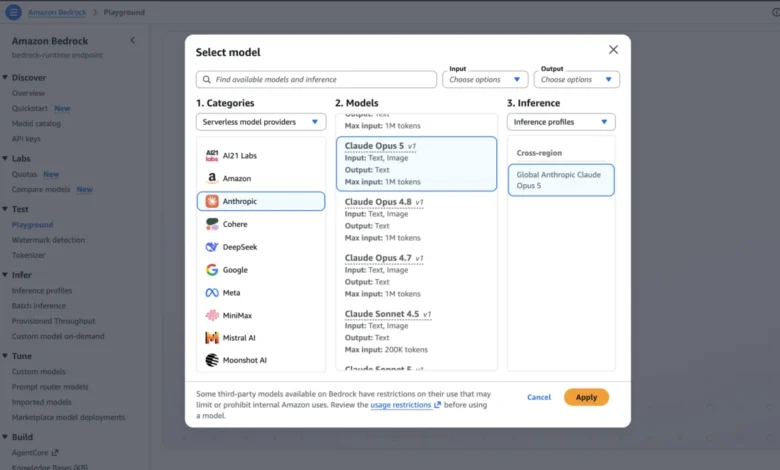
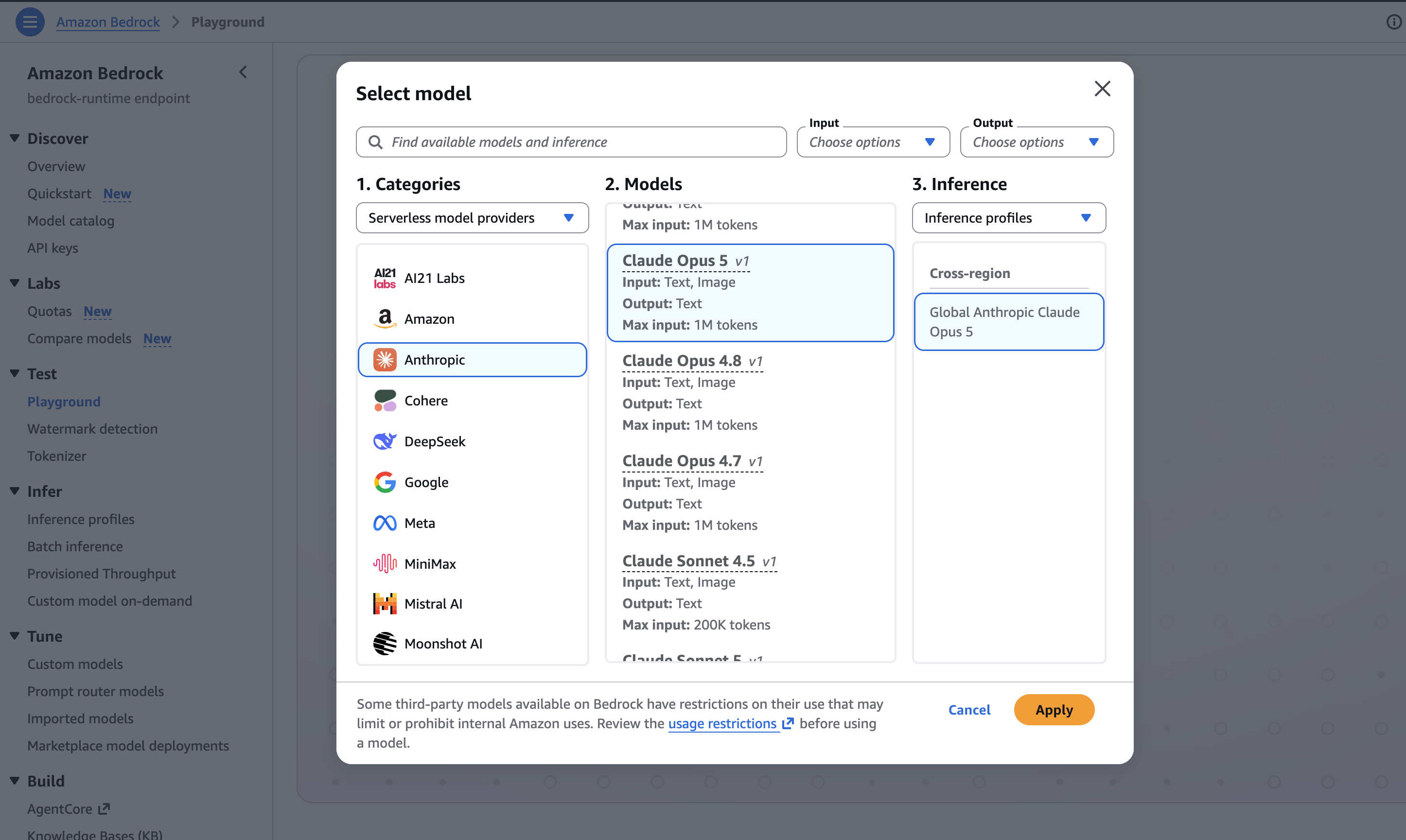
Initiating the use of Claude Opus 5 on Amazon Bedrock is a straightforward process, accessible directly through the Amazon Bedrock console. Users can navigate to the "Playground" section under the "Test" tab to begin experimenting with the model.
Step-by-Step Guide:
- Access the Amazon Bedrock Console: Log in to your AWS account and navigate to the Amazon Bedrock service.
- Select the Playground: Within the console, locate and select the "Playground" option.
- Choose Claude Opus 5: In the model selection dropdown menu, choose "Claude Opus 5."
- Test Your Prompts: Begin by entering your complex coding prompts or any other queries you wish to test with the model. The console provides an interactive environment to quickly evaluate the model’s responses.
The console interface is designed for ease of use, allowing users to see immediate results from their interactions. Sample screenshots provided with the announcement showcase a typical coding prompt submitted to Claude Opus 5 and the detailed, well-structured response it generates, illustrating the model’s coding proficiency and analytical capabilities.
Beyond the interactive console, Claude Opus 5 can be accessed programmatically through various methods:
- Anthropic Messages API: Developers can leverage the Anthropic Messages API via the
bedrock-runtimeclient. This can be done using the Anthropic SDK or through thebedrock-mantleendpoints. - Invoke and Converse APIs: For users preferring direct AWS SDK integration, the
InvokeandConverse APIcalls onbedrock-runtimeare available. These can be utilized through the AWS Command Line Interface (AWS CLI) or the broader suite of AWS SDKs.
Code Example: Invoking Claude Opus 5 via AWS SDK for Python (Boto3)
A practical example using the AWS SDK for Python (Boto3) demonstrates how to invoke Claude Opus 5:
import boto3
import json

# Create a Bedrock Runtime client
bedrock_runtime = boto3.client(
    service_name="bedrock-runtime",
    region_name="us-east-1" # Specify your desired AWS region
)

# Define the prompt for a complex architectural design
prompt_text = "Design a distributed architecture on AWS in Python that should support 100k requests per second across multiple geographic regions."

# Invoke Claude Opus 5 with the specified prompt
response = bedrock_runtime.invoke_model(
    modelId="global.anthropic.claude-opus-5", # Model identifier for Claude Opus 5
    contentType="application/json",
    accept="application/json",
    body=json.dumps(
        "anthropic_version": "bedrock-2023-05-31", # Specify Anthropic API version
        "max_tokens": 4096, # Set maximum token limit for the response
        "messages": [

                "role": "user", # Define the user's role in the conversation
                "content": prompt_text # The actual prompt text

        ]
    )
)

# Parse and print the model's response
result = json.loads(response["body"].read())
# The response content is typically a list; access the text part
if result and "content" in result and len(result["content"]) > 1:
    print(result["content"][1]["text"])
else:
    print("No valid content found in the response.")
Leveraging the Amazon Bedrock Converse API:
For a unified multi-model experience, Claude Opus 5 can be utilized with the Amazon Bedrock Converse API:
import boto3

bedrock_runtime = boto3.client("bedrock-runtime", region_name="us-east-1")

response = bedrock_runtime.converse(
    modelId="global.anthropic.claude-opus-5",
    messages=[

            "role": "user",
            "content": [

                    "text": "Design a distributed architecture on AWS in Python that should support 100k requests per second across multiple geographic regions."

            ]

    ],
    inferenceConfig=
        "maxTokens": 4096

)

if 'output' in response and 'message' in response['output'] and 'content' in response['output']['message']:
    blocks = response['output']['message']['content']
    print('n'.join(b.get('text', '') for b in blocks if 'text' in b))
else:
    print("No valid content found in the response.")
Streamlined Experience with the Anthropic SDK:
The Anthropic Messages API can also be used with the anthropic[bedrock] SDK package for a more streamlined developer experience:
from anthropic import AnthropicBedrockMantle

# Initialize the Bedrock Mantle client (uses SigV4 auth automatically)
# Ensure your AWS credentials and region are configured for the environment
mantle_client = AnthropicBedrockMantle(aws_region="us-east-1")

# Create a message using the Messages API
message = mantle_client.messages.create(
    model="anthropic.claude-opus-5", # Model identifier within the SDK
    max_tokens=4096,
    messages=[
        "role": "user", "content": "Design a distributed architecture on AWS in Python that should support 100k requests per second across multiple geographic regions"
    ]
)

# Extract and print the response text
if message and hasattr(message, 'content') and message.content:
    # The content is a list of content blocks, find the text block
    for block in message.content:
        if block.type == 'text':
            print(block.text)
            break
else:
    print("No valid content found in the response.")
Advanced Tool Use:
Claude Opus 5 introduces a more dynamic approach to tool integration. It supports the addition and removal of tools mid-conversation through tool_addition and tool_removal content blocks within role: "system" messages. This eliminates the need to resend the entire tools array for each modification, leading to more efficient and flexible agent development. Further details on this functionality are available in the Bedrock documentation.
Availability and Next Steps
Claude Opus 5 is now generally available on Amazon Bedrock in key regions, including US East (N. Virginia), Asia Pacific (Melbourne), Europe (Ireland), and Europe (Stockholm). A comprehensive list of supported regions can be found in the Bedrock documentation. Concurrently, Claude Opus 5 is also accessible through the Claude Platform on AWS, spanning North America, South America, Europe, and Asia Pacific.
Organizations are encouraged to explore Claude Opus 5 through the Amazon Bedrock console or the Claude Platform on AWS. To facilitate rapid adoption and experimentation, a suite of "Getting Started" notebooks is available on GitHub, providing practical examples and code snippets.
For those looking to maximize the performance of their AI applications, Amazon Bedrock offers "Advanced Prompt Optimization." This feature analyzes existing prompts, benchmarks them against defined evaluation criteria, and generates optimized, production-ready rewrites, ensuring that users can extract the most value from Claude Opus 5.
The introduction of Claude Opus 5 marks a significant milestone in the ongoing evolution of artificial intelligence. Its advanced reasoning, coding, and long-running task capabilities, coupled with its integration into robust cloud platforms like AWS, position it as a transformative tool for businesses seeking to innovate and optimize their operations. The commitment to data privacy and security, particularly through features like Zero Data Retention, further solidifies its appeal for enterprise adoption. As AI continues to mature, models like Claude Opus 5 are paving the way for more intelligent, autonomous, and efficient business processes across the globe.