Amazon SageMaker HyperPod Introduces Native Model Caching to Eliminate Inference Cold Starts and Accelerate Large-Scale AI Deployments

The operational bottleneck of deploying Large Language Models (LLMs) on cloud infrastructure has long been defined by the latency inherent in "cold starts"—the period between a request for compute capacity and the moment a model is ready to serve traffic. Amazon Web Services (AWS) has announced the general availability of model caching for Amazon SageMaker Inference on HyperPod, a feature designed to bypass the traditional, time-consuming download sequences that have hindered real-time scaling for enterprise-grade AI applications. By pre-loading container images and model weights onto local NVMe storage, this architectural advancement shifts the paradigm from network-bound data retrieval to high-speed local disk access.
The Anatomy of the Cold Start Problem
In traditional cloud-native AI deployments, the deployment lifecycle is dominated by two sequential, resource-intensive operations. First, the Kubernetes scheduler assigns a pod to a node, triggering the Kubelet to pull the inference server container image from the Amazon Elastic Container Registry (Amazon ECR). Given that modern inference stacks, such as vLLM or Large Model Inference (LMI), often bundle complex GPU drivers, CUDA libraries, and heavy serving frameworks, these images can reach sizes of several gigabytes, consuming five to seven minutes in network transit alone.
Once the container is initialized, the secondary phase begins: the inference server must pull the model weights from a storage backend such as Amazon S3, Amazon FSx for Lustre, or the HuggingFace Hub. For standard-sized models, this is a minor delay; however, for massive architectures like DeepSeek-R1—which exceeds 600 GB—the transfer process can last 30 minutes or longer. During a sudden traffic surge, an autoscaling event triggering five new pods would result in an aggregate wait time of over two hours of total cumulative "dead time," during which the infrastructure is active but unable to process requests. This discrepancy between the rapid response of the HorizontalPodAutoscaler and the sluggish reality of data ingestion has remained one of the most significant challenges for high-throughput AI services.
Technical Implementation and Operational Efficiency
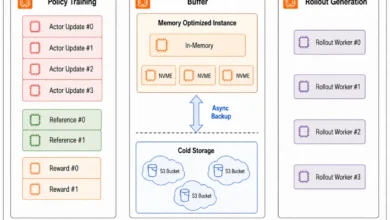
The newly launched model caching architecture mitigates these delays by introducing two distinct, automated capabilities managed through Custom Resource Definitions (CRDs): the Weights Cache and the Image Cache.
The Weights Cache functionality facilitates the background transfer of model parameters to the local NVMe storage of cluster nodes. By utilizing a preemptive download strategy, the system ensures that when the Kubernetes scheduler places a pod, the required data is already physically present on the host. This transition from network-bound retrieval to local NVMe reads—which operate at approximately 7 GB/s—reduces the weight-loading phase from tens of minutes to a matter of seconds.
Simultaneously, the Image Cache addresses the container-pull latency. The operator pre-pulls the necessary inference server container images across target nodes. A sophisticated reference-tracking mechanism ensures that multiple deployments sharing the same image utilize a single cache resource, minimizing disk footprint and cleaning up images automatically when they are no longer referenced by active pods.
Importantly, the system employs a "preferred scheduling" logic. This ensures that while pods are prioritized for nodes with warm caches, they are never blocked from execution if cached resources are unavailable. In the event of an extreme scale-out that exceeds the number of cached nodes, the pods revert to the traditional S3/ECR pull methodology. This fallback ensures system reliability and prevents hard failures, maintaining the high availability standards expected of AWS production environments.
Orchestration via Custom Resource Definitions
To manage these lifecycles, AWS has integrated two specialized controllers. The ModelDataCacheConfig manages the lifecycle of model weights, handling everything from the initial download to monitoring cache health and labeling nodes as "cache-ready." If the cache becomes corrupted or reaches a state of failure, the operator automatically removes the node label, signaling to the scheduler that the node is no longer an optimal target for new pods.
Similarly, the ModelImageCache manages the lifecycle of container images. Both controllers are designed for zero-downtime transitions; when a developer updates a model source or points to a new S3 path, the operator orchestrates the creation of a new cache and the subsequent cleanup of the legacy data, ensuring that the transition is seamless and free of stale, redundant files. Users can monitor these processes via standard Kubernetes commands, such as kubectl get modeldatacacheconfig, providing visibility into the state and target capacity of the cache.
Impact on Scale-Out Performance
The performance improvements provided by this update are significant. According to internal AWS benchmarking, the inclusion of weights caching enables up to 60 percent faster scale-out times for models in the 57 GB to 145 GB range. The image caching component, meanwhile, has demonstrated up to a 97 percent reduction in image-pull latency compared to traditional ECR-based deployments.
For the largest models currently in production, such as the 600 GB+ variants, the impact is even more profound. By eliminating the 30-minute download cycle, developers can achieve near-instantaneous horizontal scaling. This capability is critical for organizations maintaining dynamic AI services where traffic volatility is high and the cost of unavailability is measured in both missed revenue and degraded user experience.
Deployment and Compatibility
The integration of model caching into existing workflows is designed to be low-friction. By appending a modelCacheConfig section to an existing InferenceEndpointConfig or JumpStartModel resource, developers can enable these features without modifying the underlying infrastructure. The system supports a wide range of storage backends, including Amazon S3, Amazon FSx for Lustre, and HuggingFace, ensuring compatibility across diverse architectural requirements.
As of the latest release, AWS has verified compatibility with a broad spectrum of GPU-accelerated instances, including the ml.g5 and ml.p5 families. Because the system relies on local NVMe storage, developers must ensure that their chosen instance type provides sufficient capacity to accommodate the model size. For instance, the ml.p5.48xlarge, with its 30,000 GB of NVMe storage, is well-equipped to handle even the most massive LLMs currently in existence.
Broader Strategic Implications
The release of model caching reflects a growing maturity in the MLOps ecosystem. As LLMs become the standard engine for enterprise applications, the focus has shifted from the mere ability to serve a model to the efficiency, reliability, and cost-effectiveness of that service.
By offloading the "cold start" burden, AWS is effectively enabling a more fluid, cloud-native approach to AI. This allows businesses to keep their infrastructure footprint smaller during off-peak hours while maintaining the confidence that their cluster can respond to sudden, high-intensity traffic demands without a 30-minute lag. For architects and engineers, this represents a shift toward a more deterministic deployment model, where the time-to-first-token is no longer contingent upon the variable throughput of a remote storage network.
The automatic cleanup protocols, which ensure that NVMe storage is freed upon the deletion of resources, further demonstrate a commitment to efficient resource utilization. By removing the need for manual cache management and garbage collection, AWS is lowering the operational overhead for DevOps teams, allowing them to focus on model optimization and inference accuracy rather than the minutiae of container orchestration and data migration.
With this update, Amazon SageMaker HyperPod solidifies its position as a highly scalable environment for the next generation of generative AI applications, bridging the gap between massive model architectures and the real-time demands of modern global infrastructure.