Optimizing Large-Scale Mixture-of-Experts Reinforcement Learning Training on AWS Infrastructure

The rapid evolution of artificial intelligence, particularly the shift toward massive Mixture-of-Experts (MoE) architectures, has placed unprecedented demands on data center infrastructure. As developers move to scale Large Language Models (LLMs) into the trillion-parameter range, the post-training phase—specifically Reinforcement Learning from Human Feedback (RLHF) and the emerging Group Relative Policy Optimization (GRPO)—has become a critical bottleneck. To address the inherent complexities of these workflows, Amazon Web Services (AWS) has outlined an architectural framework that integrates Amazon Elastic Kubernetes Service (EKS) with Elastic Fabric Adapter (EFA) and the DeepEP communication library, providing a roadmap for balancing high-throughput inference with tightly coupled model training.
The Infrastructure Dilemma of Modern MoE Training
At the core of the challenge is the architectural nature of MoE models. Unlike dense models, where parameters are activated uniformly, MoE models utilize sparsity to maintain efficient inference costs. This sparsity, however, complicates the training pipeline, which must navigate pre-training, supervised fine-tuning, and the computationally volatile stages of reinforcement learning.
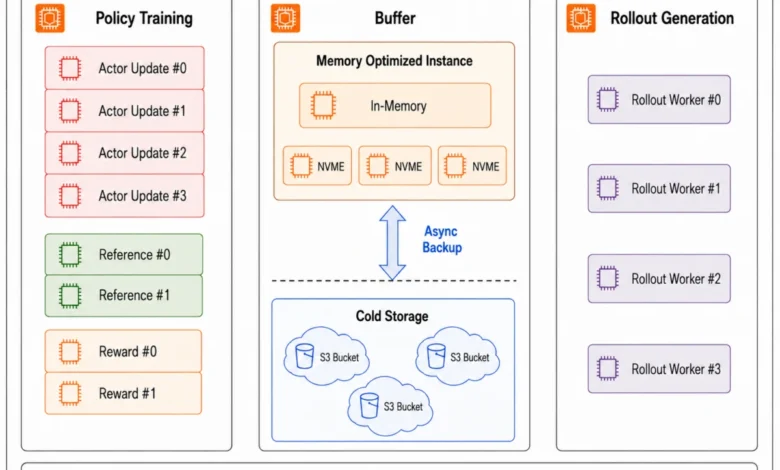
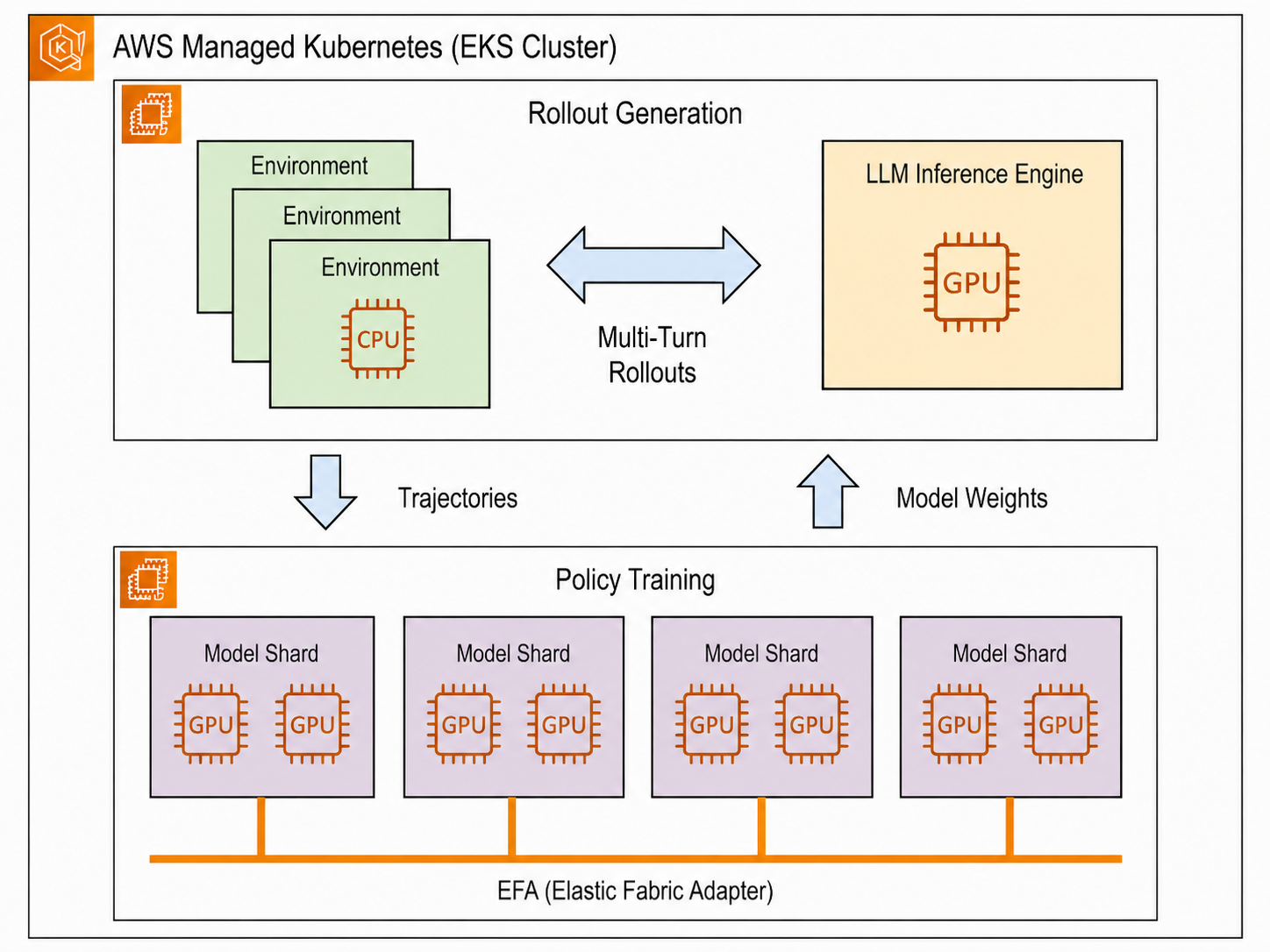
Large-scale RL training requires a dual-track approach: rollout generation, which functions as a massive distributed inference task, and policy training, which requires synchronous, low-latency communication between compute nodes. When these processes operate on shared infrastructure, the risk of resource contention is high. If the rollout generation process lags, the policy training accelerators sit idle. Conversely, if training latency spikes, it triggers timeouts that can destabilize the entire reinforcement learning loop.
Chronology of the Development Cycle
The transition to this optimized architecture follows several years of iterative improvement in high-performance computing (HPC) on AWS. Historically, developers relied on standard all-to-all communication primitives, which were designed for dense, structured data movement. As MoE architectures matured, it became clear that Expert Parallelism (EP)—the dynamic routing of tokens across different experts—generated fine-grained, irregular traffic patterns that overwhelmed traditional networking stacks.
By early 2026, the industry saw a shift toward integrating specialized GPU kernels that could distinguish between intra-node and inter-node communication. The integration of DeepEP v2 with native EFA support marks the current state-of-the-art, enabling developers to bypass standard CPU-heavy networking stacks and utilize GPUDirect RDMA to move data directly between GPU memory buffers across instances.
Technical Analysis: The Role of EFA and DeepEP
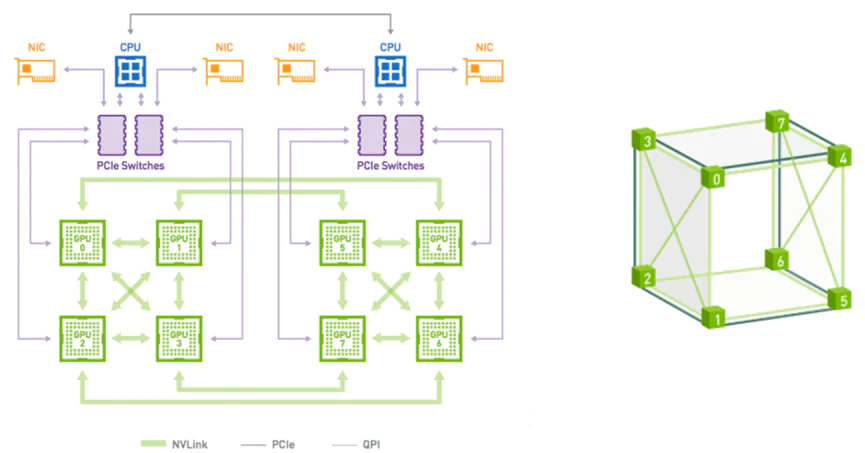
The integration of DeepEP with AWS networking hardware is designed to solve the communication overhead that occurs when Expert Parallelism spans multiple physical nodes. In an MoE setup, tokens are routed dynamically to experts residing on different accelerators. When these experts are located across different servers, the communication shifts from the high-speed, intra-node NVLink fabric to the inter-node network.
DeepEP mitigates this by replacing standard NCCL collectives with specialized dispatch and combining kernels. These kernels are topology-aware; they utilize the NVSwitch fabric for intra-node communication and shift to the EFA-backed libfabric transport for inter-node routing. This transition effectively reduces the per-message overhead that typically causes bottlenecks in distributed MoE training.
According to internal AWS benchmarks using 48 P5en instances—a configuration consisting of 16 nodes dedicated to training and 32 to inference—the implementation of DeepEP over EFA resulted in a 40 percent increase in aggregate RL rollout throughput. This improvement is not merely incremental; it represents a fundamental change in how hardware utilization is maximized for sparse, asynchronous workloads.
Orchestration via Amazon EKS
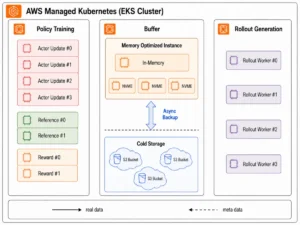
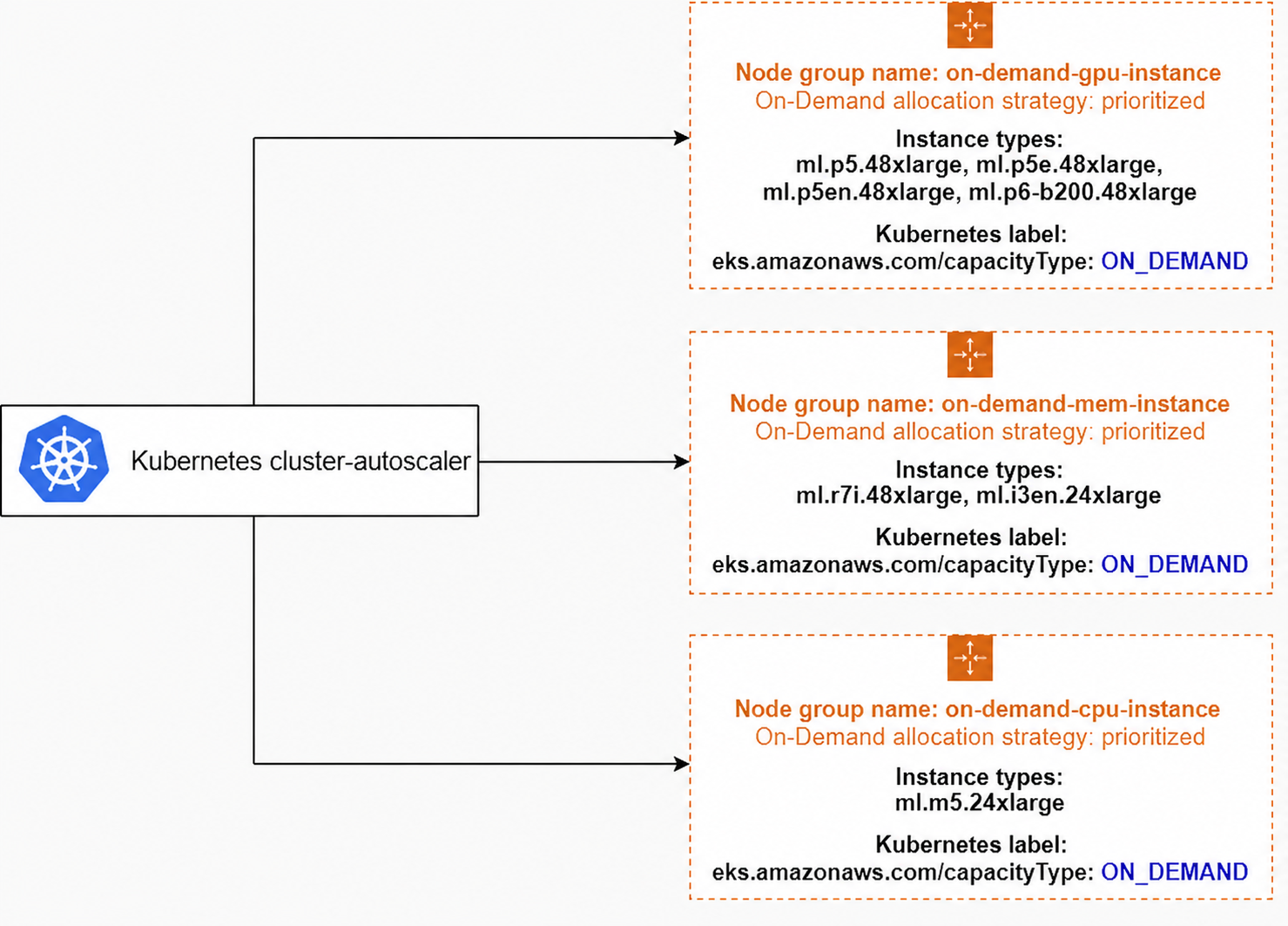
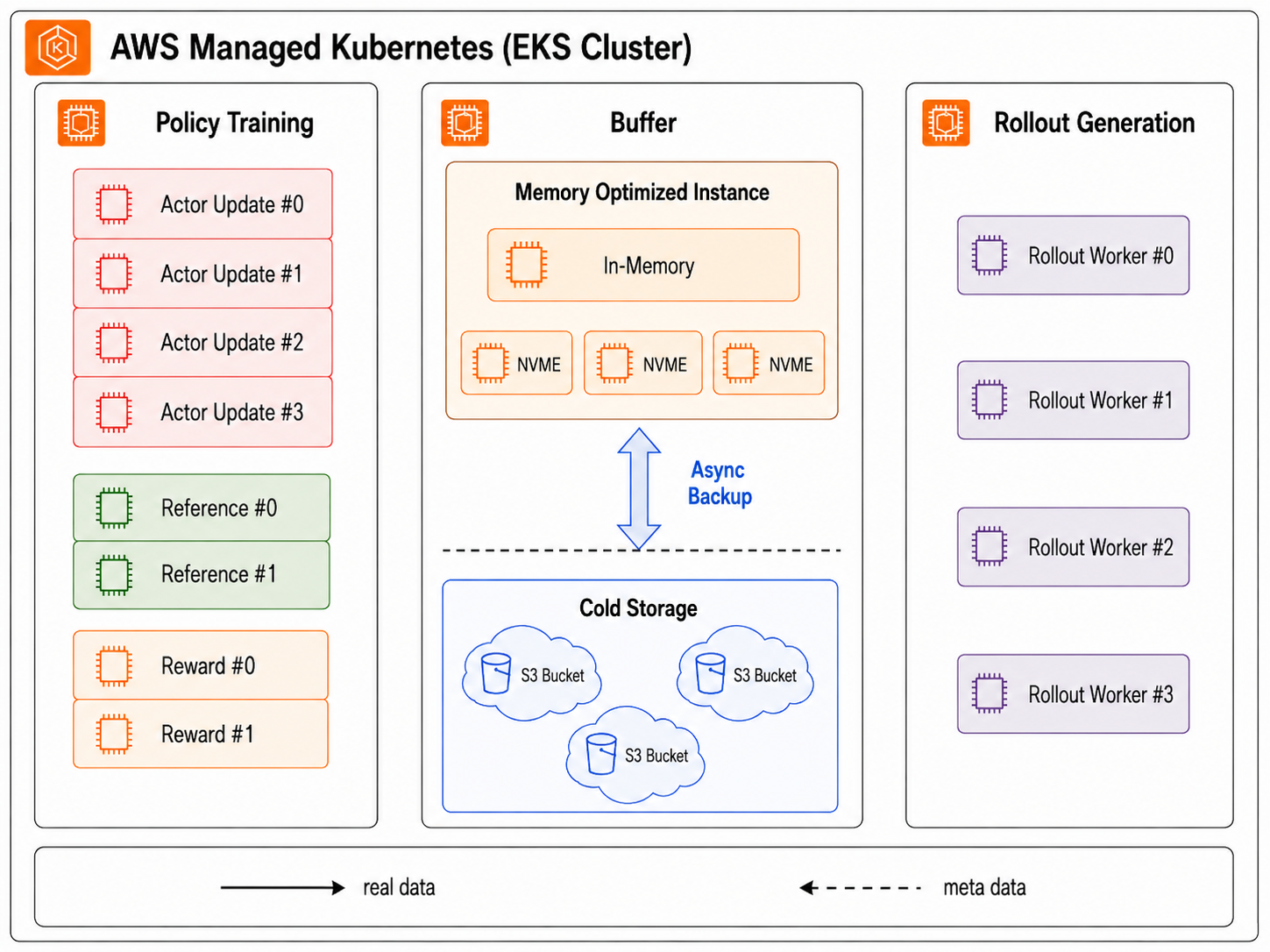
The complexity of managing such heterogeneous workloads is handled by Amazon EKS, which acts as the control plane. The architecture separates the environment into three distinct node groups:
- GPU-Accelerated Node Groups: Dedicated to the compute-heavy tasks of policy training and rollout generation.
- CPU-Optimized Node Groups: Responsible for environment interactions and data preprocessing, where memory and logic are prioritized over raw floating-point performance.
- Memory-Optimized Node Groups: Used to host experience buffers and checkpoint caches, ensuring that data can be exchanged between producers and consumers without introducing disk I/O bottlenecks.
This modular approach allows for the independent scaling of infrastructure. For example, developers can leverage Amazon EC2 Spot Instances for the rollout generation phase. Because rollout tasks are inherently partitionable and interruption-tolerant, if a Spot instance is reclaimed, the job can simply return the unfinished task to the queue without stalling the entire policy-training loop.
Implications for the AI Industry
The implications of this architectural framework extend beyond simple performance metrics. As organizations push to train models with deeper expert layers, the cost of communication becomes a primary driver of total cost of ownership (TCO). By reducing the time accelerators spend waiting for data, AWS is enabling smaller research teams to handle workloads that were previously exclusive to hyperscale labs with custom, proprietary network fabrics.
Industry analysts note that this shift toward "topology-aware" infrastructure is indicative of a broader trend: the move away from monolithic training jobs toward highly modular, asynchronous pipelines. The use of TorchX to manage job submission further underscores this, as it allows developers to define infrastructure requirements separately from the model code. This separation of concerns is vital for reproducibility and for managing the lifecycle of long-running RL jobs that may span days or weeks of training time.
Official Perspectives and Best Practices
While AWS has provided the tools, the responsibility of maintaining the balance between rollout generation and policy training remains with the system architects. The recommended practice is to keep communicating nodes within the same Availability Zone (AZ) to minimize latency. Furthermore, the alignment of the reference stack—specifically pinning NCCL versions, EFA drivers, and PyTorch kernels—is cited as a mandatory prerequisite for achieving the throughput gains described.
The use of SGLang-based deep learning containers provides a stable baseline for these configurations. By utilizing a pre-validated container, developers can avoid the "dependency hell" that often plagues custom-built HPC environments. The documentation provided by AWS emphasizes that while these tools provide a 40 percent throughput boost, they must be paired with rigorous monitoring of the rollout-training loop to ensure that queue depths and buffer sizes are optimized for the specific sparsity of the MoE model being trained.
Future Outlook: Scaling Beyond a Thousand Accelerators
The ability to scale to approximately a thousand accelerators with high efficiency is a significant milestone for enterprise-grade AI. As RLHF and GRPO become standard components of the LLM training lifecycle, the ability to manage these complex communication patterns will define the leaders in the generative AI space.
The integration of DeepEP into the public-cloud ecosystem signals a maturing of the tooling available to data scientists. Moving forward, the focus is expected to shift toward further reducing the memory footprint of the experience buffers and refining the dispatch kernels to handle even higher degrees of expert parallelism. For researchers and engineers, the path forward involves adopting these high-performance networking patterns as early as possible, as the transition to sparse, dynamic model architectures is likely to become the standard for all high-parameter count models in the coming years.
In summary, the combination of EKS, EFA, and DeepEP provides a robust foundation for modern RL training. By isolating workloads, optimizing communication through topology-aware kernels, and leveraging the elasticity of cloud compute, organizations can bridge the gap between theoretical model capacity and practical training efficiency. This architectural maturity is the essential next step in the ongoing quest to train, refine, and deploy the next generation of intelligent systems.