Unlocking Global Scale: How Jabil Prioritizes Simplification and Integration to Drive Enterprise Resilience

As multinational corporations expand their operational footprints across diverse geographies, the technological frameworks supporting them can swiftly transform from strategic assets into burdensome liabilities. For modern enterprises, the accumulation of site-specific tools, fragmented spreadsheets, legacy applications, and localized manual workarounds often generates severe data silos. These isolated pockets of information obscure operational visibility, hinder rapid cross-functional coordination, and ultimately delay critical decision-making processes.
Addressing this universal enterprise challenge requires a deliberate shift in operational philosophy. At Jabil, a prominent global manufacturing organization boasting a 60-year history, more than 100 operating sites across 30-plus countries, and a workforce exceeding 140,000 employees, leadership confronted this technical debt head-on. By prioritizing system integration and operational simplification, Jabil has established a scalable technological foundation designed to withstand global supply chain disruptions while preparing the enterprise for advanced artificial intelligence (AI) adoption.
The Anatomy of Enterprise Complexity and Technical Debt
Operating as a trusted manufacturing and supply chain partner for over 400 of the world’s leading brands naturally introduces immense organizational and operational complexity. Over decades of business expansion, individual Jabil facilities developed localized tools, customized workflows, and ad-hoc spreadsheet tracking to manage regional demands. While these measures offered short-term fixes for site-specific challenges, they collectively accumulated into significant technical debt.
This fragmentation severely limited the enterprise’s ability to identify systemic issues early across disparate plants and regions. Without a unified view of inventory, supply chain flows, and production metrics, coordinating rapid, enterprise-wide responses to global disruptions proved difficult. Recognizing that disconnected systems were impeding agility, Jabil’s leadership team made the strategic decision to elevate integration from a routine IT task to a core business priority. Central to this transformation was the establishment of a single, trusted data backbone capable of delivering real-time visibility across the entire global network.
The Simplify-First, Then-Innovate Strategy
In an era dominated by rapid technological advancements—spanning cloud computing, advanced data analytics, and generative AI—organizations frequently succumb to the temptation of adopting bleeding-edge tools without addressing foundational inefficiencies. Jabil actively avoided this pitfall by establishing a strict guiding principle: a simplify-first, then-innovate mindset.
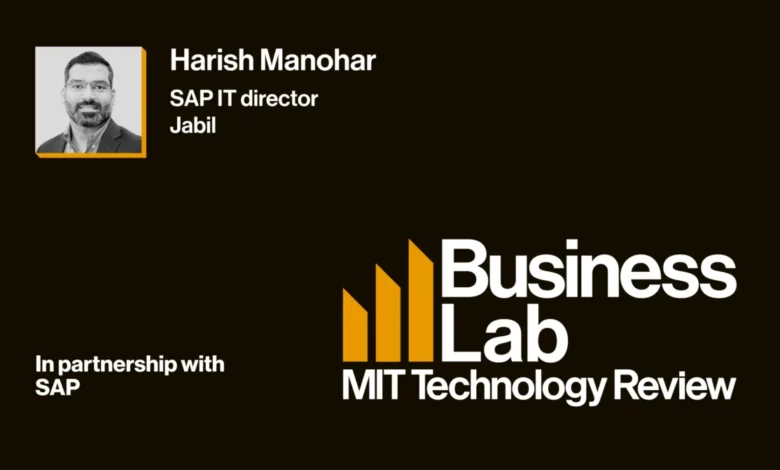
Harish Manohar, SAP IT Director at Jabil, emphasizes that any technological innovation deployed without prior simplification inevitably compounds existing operational complexity. Consequently, the company’s modernization strategy focuses squarely on delivering measurable business value rather than superficial system upgrades. Jabil designated SAP as its core digital platform, leveraging tools like the SAP Integration Suite, SAP Business Technology Platform (BTP), and SAP Signavio to drive end-to-end process standardization.
To curtail the proliferation of fragmented custom applications, Jabil instituted an API-driven, event-based integration architecture. Rather than continuously replicating and transferring data across disparate systems, this approach establishes real-time data pipelines. Furthermore, the organization has aligned closely with SAP’s clean-core methodology. By enforcing rigorous governance and review criteria on system customizations—which historically were heavily utilized to meet diverse global customer demands—Jabil is systematically reducing technical debt and positioning its core infrastructure for smoother migrations through initiatives like RISE with SAP.
Overcoming Regional Hurdles and Standardizing Global Operations
Rolling out a unified technological and operational framework across more than 100 international sites presents formidable logistical challenges. Jabil’s facilities exhibit varying degrees of process maturity, operate under distinct regulatory requirements, and maintain deeply entrenched local workflows. In heavily regulated sectors, compliance mandates add layers of complexity regarding equipment qualification and validation processes.
To navigate these barriers without disrupting active manufacturing operations, Jabil deployed a structured standardization roadmap. Rather than imposing a rigid global template overnight, the organization utilized SAP Signavio for business process management to map, analyze, and harmonize workflows. By targeting initial standardization across an initial cohort of over 400 plants with shared operational processes, Jabil began transitioning from a localized, site-by-site management model to an integrated enterprise-capability framework.
This standardization directly streamlined change management. By removing heavy, site-specific customizations, the organization significantly accelerated the deployment timeline for emerging technological capabilities, ensuring consistent data flows, workflows, and governance across international borders.
Empowering the Workforce and Enhancing Daily Operations
Enterprise technological transformation ultimately extends beyond software architecture to influence the daily experiences of human operators. Prior to Jabil’s comprehensive integration initiative, organizational personas—ranging from material buyers and inventory planners to finance analysts—spent considerable time juggling multiple disconnected tools and manually reconciling conflicting data sources. Local spreadsheets and disparate regional practices frequently generated competing versions of the truth, delaying robust decision-making.
By implementing unified, integrated workflows, Jabil successfully dismantled many of these data silos. Employees across different regional teams now share real-time visibility into operational metrics. This reduction in manual reconciliation efforts has fundamentally transformed daily job functions, allowing personnel to shift from passively chasing elusive information to actively executing strategic insights. Enhanced real-time visibility into supply chain events—such as the early identification of missing materials—has empowered operational teams to mitigate risks swiftly and maintain business continuity.
Implications for AI, Automation, and Future Scalability
With a robust integration backbone firmly established, Jabil is uniquely positioned to capitalize on next-generation enterprise technologies. Leadership maintains that advanced artificial intelligence and automation cannot function effectively atop fragmented or untrusted data sources. By ensuring seamless, event-driven data flows across core enterprise systems, Jabil has laid the groundwork for scalable AI adoption.
Looking toward the future, the company is actively exploring predictive supply chain insights, intelligent exception handling, and AI-driven planning and forecasting tools. Rather than treating AI as a series of isolated experimental use cases, Jabil’s strategic vision dictates that artificial intelligence must actively augment human decision-making and deliver quantifiable business value.
Strategic Takeaways for Enterprise Leaders
Jabil’s ongoing enterprise transformation offers valuable lessons for organizational leaders grappling with tool sprawl and digital complexity. Navigating large-scale modernization successfully requires adhering to several fundamental principles:
- Prioritize Integration as a Foundation: Treat system integration as a strategic prerequisite for transformation rather than a secondary implementation detail.
- Embrace Simplification Over Accumulation: Actively reduce technical debt and standardize core processes before introducing new, complex technologies.
- Establish a Single Source of Truth: Break down regional and departmental data silos to ensure that all business units operate from consistent, trusted data pipelines.
- Design for Long-Term Scalability: Build integration architectures and governance frameworks designed to support organizational growth over a three-to-five-year horizon, rather than implementing short-term point solutions.
- Align IT Investments with Business Outcomes: Ensure that every technological upgrade directly ties to operational resilience, enhanced visibility, and measurable economic value.
As Jabil demonstrates, achieving simplicity at scale serves as a powerful competitive differentiator in the global manufacturing sector, proving that operational excellence relies as much on disciplined integration as it does on technological innovation.