Bridging the Methodology Gap: How Open Source Agent Skills are Revolutionizing Healthcare AI Precision

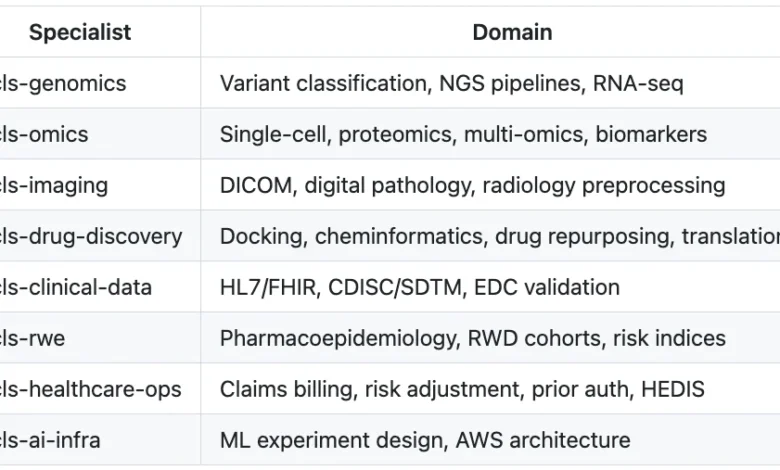
The deployment of generative artificial intelligence within healthcare and life sciences (HCLS) has long been hindered by a persistent "methodology gap." While foundation models demonstrate remarkable facility with natural language, they frequently falter when tasked with high-stakes, domain-specific decision-making. Despite having access to medical guidelines and regulatory frameworks within their training data, these models often struggle to apply them with the rigor required for clinical environments. A new, collaborative initiative from AWS and the open-source community aims to rectify this by introducing a standardized library of 38 agent skills spanning 11 critical HCLS domains.
The Problem of Silent Failure in Clinical AI
In the context of complex diagnostic and operational tasks, AI agents often produce outputs that appear superficially accurate but contain fundamental logical flaws. For instance, when asked to classify a TP53 missense variant according to the American College of Medical Genetics and Genomics (ACMG) and the Association for Molecular Pathology (AMP) criteria, an unguided model might correctly identify the framework but fail to adhere to specific population frequency thresholds or hallucinate computational predictor scores.
These errors, often termed "silent failures," are particularly dangerous because they occur without obvious system warnings. In clinical trial design, claims adjudication, or genomic interpretation, such lapses can lead to suboptimal patient care or significant regulatory exposure. The underlying issue is not a lack of factual knowledge—the model often "knows" the guidelines—but rather a deficiency in the structured, procedural reasoning that human practitioners develop over years of specialized training.
Establishing the Agent Skills Standard
To address this, the HCLS Agent Skills collection provides structured, human-readable markdown documents (SKILL.md) that encode precise decision-making procedures. By following the open-source Agent Skills standard, these documents allow agents to access validated methodologies at inference time through a process of progressive disclosure.
The collection is categorized into two distinct types: reasoning skills and pipeline skills. Reasoning skills act as the "cognitive guardrails," providing the agent with the necessary frameworks to evaluate evidence and apply domain-specific thresholds. Pipeline skills, by contrast, serve as the technical execution layer, providing verified command strings, parameter tables, and code templates for specialized tools like GATK4 or image-processing software.
This architecture marks a departure from traditional Retrieval-Augmented Generation (RAG). While RAG focuses on fetching external documents to broaden the model’s context, the "skills" approach encodes the decision logic and error-handling conditions directly into the agent’s workflow, ensuring that the model not only has the right information but also the correct methodology to process it.
Chronology of Development and Implementation
The development of this library follows a trajectory of increasing modularity in AI architecture. In early 2024, industry leaders identified that fine-tuning models for every specific HCLS protocol was unsustainable, both from a cost perspective and in terms of maintenance. By late 2025, the industry began shifting toward "agentic" frameworks, where models act as orchestrators for specialized tasks.
The launch of the HCLS Agent Skills repository serves as the culmination of this shift. Following the repository’s release, integration pathways were established across major platforms, including the AWS Strands Agents SDK, Amazon Bedrock AgentCore, and the Kiro CLI. The installation process is streamlined for interoperability; users can implement these skills via a simple universal CLI or by integrating them directly into Python-based agent architectures.
Performance and Quantitative Impact
The efficacy of these skills was validated through a comprehensive pairwise evaluation involving 410 domain-specific prompts. Researchers measured the impact of the skills across five core dimensions: scientific accuracy, coherence, relevance, critical thinking, and actionability.
The results are striking. Across both Kiro CLI and AWS Strands SDK harness configurations, skilled agents outperformed their unequipped counterparts in 70% to 86% of head-to-head comparisons. Most notably, the "critical thinking" dimension—defined as the agent’s ability to identify limitations and challenge assumptions—saw the most significant improvement, with win rates reaching up to 85.1%.
Statistical analysis using Cohen’s d effect size indicates that the improvement is not merely incidental but represents a substantial shift in performance. For example, in the Strands Agent configuration, the effect size for critical thinking was 1.03, signifying a "large" improvement. Furthermore, the variance in output quality was reduced by over 50% in clinical data tasks, suggesting that these skills bring a much-needed consistency to automated medical workflows.
Real-World Use Cases and Operational Benefits
The practical implications of these skills are most evident in high-complexity environments. In the field of drug discovery, for instance, an agent tasked with evaluating repurposing candidates for idiopathic pulmonary fibrosis (IPF) previously provided only general literature reviews. With the new skills, the agent now executes a structured evaluation, ranking candidates by evidence strength and translatability, effectively mimicking the thought process of a lead investigator.
In healthcare claims operations, the risk of "inflated estimates"—which can trigger costly CMS RADV (Risk Adjustment Data Validation) audit findings—is a major concern. By utilizing the risk-adjustment skill, agents now correctly navigate disease hierarchies and apply current CMS-HCC Model V28 coefficients. This ensures that the generated RAF (Risk Adjustment Factor) scores are not only accurate but also audit-defensible.
Similarly, in medical imaging, the sequencing of preprocessing steps is vital to avoid systematic bias. The radiology-preprocessing skill prevents common errors, such as performing skull-stripping before bias correction, thereby preserving the integrity of voxel-based morphometry (VBM) analyses.
Implications for Regulatory Compliance and Safety
The introduction of these skills has significant implications for the future of AI regulation in healthcare. By moving logic out of opaque model weights and into auditable, human-readable markdown files, organizations can maintain a clear "paper trail" of the reasoning processes their AI agents utilize. This transparency is essential for compliance with evolving health data protection regulations and safety standards.
The ability to update these skills in response to annual medical policy changes—without the need for costly and time-consuming model retraining—provides an agility that was previously impossible in AI-driven healthcare operations.
Looking Ahead
The HCLS Agent Skills project represents a transition toward a more modular and transparent era of medical AI. By treating domain expertise as a portable, version-controlled asset rather than a static property of the model itself, the developers have provided a framework that can scale alongside the rapid pace of medical discovery.
The repository remains open for community contributions, encouraging research institutions and healthcare providers to tailor these skills to their specific clinical protocols. As the industry continues to grapple with the "black box" nature of large language models, the adoption of structured, auditable reasoning skills may well become the standard for any AI implementation where patient safety and regulatory compliance remain paramount.
For organizations looking to adopt these tools, the path forward is clearly defined: the repository is now available for integration, with documentation and evaluation frameworks provided to ensure that each deployment meets the rigorous demands of the healthcare sector.
Related posts: